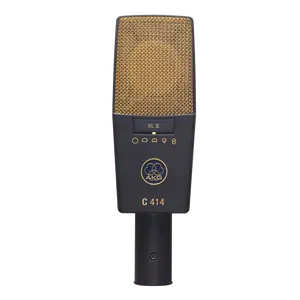
AKG C414 XLS - Multi-Pattern Condenser Microphone
Discover the legendary AKG C414 XLS, a multi-pole reference microphone whose neutrality and nine directions guarantee faithful capture of any sound source.
The "Swiss Army knife" of professional studios.
If you could only own one microphone to record everything (vocals, piano, drums, acoustic guitar), it would be the AKG C414 XLS .
At Garage à Musique , we consider the C414 not just a purchase, but a career investment. A direct descendant of the legendary C414 B-ULS, the XLS model is renowned for its absolute neutrality . Unlike its sibling (the XLII), which adds brightness, the XLS captures the source exactly as it is, with exemplary linearity.
Why is the C414 XLS a global standard?
9 Directivités (Patterns) : C'est sa force majeure. Cardioïde, Omni, Figure-8, Hypercardioïde... et toutes les positions intermédiaires. Cela vous permet de sculpter la prise de son non pas avec un EQ, mais en changeant la façon dont le micro "écoute" la pièce.
Le Roi des Instruments Acoustiques : Grâce à sa réponse plate, c'est le micro de prédilection pour les pianos à queue, les cordes et les guitares acoustiques. Il ne colore pas le son, il le restitue avec une fidélité chirurgicale.
Encaisse tout (Haut SPL) : Avec ses pads d'atténuation (-6, -12, -18 dB), vous pouvez le placer devant un ampli guitare hurlant ou au-dessus d'une caisse claire sans jamais faire saturer la capsule.
Filtres Coupe-Bas : Trois filtres (40, 80, 160 Hz) vous permettent de nettoyer les bruits de rumeur ou l'effet de proximité avant même que le signal n'entre dans votre carte de son.
Technical Specifications
| Characteristic | Technical Details |
| Kind | Large diaphragm capacitor (1 inch) |
| Guidelines | 9 (Omni, Large Cardioid, Cardioid, Hypercardioid, Figure-8 + 4 intermediate) |
| Frequency Response | 20 Hz - 20,000 Hz (Very linear) |
| Sensitivity | 23 mV/Pa |
| Maximum Level (SPL) | 140 dB (up to 158 dB with Pad) |
| Clean Noise | 6 dB-A (Extremely quiet) |
| Filters (Bass Cut) | 40 Hz, 80 Hz, 160 Hz |
| Attenuation (Pad) | -6 dB, -12 dB, -18 dB |
| Included in the box | Metal case, shock mount, pop filter, windscreen, carrying case |
| Weight | 300 g |
Comparative Table: C414 XLS vs XLII vs Neumann
The big question: Which one to choose?
| Model | AKG C414 XLS | AKG C414 XLII | Neumann TLM 103 |
| Sound | Neutral, Dark, Natural | Brilliant, Vocal Presence (High Boost) | Modern, Present, "Big" |
| Guidelines | 9 Patterns (Versatile) | 9 Patterns | 1 (Fixed Cardioid) |
| Best for | Piano, Strings, Guitar, Overhead | Lead Voice, Voice-Over, Solos | Lead Vocals, Rap |
| Legacy | Successor to the C414 B-ULS | Successor to the C12 | U87 line (Without transformer) |
| Verdict | The honest, all-purpose tool. | To break through the mix. | The modern vocal standard. |
FAQ – The most frequently asked questions on the web
We have analyzed the most frequently asked questions about the AKG C414 to guide you.
1. What is the difference between the C414 XLS and the C414 XLII (the gold one)?
That's question #1.
Le XLS (grille argentée) a une réponse en fréquence très plate. Il est transparent. Idéal pour les instruments ou les voix qui ont déjà beaucoup d'aigus.
Le XLII (grille dorée) a une bosse de présence dans les aigus (au-delà de 3kHz). Il imite le légendaire C12. Il est préféré pour les voix lead pop/rock pour "percer" le mix.
2. Is this a good microphone for voice?
Yes, absolutely. Although it's neutral, it captures the voice with incredible detail. If you have a sibilant voice (lots of "sss" sounds), the XLS is often better than the XLII because it doesn't emphasize those harsh frequencies.
3. Do I need phantom power?
Yes. Like all true condenser microphones, the C414 requires +48V phantom power via your audio interface or preamp. The LED indicator on the microphone will light up when it is receiving power.
4. Why is there a green/red LED on the microphone?
This is a great feature from AKG. The green LED indicates that the microphone is active. If it flashes red briefly, it means the microphone is clipping (peak hold). You then know immediately that you need to activate the pad.
5. Are the 9 directives really useful?
For a beginner, maybe not. For a pro, it's essential. Switching to "Omni" mode to record a choir in a church, or to "Figure-8" to isolate a singer-guitarist... that's what makes this microphone indispensable.
6. Is it made in Austria?
Historically, yes. Since Samsung's (Harman) acquisition of AKG, production has been relocated. However, AKG maintains extremely strict quality control standards, and the C414 remains a high-end, individually calibrated product.
Avis clients
Aucun avis pour le moment. Soyez le premier à partager votre expérience après votre achat.