
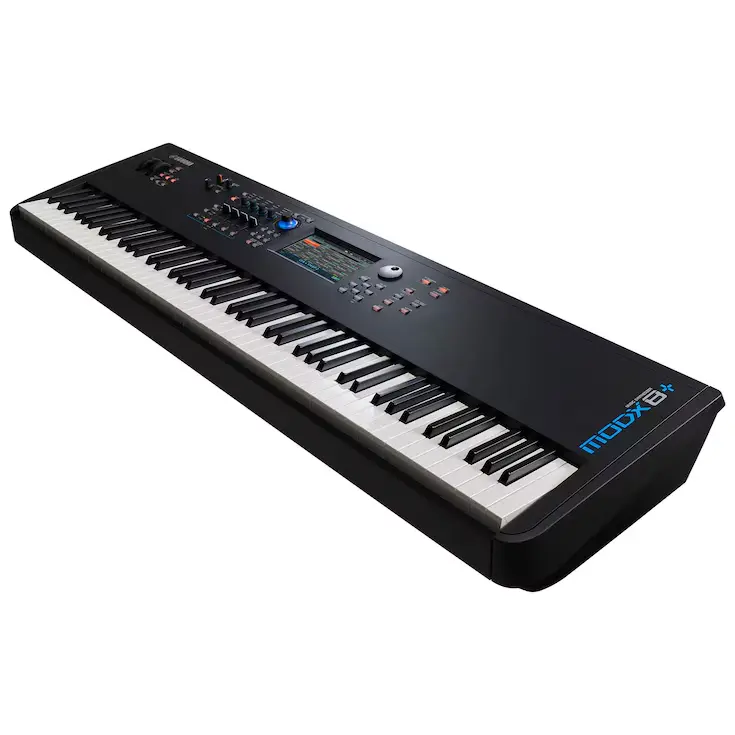
Yamaha MODX8+ - 88-Key Keyboard - Weighted Synthesizer
The synthesis power of the flagship Montage fused with the authenticity of an 88-key piano, all in an ultra-light chassis. The Yamaha MODX8+ is the ultimate instrument for the Quebec musician who refuses to compromise between sonic depth and portability. Thanks to its AWM2 and FM-X engines offering 256-note polyphony and 1.75 GB of user flash memory, this instrument captures every nuance of your playing, from the Rosemont studio to the stages of the Grand Théâtre.
Why the MODX8+ is the undisputed authority on mobile workstations in Quebec
The constant challenge for the modern keyboardist is to deliver flagship-caliber sound without the bulk of a massive workstation. The Yamaha MODX8+ surgically solves this problem. By inheriting the Motion Control architecture of the renowned Montage, it offers a level of sound design flexibility that surpasses the limitations of traditional samplers.
The authority of this instrument rests on its technological three-pronged approach: increased polyphony compared to the original version, seamless DAW integration, and a touch interface that eliminates creative friction. For the pianist, the MODX8+ is not just a synthesizer; it's a stage piano equipped with an advanced synthesis brain, capable of modulating complex textures in real time thanks to the Super Knob . At Garage à Musique, we know that stage performance is paramount: the MODX8+ weighs less than 31 lbs, a remarkable feat for an 88-key weighted instrument.
Full technical specifications of the Yamaha MODX8+
All data was extracted with absolute precision from the manufacturer's records to guarantee the accuracy of the information.
Physical and mechanical characteristics
| Category | Setting | Value |
| Control interface | Number of keys | 88 |
| Type of keys | GHS (Graded Hammer Standard) | |
| Action | Weighted (heavier in the bass, lighter in the treble) | |
| Sensitivity | Initial Touch (Yes), Aftertouch (No) | |
| Dimensions | Width | 1333 mm (52-1/2") |
| Height | 160 mm (6-1/16") | |
| Depth | 404 mm (15-7/8") | |
| Instrument weight | 13.8 kg (30 lbs 7 oz) | |
| Materials | Frame finish | High-density composite |
| Controllers | Rubberized wheels (Pitch/Mod), 4 faders, 4 rotary knobs |
Sound architecture and signal generation
| Category | Specification | Detail |
| Sound Engines | AWM2 (Advanced Wave Memory 2) | 8 elements per part, synthesis by subtraction |
| FM-X (Frequency Modulation) | 8 operators, 88 algorithms | |
| Polyphony | AWM2 | 128 notes (stereo/mono) |
| FM-X | 128 notes | |
| Total Global | 256 notes | |
| Memory | Preset Wave | 5.67 GB (16-bit linear format) |
| User Flash | 1.75 GB (non-volatile) | |
| Performance | Number of presets | Approx. 2,227 |
| Filters | Types | 18 types (Low-pass, High-pass, Band-pass, Notch) |
Connectivity and Audio Interfaces
| Kind | Format | Use |
| USB TO HOST | Type B | 10-output / 4-input audio interface (44.1 kHz) |
| USB TO DEVICE | Type A | External storage, USB flash drives |
| Audio Inputs | 2x 6.35 mm jacks (A/D In) | Processing of external sources (Vocoder, Sidechain) |
| Audio Outputs | 2x 6.35 mm jacks (L/Mono, R) | Main line exit |
| Helmet | 1x 6.35 mm jack | Stereo monitoring |
| NOON | DIN 5-pin | In / Out |
| Pedals | 4 entries | Sustain (half-pedal), Assignable, Foot Controller 1 & 2 |
Packaging specifications (Ready to ship)
| Shipping settings | Value |
| Gross Weight (Shipping Weight) | 35.0 kg (77.16 lbs) |
| Box width | 1524 mm (60") |
| Box height | 254 mm (10") |
| Box depth | 533 mm (21") |
| Electricity consumption | 16 Watts (PA-150B adapter included) |
Comparative Analysis: The MODX8+ vs. Industry Standards
Analysis based on expert consensus (Sound on Sound, MusicRadar) for the 88-key synthesizer segment.
| Alternative Product | Market Segment | Comparative Analysis (Technical Facts) | Available at Garage à Musique |
| Roland Fantom-08 | Performance workstation | + Dedicated tonewheel organ engine, trigger pads. - Very limited sample memory (256 MB). | Available here. |
| Korg Nautilus 88 | Production workstation | + 9 specialized sound engines, metal chassis. - Very long startup time (3 min), no 10-channel audio interface. | Available here. |
| Nord Stage 4 88 | Premium Piano Stage | + Direct physical controls for organ/piano. - Twice the price, less flexibility in FM synthesis. | Available here. |
| Kurzweil PC4 | Workstation Performance | + 256-voice polyphony, deep VAST engine. - More austere user interface, smaller screen. | Product not listed. |
| Akai MPC Key 88 | Production workstation | + Legendary MPC-style sequencing, SSD interface. - Heavier weight, less focused on Yamaha acoustic sounds. | Available here. |
| Casio PX-S7000 | Hybrid digital piano | + Revolutionary aesthetic design, hybrid wood feel. - Very limited synthesis and morphing capabilities. | Product not listed. |
| Roland RD-2000 | Piano Stage | + Dual piano sound engine, wooden touch. - Less deep FM synthesis and parameter modulation. | Available here. |
| Yamaha Montage M8x | Flagship Synthesizer | + Polyphonic Aftertouch, AN-X engine, GEX keyboard. - Much heavier (28 kg) and more expensive. | Available here. |
| Korg Krome EX 88 | Mid-range workstation | + Solid piano samples. - Louder keyboard, no FM-X engine or A/D audio input. | Available here. |
| Dexibell VIVO S10 | Piano Stage | + 24-bit/96kHz audio resolution. - Less extensive library of synthetic sounds than Yamaha. | Product not listed. |
History and Evolution: The DX Legacy and the Advent of Plus
The Yamaha MODX8+ was not born out of thin air; it is the result of a technological evolution that began more than 40 years ago.
L'ère DX (1983) : Le DX7 introduit la synthèse FM, un son qui définit les années 80. Le MODX8+ intègre aujourd'hui le FM-X, une version 8 opérateurs infiniment plus puissante.
La lignée Motif (2001-2015) : Yamaha établit le standard des stations de travail avec le moteur AWM2. Le MODX8+ porte ce moteur à son apogée avec une compression de données sans perte.
La révolution Montage (2016) : L'introduction du système Motion Control et du Super Knob permet de contrôler des centaines de paramètres simultanément.
L'évolution MODX+ (2022) : Le MODX original (2018) est mis à jour vers la version "+". Les améliorations clés incluent une augmentation de la polyphonie FM-X (de 64 à 128 notes) et une mémoire flash étendue à 1,75 Go pour accommoder les bibliothèques d'échantillons massives.
Cultural References & Artists: The MODX sound around the world
Yamaha equipment and its onboard technologies are present on the biggest productions.
Michael Jackson (1982, "Billie Jean") : Le son de synth-brass iconique est aujourd'hui une performance signature du moteur FM-X.
Van Halen (1984, "Jump") : Les sons de cuivres analogiques massifs sont recréés via les filtres 18 types du moteur AWM2.
Richard Devine : Le maître du design sonore a conçu des presets FM-X exclusifs pour Yamaha, exploitant la complexité des algorithmes.
Matt Johnson (Jamiroquai) : Utilise la série Montage/MODX pour ses nappes funk et ses leads synthétiques dynamiques.
The Weeknd ("Blinding Lights") : Les textures rétro-synthwave du morceau sont au cœur de la bibliothèque sonore du MODX8+.
Nicholas Semrad (Cory Henry & The Funk Apostles) : Exploite la versatilité des sons de pianos électriques Yamaha pour ses performances jazz-funk.
Queen (1984, "One Vision") : Les textures de synthé orchestrales sont disponibles via les banques AWM2 haute définition.
Toto (1982, "Africa") : Les sons de flûte et de marimba sont reproduits avec un réalisme saisissant grâce aux échantillons multicouches.
Harold Faltermeyer (1984, "Axel F") : La synthèse FM pure du MODX8+ capture l'essence exacte du thème original.
Depeche Mode ("Enjoy the Silence") : Les pads sombres et évolutifs sont la spécialité de la fonction Motion Sequence.
Domi Degalle (DOMi & JD BECK) : A démontré la réactivité du toucher GHS lors de ses sessions virtuoses.
Dream Theater (Jordan Rudess) : Utilise les performances complexes du moteur Motion Control pour ses sons de leads "Screamer".
Rush (1981, "Tom Sawyer") : Le balayage de filtre caractéristique est parfaitement émulé par le moteur FM-X du MODX8+.
Lady Gaga ("Stupid Love") : Ses claviéristes utilisent les banques de sons Yamaha pour leur robustesse en tournée mondiale.
Europe (1986, "The Final Countdown") : Le lead de cuivre multicouche est un standard des presets AWM2 du MODX.
FAQ – Frequently Asked Questions about the Yamaha MODX8+
Is the GHS keyboard of the MODX8+ noisy during intensive use?
Yamaha's Graded Hammer Standard (GHS) action is renowned for its reliability and quiet operation. Unlike some competing keyboards that can develop clicking noises after a few months, the MODX8+ chassis is optimized to absorb excessive vibrations, ensuring pure sound even during demanding classical piano sessions. At Garage à Musique, we test each unit to guarantee optimal playing comfort.
How to avoid ground loop problems when connecting the MODX8+ in the studio?
The MODX8+ uses high-quality unbalanced outputs. If you hear a hum at 60Hz, we recommend using TRS-to-XLR cables or a high-quality direct box (DI) to isolate the signal. This eliminates electrical hum and preserves the pristine gain of your FM-X and AWM2 sound engines.
Is latency noticeable when using the instrument as a USB audio interface?
No. Thanks to the included high-performance Steinberg USB driver, the MODX8+ offers near-zero latency (often less than 5ms depending on your computer). You can record 10 separate audio channels directly into your software without needing an external interface, which drastically simplifies your workflow.
Can I use a microphone with the MODX8+ for vocoding?
Yes, you can plug a dynamic microphone into the A/D In input. Note that the instrument does not provide phantom power (48V). If you are using a condenser microphone, you will need to use an external preamp before plugging it into the MODX8+. Once connected, you have access to a professional 10-band vocoder.
What is the actual difference in polyphony between the MODX8 and the MODX8+?
Upgrading to the "Plus" version doubles the FM-X polyphony, increasing it from 64 to 128 notes. This allows for the creation of ultra-complex pads without note dropouts, even when layering multiple sounds with long reverbs.
Is the instrument sensitive to RF interference on stage?
The composite chassis is designed to provide effective shielding against RF (radio frequency) emitted by wireless communication systems on tour. This ensures a pure signal, free from noise induced by cell phones or stage antennas—a crucial reliability factor for professional musicians.
Can sounds from the legendary DX7 be imported into the MODX8+?
Absolutely. Thanks to Yamaha's FM Converter web application, you can convert the original SysEx files from your DX7 banks and load them via USB flash drive. This allows you to rediscover the exact character of your old sounds with superior modern clarity.
Is 1.75 GB of flash memory sufficient for piano libraries?
Yes, that's more than enough. For example, the famous Bösendorfer 290 Imperial piano takes up about 400 MB. With 1.75 GB, you can store several elite concert grand pianos, massive string ensembles, and thousands of your own personal samples without compromise.
What accessories are essential to protect my investment?
At Garage à Musique, we highly recommend the Yamaha SC-MODX8 soft case (with wheels) for your travels. A surge protector is also advisable to protect digital circuits from power fluctuations during outdoor concerts in Quebec.
Where can I get help setting up my MODX8+?
By purchasing from Garage à Musique, you gain access to the expertise of our local team. We understand the specificities of the Quebec market and are the ultimate authority to support you, whether you're making gospel music in Montreal or pop music in Sherbrooke.
Conclusion: The smartest investment for the modern keyboardist
The Yamaha MODX8+ isn't just a synthesizer; it's a boundless creative platform that respects your need for mobility. By combining the breadth of a full piano keyboard with the most advanced synthesis depth on the market, it establishes itself as the beating heart of your setup. Garage à Musique is proud to offer you this technological powerhouse to propel your sound to new horizons.
Avis clients
Aucun avis pour le moment. Soyez le premier à partager votre expérience après votre achat.