Neural DSP Quad Cortex - Ground Modeler - Power and Flexibility
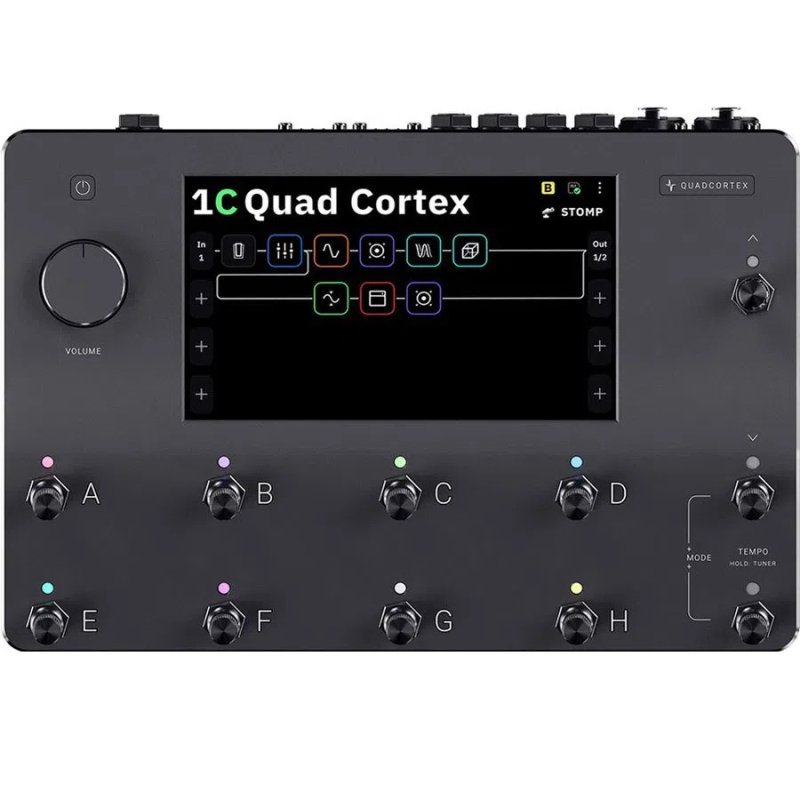
Take total control of your sonic identity with the Neural DSP Quad Cortex, the most powerful floor processor on the planet. Powered by a Quad-Core SHARC+ architecture clocked at 2GHz, this technological beast redefines the limits of modelling and neural capture. Its 7-inch multitouch screen offers a revolutionary intuitive interface, letting you sculpt complex signal chains at your fingertips. Whether you're cloning your own amps with surgical precision or exploring thousands of rigs on Cortex Cloud, the Quad Cortex is the ultimate tool for the modern guitarist and bassist seeking uncompromising perfection.
Authority Section: The End of Compromises Between Power and Portability
The Neural DSP Quad Cortex isn't just another multi-effects unit; it's a computer dedicated to sound that solves the pro musician's age-old dilemma: "Do I bring my 50 lbs rack or my digital modeller?" With its exclusive Neural Capture technology, it doesn't just imitate an amp, it learns its deep harmonic structure. Thanks to its 6 processor cores (4x SHARC+ and 2x ARM Cortex-A5), it handles signal chains that its competitors simply cannot process without latency. At Garage à Musique, we especially recommend it for its ability to serve as a complete command centre (Audio, MIDI, USB) on international stages as well as in high-calibre studios.
Complete Technical Specifications
Architecture & Processing
| Component / Feature | Precise Specifications |
| DSP Processor | Quad-Core SHARC+ (4 cores at 500MHz each) |
| System Processor | Dual ARM Cortex-A5 (2 cores at 500MHz each) |
| Screen | 7" high-brightness multitouch |
| Capture Algorithm | Neural Capture™ (biomimetic AI) |
| Latency | < 2 ms (internal processing) |
| Sample Rate | 48 kHz |
| Bit Resolution | 24 bits |
Input / Output (I/O) Connectivity
| Port Type | Technical Details |
| Inputs 1 & 2 | Neutrik combo (XLR / 1/4" TRS) with 48V phantom power |
| FX Loops (1 & 2) | 2x Send (TRS) & 2x Return (TRS) - Can be used as additional inputs/outputs |
| Outputs 1 & 2 | 2x balanced XLR (line level) |
| Outputs 3 & 4 | 2x balanced 1/4" TRS |
| Headphone Output | 1/4" TRS stereo jack with independent volume |
| MIDI | Full MIDI In & MIDI Out/Thru |
| Expression Inputs | 2x 1/4" TRS for expression pedals or footswitches |
| USB | USB Type-B (8-in / 8-out audio interface) |
| WiFi | Wireless updates and built-in Cortex Cloud access |
Construction & Physical Interface
| Element | Details |
| Chassis | Single-piece anodized aluminum |
| Footswitches | 11 stainless steel rotary switches (combined actuators and encoders) |
| Dimensions | 29 cm x 19 cm x 4.9 cm (11.4" x 7.5" x 1.9") |
| Weight | 1.95 kg (4.3 lbs) |
| Power Supply | 12V DC, 3A (centre negative polarity) |
Comparative Analysis (Rigour Protocol)
Sources consulted: Sound on Sound, MusicRadar, Gearspace, Premier Guitar.
| Alternative Product | Market Segment | Comparative Analysis | G.A.M. Availability |
| Line 6 Helix Floor | Standard Modeller | Vast ecosystem, but limited DSP power and non-touch screen. | Available here |
| Kemper Profiler Stage | Traditional Profiler | Mature profiling technology, but dated, non-touch interface. | Available here |
| Fractal Audio FM9 | Premium Modeller | Unmatched effects algorithms, but complex interface and direct purchase only. | Product not listed |
| Fender Tone Master Pro | Intuitive Modeller | Very easy to use, but less raw power and no "Capture" function. | Available here |
| Headrush Prime | Modeller & Vocal | Includes vocal effects, giant screen, but massive footprint vs Quad Cortex. | Available here |
| IK Multimedia ToneX | Compact Profiler | Excellent captures for the price, but very limited effects management (pedal only). | Available here |
| Boss GT-1000 | DSP Multi-Effects | Ultra-low latency, rugged, but less realistic models (AIRD). | Available here |
| Strymon Iridium | Amp/Cab Amp Simulator | Exceptional audio quality, but only 3 amp types and no effects. | Available here |
| Mooer GE300 | Budget Modeller | Lots of features for the price, but entry-level converters and DSP. | Product not listed |
| Blackstar Amped 3 | Amp in Pedal Format | True 100W power stage, but not a full preset-based modeller. | Available here |
History & Evolution
Founded by Douglas Castro (also creator of Darkglass Electronics), Neural DSP first dominated the market for high-fidelity software plug-ins. The Quad Cortex, announced in 2020 and shipped in 2021, represents their first foray into physical hardware. It made its mark on the industry as the first device to integrate rotary encoders directly into the footswitches, solving the space problem on pro pedalboards. Since its release, the firmware (CorOS) has evolved dramatically, adding compatibility with "P-X" plug-ins (Plug-in to Quad Cortex), a world first.
Cultural References & Artists
The Quad Cortex has become the backbone of modern touring:
Tosin Abasi (Animals as Leaders): Uses his custom captures for his crystalline clean tones and complex distortions.
Plini: Has integrated the Quad Cortex to recreate his signature studio sounds on world tours.
Rabea Massaad: One of the first ambassadors, using the routing flexibility for his hybrid rigs.
Tim Henson (Polyphia): Uses the DSP power to handle the ultra-fast preset changes their music requires.
Scott LePage (Polyphia): Relies on the Quad Cortex for sonic consistency night after night.
Misha Mansoor (Periphery): Uses the unit to capture his rare boutique amp rigs.
John Petrucci (Dream Theater): Has been seen testing the unit for his portability needs when travelling.
Mike Stringer (Spiritbox): Uses the Quad Cortex for his textured, spatial modern metal sounds.
Aaron Marshall (Intervals): A cornerstone of his live setup for its reliability and compact format.
Erik Rutan (Cannibal Corpse): Uses capture to take his favourite amps on tour without risk of breakage.
Cory Wong (Vulfpeck): Uses the compressor and clean amp simulations for his precise funk.
Mateus Asato: Appreciates the unit's dynamic response, which respects his nuanced touch.
Bea Burton: Uses the Quad Cortex for its bass and guitar versatility on pop stages.
Jordan Rudess: Explores the unit's synthesis and complex effects capabilities.
Pat Metheny: Has integrated Neural technology to modernize his legendary jazz fusion rig.
FAQ (Frequently Asked Questions)
What is the difference between modelling and "Neural Capture"?
Modelling is a mathematical reconstruction of a circuit. Neural Capture uses an artificial neural network to analyze and reproduce the real behaviour of your own amplifier, cabinet and mic. The benefit: you get your exact sound, without hauling 100 lbs of gear.
Can the Quad Cortex be used as an audio interface?
Absolutely. It features an 8-input, 8-output USB interface, letting you record "DI" and processed tracks simultaneously at 24-bit resolution. It's the perfect central studio tool for any producer in Quebec.
Can you use the Quad Cortex for bass and guitar at the same time?
Yes. Thanks to its 6 processor cores, you can create two completely independent signal chains with separate inputs and outputs. It's ideal for duos or for processing a bi-amped bass signal.
Is the touchscreen fragile for stage use?
The Quad Cortex is designed for touring, with reinforced glass and an anodized aluminum chassis. The footswitches act as natural guards against accidental presses on the screen. At Garage à Musique, we can confirm its durability after years of feedback from pro customers.
Is 48V phantom power available?
Yes, both Neutrik combo inputs support 48V, letting you plug studio condenser microphones directly into the unit to make captures or even record vocals.
How are updates done?
The Quad Cortex has built-in WiFi. You don't need a computer to update the system (CorOS) or download captures from Cortex Cloud. This eliminates cable and driver compatibility issues.
Do my Neural DSP plug-ins work on the Quad Cortex?
Yes, via the CorOS 3.0.0+ update, you can import your compatible Neural DSP plug-ins ("X" versions) directly into the unit. That way you enjoy your favourite studio sounds in physical form on stage.
What is the unit's power consumption?
It requires a 12V DC, 3A power supply. We strongly recommend using the original supplied power supply or a compatible high-power pedalboard power supply (such as the CIOKS Crux).
Does the Quad Cortex handle third-party "Impulse Responses" (IRs)?
Perfectly. You can load your own IRs via the Cortex Cloud app. The unit can store thousands of IRs, giving you total control over your cabinet simulation.
Why buy my Quad Cortex at Garage à Musique?
As an authority in Quebec, Garage à Musique offers you expert technical support, a local warranty and the peace of mind of buying from passionate people who test every update of the Neural DSP ecosystem.
Avis clients
Aucun avis pour le moment. Soyez le premier à partager votre expérience après votre achat.