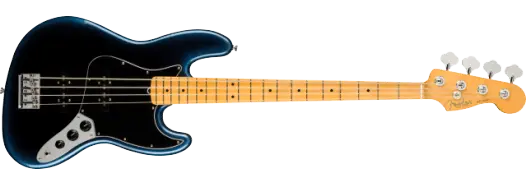
Fender American Pro II Jazz Bass - Electric Bass - Midnight Blue
The evolution of an icon: the new standard for professional bass players.
The Fender American Professional II Jazz Bass® merges over sixty years of innovation to meet the demands of today's musicians. With its ultra-comfortable Slim C neck profile and surgically precise V-Mod II pickups, it offers tonal versatility and immediate playability. It's the ultimate instrument for those who make no compromises on sound and comfort, available now to take your performance to the next level.
This content will be shared across all product pages.
The Authority of Groove: Why choose the American Professional II?
The Fender Jazz Bass is more than just a bass guitar; it's the foundation of modern music. The American Professional II series solves the real-world problems faced by both live and studio musicians: access to the upper frets is made easy by a sculpted neck heel, while tuning stability is ensured by Posiflex graphite truss rods. Whether you're looking for the punch of funk or the warmth of jazz, this bass offers superior articulation that cuts through any mix effortlessly. It's the ultimate investment in unwavering reliability.
Full Technical Specifications
Body & Construction
| Characteristic | Details |
| Series | American Professional II |
| Body material | Alder or Roasted Pine depending on the finish |
| Body finish | Glossy polyurethane (Gloss Urethane) |
| Body shape | Jazz Bass® |
| Configuration | SS (Double Single-Coil) |
Neck & Fingerboard
| Characteristic | Details |
| Handle material | Maple |
| Construction | 4 screws with sculpted heel (4-Bolt) |
| Handle finish | Satin "Super-Natural" (back), Glossy (head) |
| Handle profile | Slim "C" |
| Tuning fork | 34" (864 mm) |
| Touch | Maple or Rosewood |
| Touchdown radius | 9.5" (241 mm) |
| Number of frets | 20 |
| Type of frets | Narrow Tall |
| Nut | Bone |
| Nut width | 1.5" (38.1 mm) |
| Inlays | Black or white spots |
| Adjustment rod | Standard with Posiflex™ graphite reinforcements |
Electronics & Marine Hardware
| Characteristic | Details |
| Bridge Microphone | V-Mod II Single-Coil Jazz Bass® |
| Micro Central | V-Mod II Single-Coil Jazz Bass® |
| Controls | Volume 1 (Neck), Volume 2 (Bridge), Master Tone |
| Easel | 4-Saddle HiMass™ Vintage (Traversal or Top-Load) |
| Mechanics | Fender® Lightweight Vintage-Style with tapered axles |
| Pickguard | 3-Ply (Mint Green, Black or Tortoiseshell depending on the model) |
| Buttons | Vintage-style black plastic |
| Hardware Finish | Nickel/Chrome |
Dimensions & Accessories
| Characteristic | Details |
| Ropes | Fender® USA 7250M NPS (.045-.105 Gauges) |
| Case included | Deluxe Molded Hard Case |
| Origin | USA (Corona, California) |
Comparative Analysis
Based on consensus from Sound on Sound, MusicRadar and Gearspace.
| Alternative Product | Market Segment | Comparative Analysis | Available at Garage à Musique |
| Fender American Ultra Jazz Bass | Modern Active Bass | More versatility with active preamp, but significantly higher price. | Available here |
| Music Man StingRay Special | Premium Active Bass | Its unique "punchy" sound, but less "vintage" versatility than the J-Bass. | Available here |
| Lakland Skyline 44-60 | Jazz Bass Style "Boutique" | Excellent finish, but less resale value than Fender. | Product not listed |
| Sadowsky MetroLine J | Optimized Jazz Bass | Superior ergonomics, but more compressed sound than the Pro II. | Product not listed |
| Fender Player II Jazz Bass | Entry-level Pro | Excellent value for money, but inferior hardware and pickups. | Available here |
| G&L JB (USA) | Leo Fender's Evolution | More massive bridge, but often a thicker neck profile. | Product not listed |
| Sir Marcus Miller V7 | Budget / Assets-Liabilities | Very versatile, but less prestigious and less durable in the long term. | Available here |
| Yamaha BBP34 | Premium Passive Bass | Exceptional construction, but a different aesthetic from the US icon. | Available here |
| Sandberg California TT | European Custom | Superb "relic" options, but a more modern sound. | Product not listed |
| Fender American Performer J | Entry-level USA | More affordable, but without the sculpted heel or the hard case. | Available here |
History & Evolution
Launched in 1960 as the "Deluxe" version of the Precision Bass, the Jazz Bass has evolved into the instrument of choice for clarity and expression. From the CBS era with its block inlays to the refinements of the American Standard series, Fender has constantly refined the formula. The American Professional II represents the culmination of this lineage, incorporating for the first time the "Super-Natural" finish and V-Mod II pickups that use a specific alnico blend for each position to perfectly balance the tone.
Cultural References & Artists
Jaco Pastorius - Jaco Pastorius (1976) : A redéfini le rôle de la basse avec sa "Bass of Doom".
Geddy Lee (Rush) - Moving Pictures (1981) : Utilise la précision de la J-Bass sur "Tom Sawyer".
John Paul Jones (Led Zeppelin) - Led Zeppelin II (1969) : La base du son rock lourd.
Flea (RHCP) - Stadium Arcadium (2006) : Utilisation intensive d'une Jazz Bass 1961.
Marcus Miller - The Sun Don't Lie (1993) : L'autorité absolue du slap sur J-Bass.
Verdine White (Earth, Wind & Fire) - That's the Way of the World (1975): The funk groove par excellence.
Tim Commerford (Rage Against The Machine) - Evil Empire (1996) : Son agressif et saturé.
Adam Clayton (U2) - The Joshua Tree (1987) : Lignes de basse iconiques et solides.
Sting (The Police) - Reggatta de Blanc (1979) : Utilisait souvent une Jazz Bass en début de carrière.
Paul Simonon (The Clash) - London Calling (1979) : L'énergie punk sur une Fender.
Larry Graham - Stand! (Sly & Family Stone, 1969) : L'inventeur du slap.
Cliff Williams (AC/DC) - Back in Black (1980) : La solidité rythmique absolue.
Noel Redding (Jimi Hendrix Experience) - Are You Experienced (1967) : Un pilier du rock psychédélique.
Aston Barrett (The Wailers) - Exodus (1977) : Le cœur du reggae.
Christopher Wolstenholme (Muse) - Origin of Symmetry (2001) : Utilisation de J-Bass avec distorsion.
FAQ (Frequently Asked Questions)
What is the advantage of the sculpted sleeve heel?
The sculpted heel eliminates excessive thickness at the neck joint, allowing unobstructed access to the highest frets. This facilitates soloing and reduces hand strain, a major benefit for the technically skilled musician at Garage à Musique.
Are V-Mod II microphones sensitive to background noise?
Like all single-coil pickups, they can pick up RF interference. However, Fender has optimized the internal shielding to minimize hum. For complete silence in the studio, use both volume controls at equal levels to cancel the hum.
Why use Posiflex™ graphite rods?
These rods reinforce the neck against variations in humidity and temperature. This ensures stable action and prevents problems with weight loops or deformation, guaranteeing exemplary reliability for tours in Quebec.
Does this bass require a battery (phantom power)?
No, the American Professional II is entirely passive. It doesn't require a battery, offering a pure and organic signal with a natural gain that respects the dynamics of your playing.
What is the difference between the Alder and Roasted Pine body?
Alder offers a balanced and classic sound. Roasted pine is lighter and offers increased resonance thanks to the roasting process which stabilizes the wood, an expertise we value at Garage à Musique.
Does the HiMass Vintage bridge really change the sustain?
Yes, its increased mass enhances the transfer of energy from the strings to the body. This provides longer sustain and a more defined attack, ideal for cutting through any musical arrangement.
Can I pass the ropes through the body?
Absolutely. The bridge allows for through-body mounting for more tension and resonance, or top-loading for a softer feel, depending on your playing preference.
Does the "Super-Natural" finish on the handle become sticky?
On the contrary, this satin finish is designed to remain smooth and fast, even with perspiration. It offers the feel of natural wood while protecting the handle, eliminating any unnecessary friction.
Is the included hard case of good quality?
The Deluxe molded case is designed to withstand the most severe impacts. Its TSA-certified latches and plush lining offer ultimate protection for your investment at Garage à Musique.
Is this a good choice for the studio?
It's the global benchmark. Its harmonic clarity and lack of latency (typical of passive instruments) make it the preferred tool of sound engineers for achieving a perfect bass recording on the first try.
The Authority of Groove: Why choose the American Professional II?
The Fender Jazz Bass is more than just a bass guitar; it's the foundation of modern music. The American Professional II series solves the real-world problems faced by both live and studio musicians: access to the upper frets is made easy by a sculpted neck heel, while tuning stability is ensured by Posiflex graphite truss rods. Whether you're looking for the punch of funk or the warmth of jazz, this bass offers superior articulation that cuts through any mix effortlessly. It's the ultimate investment in unwavering reliability.
Full Technical Specifications
Body & Construction
| Characteristic | Details |
| Series | American Professional II |
| Body material | Alder or Roasted Pine depending on the finish |
| Body finish | Glossy polyurethane (Gloss Urethane) |
| Body shape | Jazz Bass® |
| Configuration | SS (Double Single-Coil) |
Neck & Fingerboard
| Characteristic | Details |
| Handle material | Maple |
| Construction | 4 screws with sculpted heel (4-Bolt) |
| Handle finish | Satin "Super-Natural" (back), Glossy (head) |
| Handle profile | Slim "C" |
| Tuning fork | 34" (864 mm) |
| Touch | Maple or Rosewood |
| Touchdown radius | 9.5" (241 mm) |
| Number of frets | 20 |
| Type of frets | Narrow Tall |
| Nut | Bone |
| Nut width | 1.5" (38.1 mm) |
| Inlays | Black or white spots |
| Adjustment rod | Standard with Posiflex™ graphite reinforcements |
Electronics & Marine Hardware
| Characteristic | Details |
| Bridge Microphone | V-Mod II Single-Coil Jazz Bass® |
| Micro Central | V-Mod II Single-Coil Jazz Bass® |
| Controls | Volume 1 (Neck), Volume 2 (Bridge), Master Tone |
| Easel | 4-Saddle HiMass™ Vintage (Traversal or Top-Load) |
| Mechanics | Fender® Lightweight Vintage-Style with tapered axles |
| Pickguard | 3-Ply (Mint Green, Black or Tortoiseshell depending on the model) |
| Buttons | Vintage-style black plastic |
| Hardware Finish | Nickel/Chrome |
Dimensions & Accessories
| Characteristic | Details |
| Ropes | Fender® USA 7250M NPS (.045-.105 Gauges) |
| Case included | Deluxe Molded Hard Case |
| Origin | USA (Corona, California) |
Comparative Analysis
Based on consensus from Sound on Sound, MusicRadar and Gearspace.
| Alternative Product | Market Segment | Comparative Analysis | Available at Garage à Musique |
| Fender American Ultra Jazz Bass | Modern Active Bass | More versatility with active preamp, but significantly higher price. | Available here |
| Music Man StingRay Special | Premium Active Bass | Its unique "punchy" sound, but less "vintage" versatility than the J-Bass. | Available here |
| Lakland Skyline 44-60 | Jazz Bass Style "Boutique" | Excellent finish, but less resale value than Fender. | Product not listed |
| Sadowsky MetroLine J | Optimized Jazz Bass | Superior ergonomics, but more compressed sound than the Pro II. | Product not listed |
| Fender Player II Jazz Bass | Entry-level Pro | Excellent value for money, but inferior hardware and pickups. | Available here |
| G&L JB (USA) | Leo Fender's Evolution | More massive bridge, but often a thicker neck profile. | Product not listed |
| Sir Marcus Miller V7 | Budget / Assets-Liabilities | Very versatile, but less prestigious and less durable in the long term. | Available here |
| Yamaha BBP34 | Premium Passive Bass | Exceptional construction, but a different aesthetic from the US icon. | Available here |
| Sandberg California TT | European Custom | Superb "relic" options, but a more modern sound. | Product not listed |
| Fender American Performer J | Entry-level USA | More affordable, but without the sculpted heel or the hard case. | Available here |
History & Evolution
Launched in 1960 as the "Deluxe" version of the Precision Bass, the Jazz Bass has evolved into the instrument of choice for clarity and expression. From the CBS era with its block inlays to the refinements of the American Standard series, Fender has constantly refined the formula. The American Professional II represents the culmination of this lineage, incorporating for the first time the "Super-Natural" finish and V-Mod II pickups that use a specific alnico blend for each position to perfectly balance the tone.
Cultural References & Artists
Jaco Pastorius - Jaco Pastorius (1976) : A redéfini le rôle de la basse avec sa "Bass of Doom".
Geddy Lee (Rush) - Moving Pictures (1981) : Utilise la précision de la J-Bass sur "Tom Sawyer".
John Paul Jones (Led Zeppelin) - Led Zeppelin II (1969) : La base du son rock lourd.
Flea (RHCP) - Stadium Arcadium (2006) : Utilisation intensive d'une Jazz Bass 1961.
Marcus Miller - The Sun Don't Lie (1993) : L'autorité absolue du slap sur J-Bass.
Verdine White (Earth, Wind & Fire) - That's the Way of the World (1975): The funk groove par excellence.
Tim Commerford (Rage Against The Machine) - Evil Empire (1996) : Son agressif et saturé.
Adam Clayton (U2) - The Joshua Tree (1987) : Lignes de basse iconiques et solides.
Sting (The Police) - Reggatta de Blanc (1979) : Utilisait souvent une Jazz Bass en début de carrière.
Paul Simonon (The Clash) - London Calling (1979) : L'énergie punk sur une Fender.
Larry Graham - Stand! (Sly & Family Stone, 1969) : L'inventeur du slap.
Cliff Williams (AC/DC) - Back in Black (1980) : La solidité rythmique absolue.
Noel Redding (Jimi Hendrix Experience) - Are You Experienced (1967) : Un pilier du rock psychédélique.
Aston Barrett (The Wailers) - Exodus (1977) : Le cœur du reggae.
Christopher Wolstenholme (Muse) - Origin of Symmetry (2001) : Utilisation de J-Bass avec distorsion.
FAQ (Frequently Asked Questions)
What is the advantage of the sculpted sleeve heel?
The sculpted heel eliminates excessive thickness at the neck joint, allowing unobstructed access to the highest frets. This facilitates soloing and reduces hand strain, a major benefit for the technically skilled musician at Garage à Musique.
Are V-Mod II microphones sensitive to background noise?
Like all single-coil pickups, they can pick up RF interference. However, Fender has optimized the internal shielding to minimize hum. For complete silence in the studio, use both volume controls at equal levels to cancel the hum.
Why use Posiflex™ graphite rods?
These rods reinforce the neck against variations in humidity and temperature. This ensures stable action and prevents problems with weight loops or deformation, guaranteeing exemplary reliability for tours in Quebec.
Does this bass require a battery (phantom power)?
No, the American Professional II is entirely passive. It doesn't require a battery, offering a pure and organic signal with a natural gain that respects the dynamics of your playing.
What is the difference between the Alder and Roasted Pine body?
Alder offers a balanced and classic sound. Roasted pine is lighter and offers increased resonance thanks to the roasting process which stabilizes the wood, an expertise we value at Garage à Musique.
Does the HiMass Vintage bridge really change the sustain?
Yes, its increased mass enhances the transfer of energy from the strings to the body. This provides longer sustain and a more defined attack, ideal for cutting through any musical arrangement.
Can I pass the ropes through the body?
Absolutely. The bridge allows for through-body mounting for more tension and resonance, or top-loading for a softer feel, depending on your playing preference.
Does the "Super-Natural" finish on the handle become sticky?
On the contrary, this satin finish is designed to remain smooth and fast, even with perspiration. It offers the feel of natural wood while protecting the handle, eliminating any unnecessary friction.
Is the included hard case of good quality?
The Deluxe molded case is designed to withstand the most severe impacts. Its TSA-certified latches and plush lining offer ultimate protection for your investment at Garage à Musique.
Is this a good choice for the studio?
It's the global benchmark. Its harmonic clarity and lack of latency (typical of passive instruments) make it the preferred tool of sound engineers for achieving a perfect bass recording on the first try.