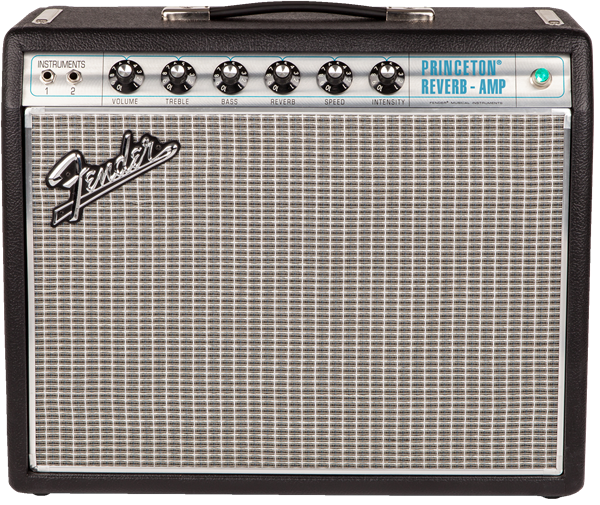
Fender 68 Custom Princeton Reverb - Combo Amp - Vintage Sound
The giant of small amps, tailored for the studio and creative intimacy.
The Fender '68 Custom Princeton Reverb® celebrates the classic 1968 "Silverface" look while offering a voice optimized for the modern guitarist. With 12 watts of tube power and a 10-inch Celestion® speaker, it delivers the velvety clean tone and creamy overdrive that have made it famous on countless recordings. Compact, dynamic, and featuring legendary spring reverb, it's the amp of choice for those seeking that authoritative Fender sound in a portable format, available at Garage à Musique.
This content will be shared across all product pages.
Studio Authority: Why is the '68 Custom Princeton Reverb a must-have?
The Princeton Reverb has always been the secret weapon of session musicians. The '68 Custom version takes it a step further by modifying the circuit for a more tactile response: negative feedback has been reduced to allow the tubes to saturate earlier and with greater musicality. Its Celestion® Ten 30 speaker adds a touch of modernity, offering tighter bass and a more assertive character with overdrive pedals. Whether you're in your living room in Terrebonne or in a professional studio, this amp delivers surgical precision and an unrivaled vintage "mojo" at Garage à Musique.
Full Technical Specifications
Electronics & Power
| Characteristic | Details |
| Power | 12 Watts |
| Amplifier type | All lamps (Tube) |
| Canals | A single channel |
| Entrances | Two (1/4", Input 2 at -6dB) |
| Controls | Volume, Treble, Bass, Reverb, Speed, Intensity |
| Effects | Spring Reverb, Tremolo (Vibrato) |
Speakers & Lamps
| Characteristic | Details |
| Speaker | 1 x 10" Celestion® Ten 30 |
| Total impedance | 8 Ohms |
| Power lamps | 2 x 6V6 |
| Preamp tubes | 3 x 12AX7, 1 x 12AT7 |
| Straightener | 5AR4 Lamp (Rectifier Tube) |
Construction & Look
| Characteristic | Details |
| Cabinet material | Birch/Pine Plywood (7-Ply Birch/Pine) |
| Coating | Black Textured Vinyl |
| Grid fabric | Sparkling Silver (Silver-Turquoise) |
| Front panel | Silverface™ style with "Drip Edge" |
Dimensions & Accessories
| Characteristic | Details |
| Weight | 34 lbs (15.4 kg) — Easy to carry |
| Dimensions (H x W x D) | 16" x 19.88" x 9.5" |
| Footswitch | Included (2 buttons: Reverb/Vibrato) |
| Cover | Included (Fitted Cover) |
Comparative Analysis
Based on consensus from MusicRadar, Guitar Player and Gearspace.
| Alternative Product | Market Segment | Comparative Analysis | Available at Garage à Musique |
| Fender '65 Princeton Reverb | Purist / Jazz | More clarity at high volume, but saturates in a less flattering way. | Available here |
| Fender '68 Custom Deluxe | Stage / Club | 22W, more volume and bass, but heavier and bulkier. | Available here |
| Vox AC10C1 | Alternative British | A more chiming and mid-range sound, but less deep reverberation. | Available here |
| Blues Junior IV | Modern / Rock | More preamp gain, but lacks the smoothness of 6V6 tubes. | Available here |
| Supro '64 Reverb | Vintage Shop | Its sound is superb, but it's often more expensive and less versatile. | Product not listed |
History & Evolution
The 1968 Princeton Reverb marked the beginning of the Silverface era with its distinctive aluminum frame. This '68 Custom reissue isn't just a carbon copy; it was designed as a pedal-optimized platform. By incorporating a Celestion® speaker instead of the traditional Jensen®, Fender delivers an amp that handles modern distortion better while retaining the legendary tremolo and reverb that have defined surf, country, and rock sounds for decades.
Cultural References & Artists
Mike Campbell (Tom Petty) - Grand utilisateur du Princeton pour ses textures studio précises.
Jim Campilongo - Le maître de la Telecaster qui tire des sons incroyables d'un Princeton poussé à bout.
Ryan Adams - Utilise souvent des Princeton en configuration stéréo sur scène.
The Beatles - Les petits Fender étaient omniprésents lors des dernières sessions d'enregistrement.
Bill Frisell - Pour ses ambiances jazz et Americana nécessitant une réverbération parfaite.
FAQ (Frequently Asked Questions)
What is the difference between '65 and '68 Princeton?
The '65 is more crystalline and stays "clean" longer. The '68 Custom has reduced negative feedback, giving it a warmer sound, more dynamics, and earlier saturation, which is ideal for blues and rock.
Is 12 watts enough to play with a drummer?
For jazz or light blues, yes. For rock with an energetic drummer, you'll be pushing the boundaries of clean tones. However, when plugged into a PA system, it's the ideal amp for maintaining a controlled stage volume while still delivering a massive sound.
Why a 10-inch speaker instead of a 12-inch one?
The 10-inch driver offers a faster response and more articulate midrange frequencies. This contributes to the Princeton's punchy and focused character, preventing the bass from becoming muddy in the studio.
Is the reverb the same as on large Fender amps?
Absolutely. It's a true tube-driven spring reverb. It has the same depth and organic character as a Twin Reverb or Deluxe Reverb.
Is tremolo effective?
It's a "bias-modulated" tremolo, considered by many to be the best type of Fender tremolo. It's smoother and deeper than the optical tremolo on larger models, creating a very warm pulse.
Can I use it at low volume at home?
Yes, that's one of its major strengths. Even at low volumes, the tubes provide a harmonic richness that solid-state amps can't match. However, to achieve room-room volume distortion, an overdrive pedal will be necessary.
Does the amp generate hiss?
Due to its reduced negative feedback design for more gain, it may have a slight residual hiss greater than the '65 model. This is normal behavior for this type of "hot-rodded" circuit.
Does this amp accept pedals well?
This is one of its strengths. The single channel is designed to be a surgical platform for your effects, respecting the character of each pedal you plug into it.
Do I need to "bias" the bulbs if I change them?
The Princeton Reverb is a fixed-bias circuit. A technician will need to check and adjust the bias when changing the 6V6 power tubes to ensure optimal and lasting performance.
Is it a good investment?
The Princeton is one of the amplifiers that best retains its value on the market. It's an industry standard that will remain relevant as long as electric guitars exist.
Studio Authority: Why is the '68 Custom Princeton Reverb a must-have?
The Princeton Reverb has always been the secret weapon of session musicians. The '68 Custom version takes it a step further by modifying the circuit for a more tactile response: negative feedback has been reduced to allow the tubes to saturate earlier and with greater musicality. Its Celestion® Ten 30 speaker adds a touch of modernity, offering tighter bass and a more assertive character with overdrive pedals. Whether you're in your living room in Terrebonne or in a professional studio, this amp delivers surgical precision and an unrivaled vintage "mojo" at Garage à Musique.
Full Technical Specifications
Electronics & Power
| Characteristic | Details |
| Power | 12 Watts |
| Amplifier type | All lamps (Tube) |
| Canals | A single channel |
| Entrances | Two (1/4", Input 2 at -6dB) |
| Controls | Volume, Treble, Bass, Reverb, Speed, Intensity |
| Effects | Spring Reverb, Tremolo (Vibrato) |
Speakers & Lamps
| Characteristic | Details |
| Speaker | 1 x 10" Celestion® Ten 30 |
| Total impedance | 8 Ohms |
| Power lamps | 2 x 6V6 |
| Preamp tubes | 3 x 12AX7, 1 x 12AT7 |
| Straightener | 5AR4 Lamp (Rectifier Tube) |
Construction & Look
| Characteristic | Details |
| Cabinet material | Birch/Pine Plywood (7-Ply Birch/Pine) |
| Coating | Black Textured Vinyl |
| Grid fabric | Sparkling Silver (Silver-Turquoise) |
| Front panel | Silverface™ style with "Drip Edge" |
Dimensions & Accessories
| Characteristic | Details |
| Weight | 34 lbs (15.4 kg) — Easy to carry |
| Dimensions (H x W x D) | 16" x 19.88" x 9.5" |
| Footswitch | Included (2 buttons: Reverb/Vibrato) |
| Cover | Included (Fitted Cover) |
Comparative Analysis
Based on consensus from MusicRadar, Guitar Player and Gearspace.
| Alternative Product | Market Segment | Comparative Analysis | Available at Garage à Musique |
| Fender '65 Princeton Reverb | Purist / Jazz | More clarity at high volume, but saturates in a less flattering way. | Available here |
| Fender '68 Custom Deluxe | Stage / Club | 22W, more volume and bass, but heavier and bulkier. | Available here |
| Vox AC10C1 | Alternative British | A more chiming and mid-range sound, but less deep reverberation. | Available here |
| Blues Junior IV | Modern / Rock | More preamp gain, but lacks the smoothness of 6V6 tubes. | Available here |
| Supro '64 Reverb | Vintage Shop | Its sound is superb, but it's often more expensive and less versatile. | Product not listed |
History & Evolution
The 1968 Princeton Reverb marked the beginning of the Silverface era with its distinctive aluminum frame. This '68 Custom reissue isn't just a carbon copy; it was designed as a pedal-optimized platform. By incorporating a Celestion® speaker instead of the traditional Jensen®, Fender delivers an amp that handles modern distortion better while retaining the legendary tremolo and reverb that have defined surf, country, and rock sounds for decades.
Cultural References & Artists
Mike Campbell (Tom Petty) - Grand utilisateur du Princeton pour ses textures studio précises.
Jim Campilongo - Le maître de la Telecaster qui tire des sons incroyables d'un Princeton poussé à bout.
Ryan Adams - Utilise souvent des Princeton en configuration stéréo sur scène.
The Beatles - Les petits Fender étaient omniprésents lors des dernières sessions d'enregistrement.
Bill Frisell - Pour ses ambiances jazz et Americana nécessitant une réverbération parfaite.
FAQ (Frequently Asked Questions)
What is the difference between '65 and '68 Princeton?
The '65 is more crystalline and stays "clean" longer. The '68 Custom has reduced negative feedback, giving it a warmer sound, more dynamics, and earlier saturation, which is ideal for blues and rock.
Is 12 watts enough to play with a drummer?
For jazz or light blues, yes. For rock with an energetic drummer, you'll be pushing the boundaries of clean tones. However, when plugged into a PA system, it's the ideal amp for maintaining a controlled stage volume while still delivering a massive sound.
Why a 10-inch speaker instead of a 12-inch one?
The 10-inch driver offers a faster response and more articulate midrange frequencies. This contributes to the Princeton's punchy and focused character, preventing the bass from becoming muddy in the studio.
Is the reverb the same as on large Fender amps?
Absolutely. It's a true tube-driven spring reverb. It has the same depth and organic character as a Twin Reverb or Deluxe Reverb.
Is tremolo effective?
It's a "bias-modulated" tremolo, considered by many to be the best type of Fender tremolo. It's smoother and deeper than the optical tremolo on larger models, creating a very warm pulse.
Can I use it at low volume at home?
Yes, that's one of its major strengths. Even at low volumes, the tubes provide a harmonic richness that solid-state amps can't match. However, to achieve room-room volume distortion, an overdrive pedal will be necessary.
Does the amp generate hiss?
Due to its reduced negative feedback design for more gain, it may have a slight residual hiss greater than the '65 model. This is normal behavior for this type of "hot-rodded" circuit.
Does this amp accept pedals well?
This is one of its strengths. The single channel is designed to be a surgical platform for your effects, respecting the character of each pedal you plug into it.
Do I need to "bias" the bulbs if I change them?
The Princeton Reverb is a fixed-bias circuit. A technician will need to check and adjust the bias when changing the 6V6 power tubes to ensure optimal and lasting performance.
Is it a good investment?
The Princeton is one of the amplifiers that best retains its value on the market. It's an industry standard that will remain relevant as long as electric guitars exist.