
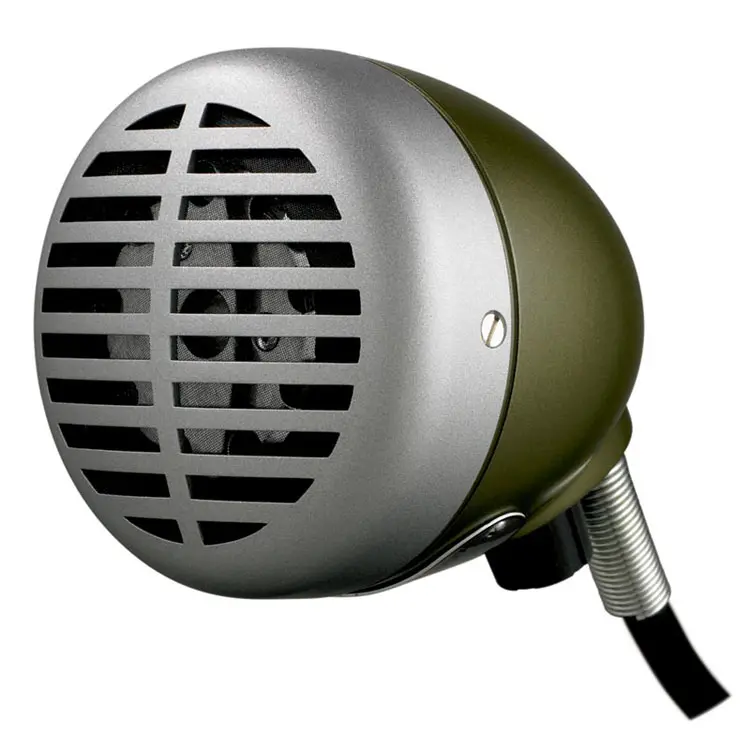
Shure 520DX Green Bullet Omnidirectional Dynamic Harmonica Microphone
The Shure 520DX « Green Bullet » is an omnidirectional dynamic harmonica microphone, high impedance, with a volume knob at its base. Its bullet-shaped housing sits in cupped hands with the harmonica, and its 6.1 m cable ends in a 1/4 in. plug that goes straight into a guitar amp.
What sets it apart
- Volume knob at the base of the mic, adjustable mid-performance
- Attached 6.1 m cable, 1/4 in. (6.35 mm) plug, wired for high-impedance unbalanced use
- Frequency response of 100 to 5,000 Hz
- Green and chrome die-cast housing, contoured for the palm
- Dynamic cartridge designed to recapture the sound of the very first Green Bullet, launched in 1949
Plugged into a guitar amp
Shure's guide plugs it straight into a guitar amp for the classic blues harp sound. Turn the mic's knob down before plugging in, then turn it up as you move away from the amp. The amp's volume setting changes the tone a lot: Shure suggests trying several balances between mic and amp.
To avoid feedback, the player keeps as much distance as possible from monitors and loudspeakers, and monitors are set at the console so they stay feedback-free even with the mic's knob at maximum. During the show, the knob is used to switch from rhythm to lead, or to put the mic on standby between sets.
Into a mixing console
The 520DX has a high-impedance output, into a minimum load of 100 kΩ. To feed a low-impedance device such as a mixer, Shure specifies a low-to-high impedance-matching transformer, for example the A95U. The mic can be rewired for low impedance, but the volume knob then no longer works.
From radio mic to the voice of the blues
The Green Bullet was born in 1949, as the Model 520, for outdoor public address and radio. According to a legend Shure reports, Little Walter was the first to play harmonica right up against a bullet-shaped mic. The first Shure catalogue to present it as a harmonica microphone dates from 1986. The 520DX, introduced in 1997, carries a dynamic cartridge designed to sound like the original R5 element, and its volume knob takes the place of the old threaded hole.
Specifications
| Type | Dynamic (moving coil) |
|---|---|
| Polar pattern | Omnidirectional |
| Frequency response | 100 to 5,000 Hz |
| Impedance | High, unbalanced |
| Minimum load impedance | 100 kΩ |
| Sensitivity (1 kHz, open circuit) | -38 dBV/Pa (13 mV) |
| Cable | 6.1 m, two-conductor shielded, attached 1/4 in. (6.35 mm) plug |
| Housing | Die-cast, green and chrome finish |
| Dimensions | 63 mm max. diameter, 82.6 mm long |
| Net weight with cable | 737 g |
What it's for
- Blues harmonica plugged straight into a guitar amp
- Harmonica through the PA, via a transformer into the console
- Distinct, deliberately lo-fi vocals
- Quickly putting the mic on standby between songs
Compared with other manufacturers
Other harmonica microphones from other manufacturers. Data as published by each manufacturer.
| Model | Polar pattern | Output | Designed for |
|---|---|---|---|
| Shure 520DX Green Bullet | Omnidirectional | High impedance, attached cable and 1/4 in. plug | Blues harmonica, lo-fi vocals |
| Hohner Harp Blaster HB52 | Not stated on the manufacturer's page | High-impedance capsule, gold-plated XLR connector | Harmonica, the sound of vintage mics |
| Superlux D112/C | Omnidirectional | High impedance, attached 20 ft cable and 1/4 in. plug | Harmonica |
| Audix FireBall | Cardioid | Low impedance, transformer required into a guitar amp | Harmonica, beatbox, accordion, percussion |
Frequently asked questions
- Can you sing into a 520DX?
- Yes, for a deliberate effect. Shure notes that, contoured to fit between harmonica and hands, it also works for distinct, lo-fi vocals. Its 100 to 5,000 Hz response does not make it a conventional vocal mic.
- What is the impedance of the 520DX? Can it go into a mixer?
- It is high impedance, unbalanced, for a load of at least 100 kΩ, like a guitar amp input. Into a low-impedance mixer, Shure specifies an impedance-matching transformer, for example the A95U.
- What is the frequency response of the 520DX?
- 100 to 5,000 Hz, according to Shure's guide. This band, focused on the midrange, is part of the sound blues harp players are after.
- Where does the name Green Bullet come from?
- From its bullet-shaped housing and its green finish. Shure launched it in 1949 as the Model 520, for public address and radio; blues harp players adopted it, and Shure has advertised it as a harmonica mic since 1986.
Avis clients
Which amp does your Green Bullet play through? Tell us.
Aucun avis pour le moment. Soyez le premier à partager votre expérience après votre achat.