
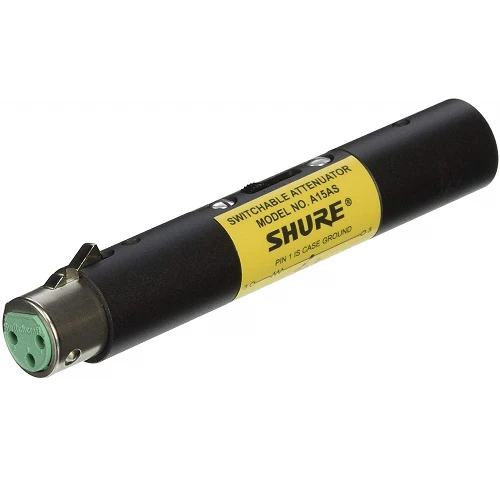
Shure A15AS Inline Switchable XLR Attenuator, 15, 20 or 25 dB
The Shure A15AS is an inline attenuator that fits between an XLR cable and an input to lower the level of a microphone or a balanced line signal by 15, 20 or 25 dB. It solves one specific problem: a hot mic that overloads the mixer or recorder even with the gain turned all the way down.
What sets it apart
- Three steps chosen with a slide switch: 15, 20 or 25 dB
- Passes phantom power from the mixer through to the mic
- Female XLR in, male XLR out: it plugs into the line with no extra cable
- Flat response from 20 Hz to 20 kHz, within ±0.5 dB
- Steel housing with full magnetic shielding
When the distortion comes from the mic, not the settings
A mic placed close to a very loud source can deliver more signal than the input can take. Shure puts it this way: if the mic's output level comes within 5 dB of the input's clipping point, distortion is certain. Turning the gain down fixes nothing when the input stage overloads before it. Placed just ahead of the input, the A15AS removes the excess upstream.
Shure gives the example of a high-output mic overloading a mixer input: insert the A15AS just before the mixer and pick the step that brings the signal back into its working range.
Works with condenser mics
The A15AS passes the mixer's phantom power through to the mic, which makes it an attenuator for dynamic and condenser mics alike. Shure names the SM81. One exception: it is not suited to the powering system known as "A-B". Its equivalent series resistance of 215 ohms adds to that of the existing circuit.
For line signals too
The same adapter lowers a mixer's line output so it does not overload a recorder's aux input. Its input bridges the mic output: the load stays light, which limits distortion and preserves the clipping level.
Specifications
| Attenuation | 15, 20 or 25 dB, three-position slide switch |
|---|---|
| Signal | Mic or line, balanced |
| Connectors | 3-pin female XLR input, 3-pin male XLR output |
| Impedance | 1,000 ohms input, 150 ohms output |
| Frequency response | 20 Hz to 20 kHz, ±0.5 dB |
| Phantom power | Passed to the mic (except A-B powering) |
| Maximum input level | 5 V peak to peak (+14 dBV), conservative Shure estimate |
| Housing | Grey enamelled steel, full magnetic shielding |
| Dimensions | 19 mm diameter, 114 mm long |
| Warranty | 2 years, Shure limited warranty |
What it's for
- Condenser mic in front of a guitar amp or kick drum that overloads the mixer
- Powerful vocal mic plugged into a mixer with no input gain control
- Portable recorder whose mic input clips on loud sounds
- Balanced XLR line output to bring down for a more sensitive input
Compared with other manufacturers
Other inline XLR attenuators from other manufacturers. Data published by each manufacturer.
| Model | Attenuation | Phantom power | Format |
|---|---|---|---|
| Shure A15AS | 15, 20 or 25 dB, selectable | Passed through | Female to male XLR, slide switch |
| Audio-Technica AT8202 | 10, 20 or 30 dB, selectable | Compatible, per the manufacturer | Inline XLR adapter for balanced mics |
| Hosa ATT-448 | 20, 30 or 40 dB, selectable | Not stated; designed for dynamic mics | Female to male XLR adapter |
| Whirlwind IMP PAD | Fixed value: 10, 20, 30 or 40 dB depending on model | Not stated by the manufacturer | H-pad, 1,000 ohms input, 150 ohms output |
Frequently asked questions
- Does the A15AS work with phantom power?
- Yes. Shure states that the A15AS passes the mixer's phantom power through to the mic, so it suits condenser mics. That was not the case with the A15A, an older model in the same Shure adapter series, which could cause noise in this setup.
- What is the maximum level the A15AS can take?
- Shure's conservative estimate is 5 V peak to peak, or +14 dBV. It cannot handle the output of a power amplifier, because the current is too high.
- What is the impedance of the A15AS?
- 1,000 ohms at the input and 150 ohms at the output, according to Shure's user guide.
- How can I tell if the mic is overloading a recorder's input?
- Shure suggests comparing the mic's output level, at the actual sound level, with the input's clipping point. A margin of 15 to 25 dB is comfortable; under 5 dB, clipping is certain. An inline attenuator such as the A15AS solves the problem if the recorder has no built-in pad.
Avis clients
Which mixer or recorder did the A15AS keep from clipping? Your review helps the next buyer.
Aucun avis pour le moment. Soyez le premier à partager votre expérience après votre achat.