
Darkglass Alpha Omega Photon Bass Distortion Pedal
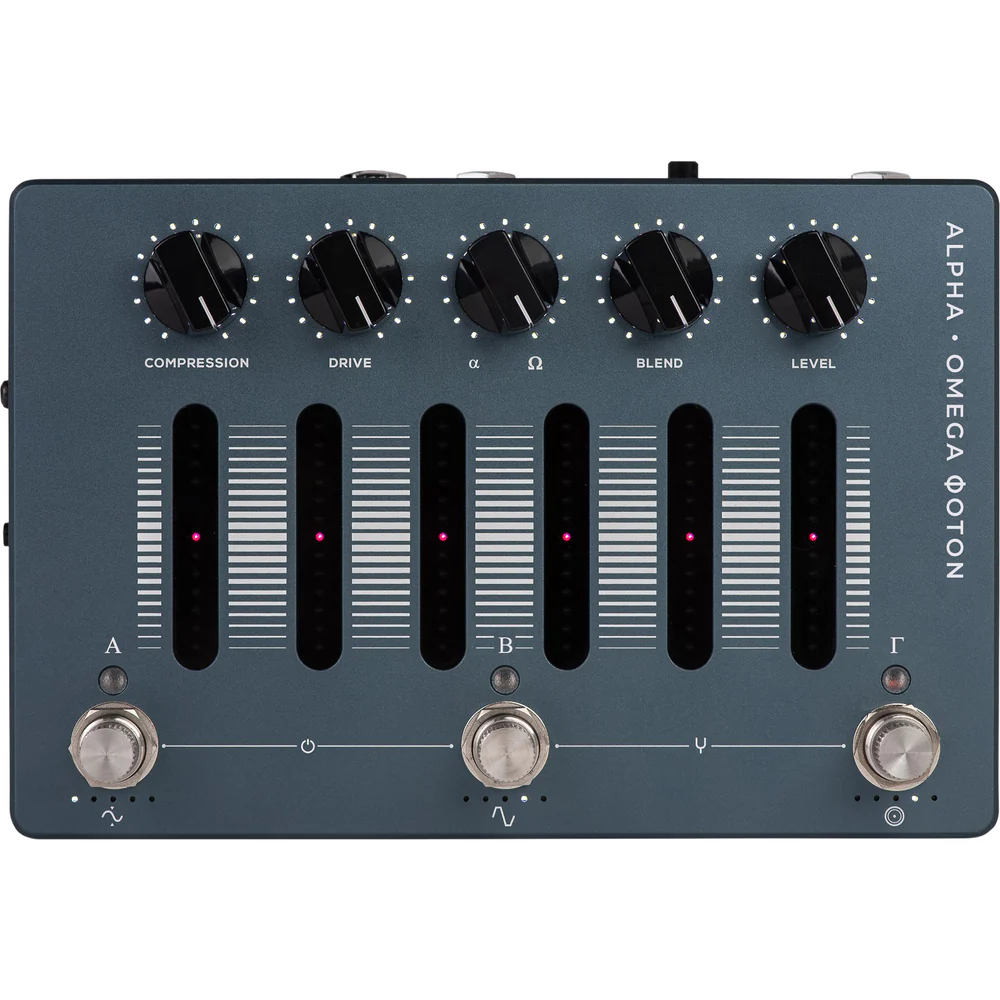
The ultimate convergence of surgical distortion and touch technology. The Alpha·Omega $\phi$oton (Photon) is not just a pedal, it is the definitive command centre for the modern bassist. By fusing Jon Stockman's famous saturation circuit with a revolutionary "photonic" interface, Darkglass gives you total control over your dynamics: studio compression, a 6-band touch graphic EQ and a high-resolution IR loader. Whether you are in the studio or on stage, the Photon projects undeniable sonic authority, eliminating the need for complex rigs while guaranteeing a pure, devastating signal.
Why the Alpha·Omega $\phi$oton Is Essential
For the studio or touring bassist, the quest for the "perfect tone" often runs up against the complexity of signal chains. The Darkglass Alpha·Omega $\phi$oton solves this problem by integrating a cutting-edge digital signal processor (DSP) into an iconic anodized aluminum chassis.
The Photon's strength lies in its duality: the Alpha circuit is incisive and punchy, ideal for cutting through a dense mix, while the Omega circuit is raw, massive and earth-shaking. With its backlit touch sliders, you adjust your EQ with organic fluidity, without the mechanical risks of conventional potentiometers. It is the ultimate precision instrument for those who demand total versatility, from crystal-clear clean to the most aggressive saturation, without ever sacrificing low-end definition.
Complete Technical Specifications (Absolute Extraction)
Control Interface & Audio
| Feature | Technical Detail |
| Compression | Dedicated rotary potentiometer (One-knob studio grade) |
| Drive | Adjusts the amount of saturation |
| Mod | Blend between the Alpha (incisive) and Omega (massive) circuits |
| Blend | Mix between the clean signal and the saturated signal |
| Level | Master output volume |
| Equalizer (EQ) | 6 touch graphic bands (LED slider) |
| Footswitches | 3 multifunction rotary switches (Presets / Mode) |
| Impulse Responses (IR) | 5 internal slots, reloadable via USB-C |
Connectivity & Digital
| Port | Connector Type |
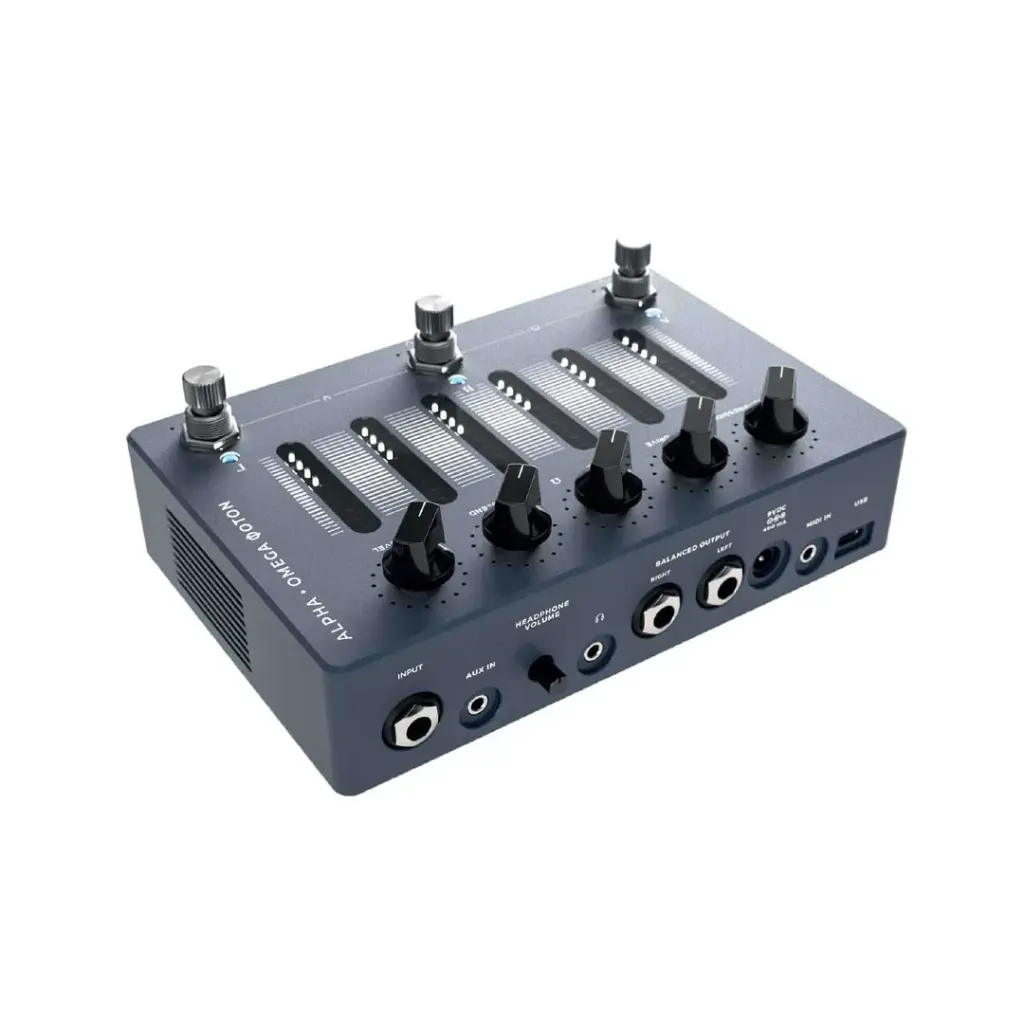
| Instrument Input | Unbalanced 1/4" jack |
| Auxiliary Input | 1/8" mini-stereo jack |
| Headphone Outputs | 1/8" jack with dedicated volume control |
| Line Outputs | 2 x balanced 1/4" jacks (L/R) |
| Direct Output (DI) | XLR with ground lift switch |
| MIDI In | 1/8" TRS jack (Type B) |
| USB | USB-C (48kHz audio interface, MIDI, Software Suite) |
| Bluetooth | Wireless connection for the Darkglass Suite app (iOS/Android) |
Physical Structure & Power
| Feature | Measurement |
| Enclosure Material | One-piece anodized aluminum |
| Dimensions | 180 x 120 x 60 mm (7.1" x 4.7" x 2.4") |
| Weight | 700 g (1.54 lbs) |
| Power Requirements | 9V DC (centre negative) |
| Current Draw | 500 mA minimum |
| Finish | Photonic space grey with laser engravings |
Comparative Analysis: The Experts' Verdict
Based on the consensus of Sound on Sound, MusicRadar and Gearspace.
| Alternative Product | Market Segment | Comparative Analysis | Availability at Garage à Musique |
| Darkglass Microtubes Infinity | Modern / Versatile | Same touch functions, but B3K/MVM circuits. More "sculpted" sound than the Photon. | Available here |
| Tech 21 SansAmp Bass Driver V2 | Classic / Standard | Fully analog. Less control, no IR or Bluetooth. | Available here |
| Ampeg SGT-DI | Vintage / Studio | Excellent compression and SVT-style sound. Lacks the Photon's aggressive distortion. | Available here |
| Neural DSP Quad Cortex | Workstation | Limitless power, but a bulky format and triple the price. Less portable than the Photon. | Available here |
| Origin Effects BassRIG | Boutique / Analog | Incredible sound fidelity. No preset saving or USB interface. | Available here |
| Source Audio Aftershock | Digital / Compact | Very versatile via app. No direct XLR outputs or touch EQ. | Available here |
| EBS MicroBass 3 | Professional / Pro | Dual channel with effects loop. Traditional look, no IR loader. | Available here |
| Two Notes Le Bass | Hybrid / Tubes | Real tube warmth. Bulky and limited in terms of modern distortion. | Available here |
| Boss GT-1000Core | Multi-FX / Pro | Effective all-in-one. Bass distortion quality falls short of Darkglass precision. | Available here |
| Bergantino Super Pre | High-End / Hi-Fi | Very clean, transparent sound. Less focused on metal-style saturation than the Photon. | Product not listed |
History & Evolution: The Alpha·Omega Lineage
The Alpha·Omega was born as a collaboration between Darkglass and Jon Stockman (Karnivool), aiming to create the most versatile bass distortion in the world. Initially a simple analog pedal, it evolved into the Ultra version (with a physical graphic EQ), then was integrated into the 500/900 amp heads. The Alpha·Omega $\phi$oton represents the pinnacle of this lineage: digital (DSP) integration now makes it possible to save complete presets and add bus-style studio compression, while keeping the analog grit that built Darkglass's reputation in Helsinki.
Cultural References & Artists
They defined the sound of modern bass with Darkglass:
Jon Stockman (Karnivool): The original creator of the Alpha·Omega circuit.
Adam "Nolly" Getgood (Periphery): Architect of the "Modern Metal" sound.
Amos Williams (TesseracT): Uses Darkglass for his clear, punchy textures.
Alex Webster (Cannibal Corpse): For the precision of pick attacks.
Billy Gould (Faith No More): A devotee of Darkglass power live.
Tony Levin (Peter Gabriel/King Crimson): For harmonic clarity.
Nick Schendzielos (Job for a Cowboy): Master of the slap/darkglass technique.
Pino Palladino: Has explored Darkglass preamps for specific sessions.
Bryan Beller (The Aristocrats): For versatility between fusion and rock.
Conner Green (Haken): For complex progressive bass lines.
Liam Wilson (Dillinger Escape Plan): For aggressive, stable saturation.
Eugene Abdukhanov (Jinjer): His signature sound is inseparable from the Darkglass engine.
Dick Lövgren (Meshuggah): For authority in the sub-bass frequencies.
Ra Díaz (Korn): Uses Darkglass to sound massive on stages around the world.
Jacob Umansky (Intervals): A representative of the new generation of technical bass.
FAQ - Musical & Technical Expertise
What is the difference between the Alpha and Omega modes? It is a matter of harmonic structure. Alpha mode is tight and focused, with incredible midrange definition to cut through the mix. Omega mode is more open, gritty and rich in low harmonics, ideal for massive, textured sounds. The "Mod" knob lets you find the perfect balance point between these two worlds.
Are the touch sliders reliable in concert? They are more durable than physical sliders. With no moving mechanical parts, they will not clog or break. The LED backlighting provides full visibility on dark stages in Quebec, ensuring your EQ stays exactly where you set it, a guarantee of authority from Garage à Musique.
Can I use the Photon without an amplifier? Absolutely, it is a complete rig. Thanks to the XLR DI output and the IR loader, you send studio-quality sound directly to the mixing console (PA). It is the ideal solution for travelling light while keeping total control over your gain and your sonic image.
What is the Bluetooth connectivity for? For intuitive management via the Darkglass Suite. You can change your IRs, fine-tune the compression settings and map your footswitches without ever plugging in a USB cable. It is essential flexibility for last-minute adjustments at rehearsal.
Is the compressor before or after the distortion? It is optimally positioned at the start of the chain. This smooths out the dynamics of your playing before it hits the saturation stage, guaranteeing infinite sustain and a consistent response, no matter how hard you attack. It is the secret to the "polished" sound of modern productions.
Does the Photon work with an active bass? Perfectly, thanks to the input Gain control. The unit has massive headroom that handles the most powerful 18V signals without unwanted digital clipping. You keep all the fidelity of your high-end pickups.
Can several different EQ settings be saved? Yes, via presets. Each rotary footswitch can be assigned to a complete configuration (EQ, Drive, Compression, IR). You go from a crystal-clear slap sound to a wall of distortion with a single press, with no processing latency.
What is the resolution of the IR loader? It supports high-resolution files. This means your cabinet emulation is strikingly realistic, capturing not only the frequency but also the acoustic resonance of the wood. Garage à Musique recommends exploring the artist libraries on the Darkglass cloud.
Can I record directly into my DAW via USB-C? Yes, the Photon acts as an audio interface. It lets you record your processed signal along with a "Dry" signal for later reamping. It is the ultimate production tool for bassists from Gatineau to Rimouski.
Why is the Alpha·Omega Photon considered "high-end"? Because it makes no compromises on components. From the high-fidelity converters to the machined chassis, every detail is designed to last and to deliver total sonic transparency. At Garage à Musique, we validate every unit to make sure it meets the standards of the musical elite.
Avis clients
Aucun avis pour le moment. Soyez le premier à partager votre expérience après votre achat.