
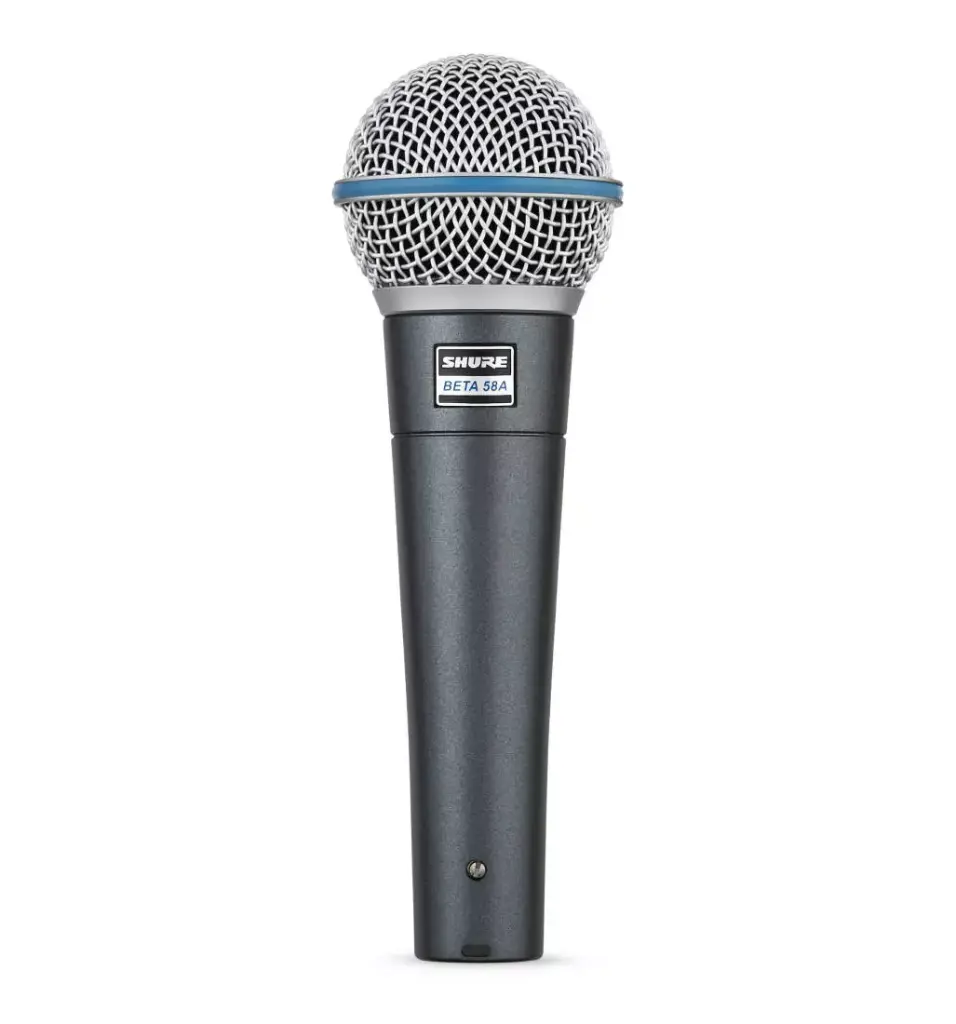
Shure BETA 58A Supercardioid Dynamic Vocal Microphone
The Shure BETA 58A is a supercardioid dynamic vocal microphone designed for professional live sound and studio recording. Its response brings out the clarity of the voice, and its tight pattern gives it high gain before feedback on a busy stage.
What sets it apart
- Response shaped for vocals: brightened midrange and bass rolloff to control proximity effect
- Uniform supercardioid pattern, for high gain before feedback
- Built-in pop filter against breath and wind noise
- Neodymium magnet for higher sensitivity and output
- Hardened steel mesh grille that resists dents
For vocals sung up close
Shure intends the BETA 58A for lead and backing vocals sung up close, especially where sound levels are high. The guide describes the effect of distance. Lips less than 15 cm away or touching the windscreen, on axis: robust sound, emphasized bass, maximum isolation. At 15 to 60 cm, just above nose height: natural sound, less bass. At 20 to 60 cm, slightly off to one side: natural sound and fewer sibilants.
BETA 58A or SM58: two different tools
Shure insists: this is not a question of better or worse. The SM58, Shure's other dynamic vocal mic and the most popular in the world according to the brand, is a cardioid and rejects best from the rear; the BETA 58A, a supercardioid, rejects better from the sides. The BETA 58A has about 4 dB more output, an extended response in the lows and highs, and makes less noise when handled. This extra sensitivity does not suit every voice: Shure cites the metal singer who screams into the mic, who may prefer to do without it.
Built for the road
The enamelled die-cast metal housing, the hardened steel grille and the proven pneumatic shock mount stand up to the rigours of daily sound reinforcement. On its product page, Shure presents it as one of its best-selling single-element dynamic microphones, seen every night on stages around the world.
Specifications
| Type | Dynamic (moving coil) |
|---|---|
| Polar pattern | Supercardioid |
| Frequency response | 50 to 16,000 Hz |
| Output impedance | 150 Ω rated (290 Ω actual) |
| Sensitivity (1 kHz, open circuit) | -51.5 dBV/Pa (2.6 mV) |
| Connector | 3-pin male XLR, balanced |
| Housing | Silver-blue enamelled die-cast metal, hardened matte-finish steel mesh grille |
| Dimensions | 50 mm wide, 160 mm long |
| Net weight | 278 g |
| Included | A25D clip, 5/8 in. to 3/8 in. thread adapter, storage bag |
What it's for
- Lead vocals in concert, on a loud stage
- Backing vocals sung up close
- Vocals in a home studio
- Guitar or bass amp, when needed
Compared with other manufacturers
Other tight-pattern dynamic vocal microphones from other manufacturers. Data as published by each manufacturer.
| Model | Polar pattern | Frequency response | Stated feature |
|---|---|---|---|
| Shure BETA 58A | Supercardioid | 50 to 16,000 Hz | Built-in pop filter, brightened midrange |
| Sennheiser e 945 | Supercardioid | 40 to 18,000 Hz | Hum-compensating coil, metal housing |
| Electro-Voice ND96 | Supercardioid | 30 to 15,000 Hz, up close | Selectable vocal tuning that trims the low mids |
| Audix OM5 | Hypercardioid | Not stated on the manufacturer's page | Natural rolloff at 120 Hz against boominess |
| Audio-Technica ATM610a | Hypercardioid | 40 to 16,000 Hz | Rare-earth magnet, multi-stage grille |
Frequently asked questions
- Is the BETA 58A better than the SM58?
- Shure does not rank them: they are two tools. The BETA 58A offers more output, a tighter supercardioid pattern, less handling noise and a more extended sound. The SM58 keeps a cardioid pattern, a classic tone and more forgiving performance.
- Is the BETA 58A supercardioid?
- Yes, and it keeps that pattern across its whole range. It rejects sound best at 120° toward the rear: monitors go at those angles, on either side, rather than directly behind the mic.
- Is the BETA 58A available as a wireless mic?
- Yes. Shure offers the BETA 58A head in various wireless systems, analogue and digital. This listing is for the wired version, with an XLR connector.
- Can you record with a BETA 58A?
- Yes. Shure designed it for professional sound reinforcement and project studio recording. Its response shaped for close-up vocals and its built-in pop filter also serve when recording.
- Does the BETA 58A make noise when you hold it?
- Less than an SM58, according to Shure, thanks to its advanced pneumatic shock mount that limits the transmission of mechanical noise and vibration. The guide advises avoiding excessive handling and never covering the grille with your hand.
Avis clients
Does the BETA 58A keep your voice above the band? Tell us.
Aucun avis pour le moment. Soyez le premier à partager votre expérience après votre achat.