
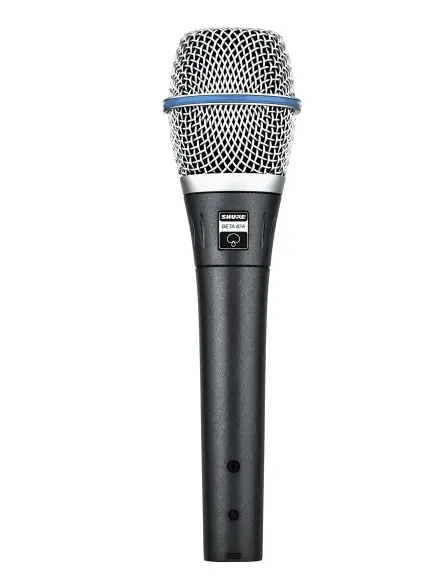
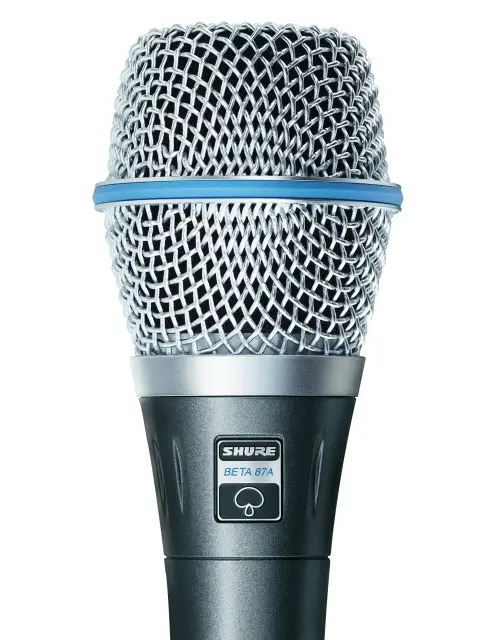
Shure BETA 87A Supercardioid Condenser Vocal Microphone
The Shure BETA 87A is a handheld electret condenser microphone with a supercardioid pattern, designed for vocals in professional sound reinforcement, broadcast and the studio. Its smooth response, with a gradual presence rise, brings the voice forward, and its tight pattern isolates it from other singers and instruments.
What sets it apart
- Consistent supercardioid pattern, for high gain before feedback
- Response from 50 Hz to 20 kHz, with a gradual presence rise
- Electronic low-frequency rolloff that compensates for proximity effect
- Handles 140.5 dB SPL, for a dynamic range of 117 dB
- Very low susceptibility to radio interference and electromagnetic hum
- Dent-resistant hardened steel mesh grille
Placing monitors for a supercardioid
A supercardioid does not reject best at the rear. The BETA 87A guide puts its greatest rejection at about 120 degrees off axis, and the product page speaks of null points near 125 degrees. Monitors and loudspeakers therefore go at those angles, on either side of the back of the mic, not directly behind it. Shure recommends testing the placement before every performance.
Singing up close without a booming low end
Shure designed it for lead vocals as well as backing vocals picked up at short range, loud stages included. The closer the mouth gets, the more proximity effect builds up the bass; an electronic rolloff, built into the mic, compensates for that build-up and avoids a boomy sound. The gentle presence rise brightens the upper midrange, so the voice cuts through the mix.
A condenser built for touring
Like any condenser microphone, the BETA 87A needs phantom power. The ideal voltage is 48 V; from 11 V up it still works, but its headroom and sensitivity drop slightly. It connects with a balanced cable, XLR to XLR or XLR to TRS.
Its metallic blue aluminum housing, hardened steel grille and advanced cartridge shock mount are built to withstand daily sound reinforcement.
Specifications
| Type | Electret condenser |
|---|---|
| Polar pattern | Supercardioid |
| Frequency response | 50 Hz to 20 kHz |
| Sensitivity at 1 kHz | -52.5 dBV/Pa |
| Maximum level | 140.5 dB SPL at 1 kHz, 1% distortion |
| Output clipping | -6 dBV (0.5 V) |
| Self-noise | 23.5 dB, A-weighted |
| Signal-to-noise ratio (ref. 94 dB SPL) | 70.5 dB |
| Impedance | 150 ohms rated (100 ohms actual) |
| Dynamic range | 117 dB |
| Phantom power | 11 to 52 V DC, 1.2 mA |
| Connector | 3-pin male XLR, balanced |
| Housing | Metallic blue painted aluminum; hardened steel grille with nickel satin chrome plating |
| Net weight | 207 g |
| Supplied | A25D stand adapter, zippered carrying bag |
| Replacement parts | RK312 grille, R193 cartridge |
What it's for
- Lead vocals on a loud stage
- Closely spaced backing singers, isolated from one another
- Vocals for broadcast and studio recording
- Touring shows, where the mic is handled every night
Compared with other manufacturers
Other condenser vocal microphones for the stage, from other manufacturers. Data published by each manufacturer.
| Model | Type | Polar pattern | Stated feature |
|---|---|---|---|
| Shure BETA 87A | Electret condenser | Supercardioid | Electronic low-frequency rolloff against proximity effect |
| Sennheiser e 865 | Electret condenser | Supercardioid | Response from 40 Hz to 20 kHz |
| Neumann KMS 105 | Condenser | Supercardioid | Up to 150 dB SPL without clipping, hardened steel grille |
| Audix VX5 | Electret condenser | Supercardioid | Switchable 10 dB pad and bass rolloff |
| Audio-Technica AE5400 | Condenser | Cardioid | 10 dB pad and 80 Hz high-pass filter |
Frequently asked questions
- Is the BETA 87A a condenser microphone?
- Yes, an electret condenser. It therefore requires phantom power, from 11 to 52 V, which most modern mixers provide.
- BETA 87A or SM58: what is the difference?
- The SM58 is a cardioid dynamic microphone that works without power, with a response from 50 Hz to 15 kHz. The BETA 87A is a phantom-powered supercardioid condenser that reaches up to 20 kHz and better rejects sound coming from the sides.
- BETA 87A or BETA 58A?
- Both are supercardioid and designed for vocals on stage. The BETA 58A is dynamic and works without power; the BETA 87A is a condenser, needs phantom power and reaches higher in the treble, up to 20 kHz against 16 kHz.
- Is the BETA 87A good for studio recording?
- Yes. Shure designed it for professional sound reinforcement, broadcast and studio recording, notably for vocals picked up up close.
Avis clients
Used this BETA 87A on stage? Comments are open.
Aucun avis pour le moment. Soyez le premier à partager votre expérience après votre achat.