
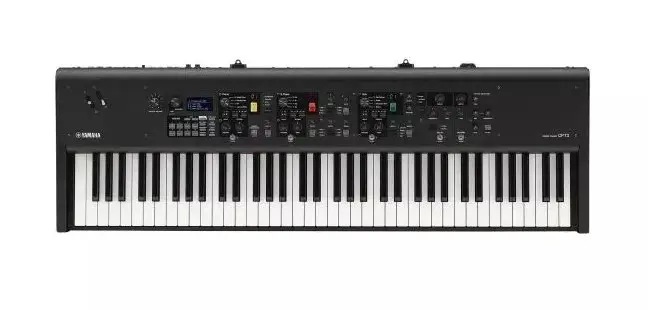
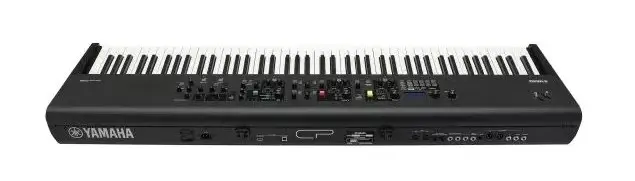
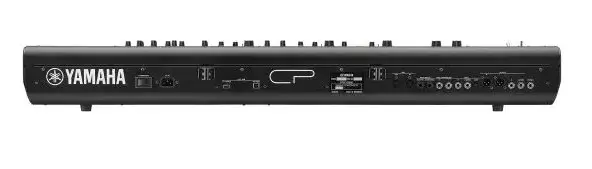
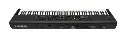
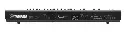
Yamaha CP73 - Stage Piano - Breathtaking Performance
The ultimate "One-to-One" interface for the demanding stage pianist.
The Yamaha CP88 (88 natural wood keys) and CP73 (73 balanced keys) eliminate menu complexity, giving you complete physical control. With CFX and Bösendorfer concert grand piano sounds, vintage VCM effects, and a robust aluminum construction, it's the ultimate touring instrument for those who refuse to compromise between authentic feel and digital reliability.
The Authority of the Scene: Why the CP series is essential viewing
The Yamaha CP88 solves the number one problem for keyboardists in concert: technology paralysis. Where other workstations lose you in complex submenus, the CP offers a "One-to-One" interface where each major function has its own dedicated button or switch.
It combines three once-separate worlds: the authentic feel of a grand piano thanks to its natural wood keys (NW-GH), virtual circuit modeling (VCM) for legendary pedal effects, and modern connectivity (USB Audio/MIDI) that transforms the CP into a command center for your studio or hybrid setup. It's the instrument that lets you focus on your performance, not the programming.
Full Technical Specifications (Absolute Extraction)
| Category | Characteristic | Technical Details CP88 | Technical Details CP73 |
| Keyboard | Number of keys | 88 keys | 73 keys |
| Keyboard | Type of action | NW-GH (Natural Wood Graded Hammer) | BHS (Balanced Hammer Standard) |
| Keyboard | Finishing | Wooden keys, synthetic ebony/ivory top | Matte black accents |
| Generator | Synthetic technology | AWM2 | AWM2 |
| Generator | Maximum polyphony | 128 notes | 128 notes |
| Voice | Number of votes | 57 (Piano: 10 / E. Piano: 14 / Sub: 33) | 57 (Piano: 10 / E. Piano: 14 / Sub: 33) |
| Effects | Insertion (Piano) | Damper Resonance, Reverb, Chorus, EQ | Damper Resonance, Reverb, Chorus, EQ |
| Effects | Insertion (E. Piano) | Drive, Auto Pan, Tremolo, Phaser, Chorus | Drive, Auto Pan, Tremolo, Phaser, Chorus |
| Effects | Insertion (Sub) | Chorus/Flanger, Rotary Speaker, Tremolo | Chorus/Flanger, Rotary Speaker, Tremolo |
| Effects | Master | Delay (Analog/Digital), Reverb, Master EQ | Delay (Analog/Digital), Reverb, Master EQ |
| Connectivity | Line exits | OUTPUT [L/MONO]/[R] (6.3 mm, TS) | OUTPUT [L/MONO]/[R] (6.3 mm, TS) |
| Connectivity | Symmetrical outputs | OUTPUT [L/R] (symmetrical XLR) | OUTPUT [L/R] (symmetrical XLR) |
| Connectivity | Helmet | [PHONES] (6.3 mm, stereo) | [PHONES] (6.3 mm, stereo) |
| Connectivity | Controllers | FOOT CONTROLLER [1]/[2], FOOT SWITCH | [SUSTAIN]/[ASSIGNABLE] |
| Connectivity | MIDI / USB | MIDI [IN]/[OUT], USB [TO HOST]/[TO DEVICE] | MIDI [IN]/[OUT], USB [TO HOST]/[TO DEVICE] |
| Connectivity | Auxiliary Entrance | INPUT [L/MONO]/[R] (6.3 mm, TS) | INPUT [L/MONO]/[R] (6.3 mm, TS) |
| Physical | Dimensions (LxWxH) | 1298 mm x 364 mm x 141 mm | 1086 mm x 355 mm x 144 mm |
| Physical | Weight | 18.6 kg (41 lb) | 13.1 kg (28 lb, 14 oz) |
| Screen | Kind | LCD (128 x 64 pixels) | LCD (128 x 64 pixels) |
Comparative Analysis
Based on consensus from Piano World, Sound on Sound and MusicRadar.
| Alternative Product | Market Segment | Comparative Analysis | Available at Garage à Musique |
| Nord Stage 4 | Hybrid Performance | More advanced synthesis, but less "piano" feel and 50% higher price. | Available here |
| Roland RD-2000 | Workstation Scene | More sounds, but a complex interface and a much higher weight (21.7kg). | Available here |
| Kawai MP11SE | Purist Piano | Best touch in the world, but bulky and lacks a USB audio interface. | Product not listed |
| Korg SV-2 | Vintage / Retro | Iconic design, but less versatility for "Sub" sounds (pads, pads). | Available here |
| Dexibell Vivo S9 | High Resolution | 24-bit/48kHz technology, but distribution network limited to Quebec. | Product not listed |
| Casmio Privia PX-S6000 | Modern Design | Unique aesthetics, but less powerful built-in speakers for the pro scene. | Available here |
| Kurzweil Forte | Production / Live | VAST synthesis engine, but very steep learning curve. | Product not listed |
| Nord Piano 5 | Stage Piano | Exceptional sound libraries, but no balanced XLR outputs. | Available here |
| Yamaha YC88 | Organ / Piano Combo | Similar to the CP88 but with organ drawbars; more expensive. | Available here |
| Studiologic Numa X Piano GT | Compact Premium | Fatar keyboard is excellent, but its reputation for reliability is lower than Yamaha's. | Product not listed |
History & Evolution
The CP (Combo Piano) series began in 1976 with the legendary CP-80 , an electro-acoustic stage piano with real strings that defined the sound of 1980s rock. After the CP4/CP40 era, Yamaha made a radical shift with the launch of the CP88 in 2019, abandoning the complex display in favor of an interface inspired by vintage synthesizers and mixing consoles. This evolution marks Yamaha's return to the "musician first" philosophy, prioritizing physical feel and speed of execution.
Cultural References & Artists
The Yamaha CP sound is a cornerstone of modern music:
Chick Corea : Ambassadeur historique du CP, utilisant la dynamique de l'action Yamaha pour son jeu virtuose.
Elton John : Utilisateur du CP-80 original, dont le son est fidèlement reproduit dans le CP88.
Billie Eilish (Finneas) : Utilise le CP88 en tournée pour sa fiabilité et son format compact.
Alicia Keys : Adepte du son Yamaha CFX échantillonné présent dans la série CP.
Sarah McLachlan : Utilise régulièrement les pianos Yamaha pour leur clarté cristalline.
Jamie Cullum : Pour l'expressivité du toucher NW-GH lors de ses performances jazz énergiques.
Sia : Les textures de piano CP88 soutiennent souvent ses arrangements live épurés.
Vulfpeck (Jack Stratton) : Pour les sons de Rhodes et de CP-80 typés funk.
Keane : Le son du CP-80 est le cœur battant de leur discographie (ex: "Somewhere Only We Know").
Peter Gabriel : Utilisateur de longue date des pianos de scène Yamaha pour ses ambiances.
Jacob Collier : Pour la justesse harmonique et la réponse aux nuances.
Coldplay (Chris Martin) : Fidèle à l'échantillonnage Yamaha pour les pianos de stade.
Snarky Puppy : Les claviéristes du groupe utilisent la polyvalence des effets VCM.
Bruce Hornsby : Le standard du piano rock "bright" par excellence.
H.E.R. : Pour l'intégration fluide avec les configurations MIDI modernes.
FAQ (Frequently Asked Questions)
What is the difference in feel between the CP88 and the CP73?
The CP88 features an NW-GH (natural wood) action designed to replicate the graduated resistance of a grand piano. The CP73 uses a BHS (balanced) action, ideal for musicians playing piano, organ, and synthesizer, offering a more even response across the entire keyboard.
Can the Yamaha CP88 be used as an audio interface?
Yes. Thanks to its USB "To Host" port, it transmits and receives digital audio and MIDI. You can record directly into your DAW without an external sound card and play virtual instruments through the piano's professional outputs with minimal latency .
How does Seamless Sound Switching (SSS) work?
This crucial feature allows you to change sounds without cutting out the notes or reverb effects. This is essential for smooth transitions between sections of a song during a live performance.
Are the piano sounds updated regularly?
Absolutely. Yamaha releases free firmware updates that add new sound banks (e.g., Hamburg Steinway, Felt Pianos) and features requested by the community.
What is integrated VCM modeling?
Virtual Circuitry Modeling doesn't just record effects; it simulates the physical behavior of the electronic components (resistors, capacitors) in vintage pedals. This results in an organic texture and saturation impossible to achieve with conventional digital effects.
Does the CP88 have XLR outputs?
Yes. It features studio-quality balanced XLR outputs, allowing direct connection to a sound console or stage box without the use of direct boxes (DI boxes), thus eliminating background noise and signal loss.
Can I split the keyboard to play two different sounds?
Absolutely. The interface makes it easy to create Splits (divide the keyboard) or Layers (overlay sounds) with independent volume and effects controls for each section.
Is the piano too heavy for a solo musician?
The CP88 weighs 18.6 kg, which is very competitive for a piano with wooden keys. If portability is your top priority, the CP73 weighs only 13.1 kg while maintaining the same sound and build quality.
How is velocity sensitivity handled?
Yamaha's high-precision sensors detect every nuance of your keystrokes. You can adjust the response curve (Soft, Medium, Hard, Fixed) to tailor the keyboard to your personal playing style.
How reliable is the CP88 on tour in Quebec?
The reinforced aluminum chassis is designed to withstand the rigors of transportation and frequent temperature changes in Canada. When you buy from Garage à Musique, you benefit from local expertise and the solid warranty of Yamaha Canada.
Avis clients
Aucun avis pour le moment. Soyez le premier à partager votre expérience après votre achat.