
Shure DMK57-52 Drum Microphone Kit
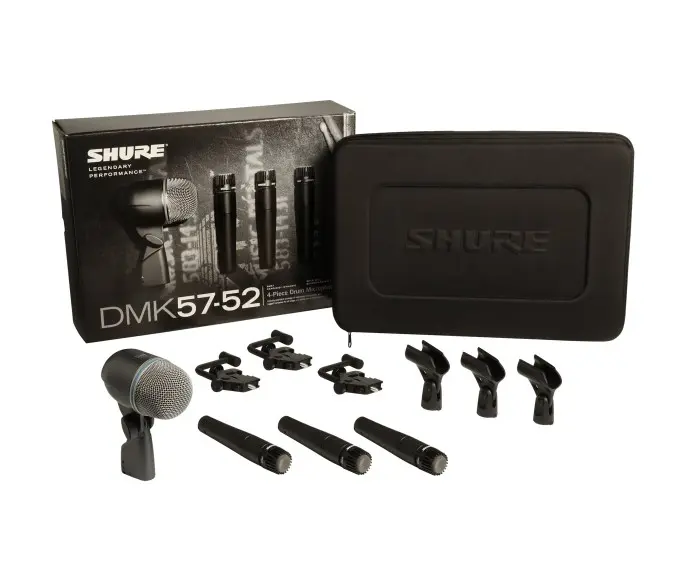
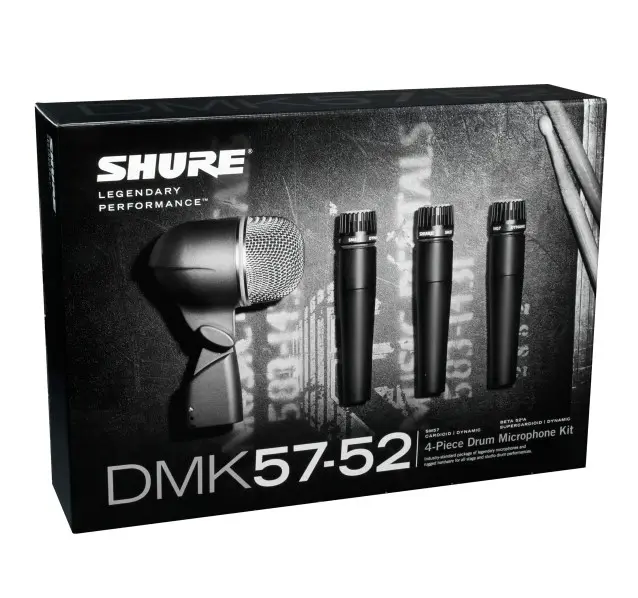
The Shure DMK57-52 is a drum microphone kit that brings together three SM57 dynamic microphones for snare and toms, a Beta 52A for kick drum, three A56D drum mounts and a carrying case. Shure presents it as the core of a drum miking setup, for the drummer who plays live as much as for the one who records.
What sets it apart
- Three cardioid SM57s, which Shure calls the standard for snare and a reliable choice for toms
- A supercardioid Beta 52A with a response shaped for kick drum, up to 174 dB SPL
- Three A56D mounts that clamp a mic to a drum rim, a mic stand or a cymbal stand
- Locking stand adapter built into the Beta 52A, with its XLR connector
- A rugged case that holds the four microphones and the mounts
What's in the box, and what to plan for
The box holds three SM57s, one Beta 52A, three A56D universal mounts and a rugged case. The three A56Ds are for the SM57s, which sit on the drum rims. The Beta 52A threads onto a mic stand through the locking adapter that is part of its body.
The contents list includes no stand and no cable: plan for a stand for the kick drum mic and four XLR cables. Shure also names snare, rack toms, floor tom and even congas among the kit's uses. Cymbals and hi-hat are not covered: the kit includes no overhead microphone.
The SM57 on snare and toms
The SM57 guide places the mic 2.5 to 7.5 cm above the rim of the top head, aimed at the head: that is where it gives the most snap. A second mic can go just below the rim of the bottom head. For toms, Shure suggests one mic per tom, or one mic between two toms, at the same height; on a double-headed tom, the bottom head can also come off and the mic go inside, pointing up.
The closer the SM57, the more it boosts the bass: at about 6 mm from the source, proximity effect adds 6 to 10 dB below 100 Hz. The SM57's grille rotates freely, by design. If it rattles while the drummer plays, a windscreen or a small piece of foam slipped underneath solves it, without ever blocking the vents with tape.
The Beta 52A on kick drum
Shure places the Beta 52A 5 to 7.5 cm from the batter head, slightly off-centre from the beater, for the sharpest attack and the most bass. Pulled back 20 to 30 cm, in line with the beater, it gives a more balanced sound. Shure's kick drum article sums up the choice: inside and aimed at the beater, the mic picks up the attack; just inside or at the port, it picks up the weight. The mic must touch neither the head nor the damping.
Its supercardioid pattern rejects sound best at 120 degrees toward the rear: that is where stage monitors belong, rather than directly behind it. The stand adapter resists knocks and vibration without slipping; it is tightened by hand, never with a tool.
The A56D mounts
The A56D clamp grips a drum rim 12.7 to 57.2 mm high or a cymbal stand 9.5 to 28.6 mm in diameter, and takes any mic adapter with a 5/8 in.-27 thread. An extension bent at 90 degrees helps aim at the head. Its parts are captive, so none goes missing between two gigs. Shure recommends keeping the mic out of the path of sticks and cymbals, to avoid noise and damage.
Specifications
| Contents | 3 SM57, 1 Beta 52A, 3 A56D mounts, 1 case |
|---|---|
| SM57, type | Dynamic (moving coil), cardioid |
| SM57, frequency response | 40 to 15,000 Hz |
| SM57, output impedance | 310 ohms |
| SM57, net weight | 284 g |
| Beta 52A, type | Dynamic (moving coil), supercardioid |
| Beta 52A, frequency response | 20 to 10,000 Hz |
| Beta 52A, maximum SPL | 174 dB (1 kHz, 1% THD) |
| Beta 52A, output impedance | 45 ohms |
| Beta 52A, weight | 605 g |
| Connectors | 3-pin male XLR |
| A56D, clamping range | Drum rim 12.7 to 57.2 mm; cymbal stand 9.5 to 28.6 mm |
| A56D, thread | 5/8 in.-27 |
What it's for
- Miking a drum kit live, from kick drum to toms
- Recording a drum kit in the rehearsal space or home studio
- Giving a venue or a church a complete set of drum microphones
- Replacing a mismatched assortment with four mics designed for these drums
Compared with other manufacturers
Other drum microphone kits, from other manufacturers. Contents as published by each manufacturer.
| Kit | Microphones included | Mounts | Transport |
|---|---|---|---|
| Shure DMK57-52 | 3 SM57 and 1 Beta 52A, all dynamic | 3 A56D for drum rim or cymbal stand | Rugged case |
| Audix DP5A | D6, i5, D4 and 2 D2, all dynamic | DFLEX and D-Vice | Foam-lined aluminum case |
| Sennheiser e 600 Series Drum Case | 1 e 602-II, 4 e 604 and 2 e 614 condensers for cymbals | 4 MZH 604 and 2 MZQ 100 | Heavy-duty case |
Frequently asked questions
- Does the Beta 52A need phantom power?
- No. Shure lists it as a dynamic moving-coil microphone, like the SM57: none of the kit's four mics depends on phantom power to work.
- How do you set up the DMK57-52 microphones?
- The three SM57s attach to the drums with the A56Ds, 2.5 to 7.5 cm above the head and out of the sticks' path. The Beta 52A threads onto a mic stand, not included, through its built-in adapter, then locks by hand.
- Does the Beta 52A go inside the kick drum?
- It can. According to Shure, aimed at the beater inside the shell, it captures the attack; just inside or at the port, it captures more of the weight. It must touch neither the head nor the damping.
- Does the Beta 52A work on a bass amp?
- Yes. Shure designs it for kick drums and other bass instruments, and its guide gives the placement in front of an amp: 2.5 cm from the speaker for a sharp attack, 60 to 90 cm for a softer attack.
- Are the SM57 and the SM58 the same microphone?
- No. Both are dynamic and cardioid, but the SM58 is a vocal mic with a spherical grille and pop filter, 50 to 15,000 Hz response. The SM57 is aimed first at instruments, with a polycarbonate grille over a stainless steel screen and a 40 to 15,000 Hz response.
Avis clients
Which drum kit did this DMK57-52 end up on? Comments are open.
Aucun avis pour le moment. Soyez le premier à partager votre expérience après votre achat.