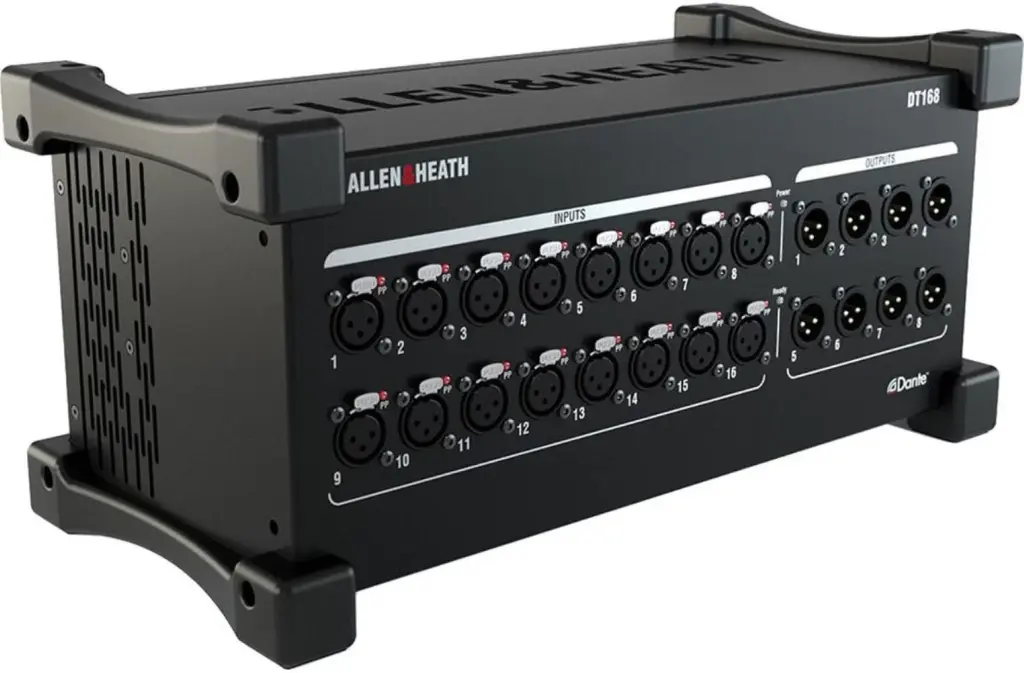
Allen & Heath DLIVE-DT168 - Dante Audio Rack
Elevate your audio network to uncompromising resolution with the Allen & Heath DT168.
This ultra-rugged Dante expansion unit deploys 16 world-class mic preamps and 8 line outputs at the heart of your dLive, Avantis, or SQ infrastructure. Featuring high-fidelity 96kHz conversion, redundant EtherCon ports, and a road-ready steel chassis, it guarantees absolute sonic transparency and near-zero latency. It's the ultimate tool for sound engineers and integrators in Quebec who demand total flexibility without sacrificing the signature Allen & Heath sound.
This content will be shared across all product pages.
The Technical Authority: The Evolution of Digital Audio Transport
The Allen & Heath DT168 does more than simply add inputs and outputs to a console; it represents a fundamental shift toward decentralizing audio intelligence on stage. In modern live production, broadcast, and fixed installation environments, the ability to place high-quality converters as close as possible to the source is paramount to preserving the integrity of the analog signal before digitization. The DT168 solves the long-standing problem of signal loss due to long analog (multi-core) cabling by converting the signal at the source to a 96kHz data stream via Audinate's Dante protocol.
The engineering of this unit is based on acclaimed Allen & Heath preamps, capable of delivering +60dB of gain with exceptional linearity. Unlike standard 48kHz systems, native 96kHz support not only allows for a wider frequency response but also reduces conversion latency, a critical factor for in-ear monitoring (IEM) where every microsecond counts for the performer's comfort. The integration of 32-bit converters ensures an extended dynamic range, capturing the most subtle nuances of acoustic instruments while handling the massive sound pressure levels of brass or percussion sections.
The DT168's robust construction is a direct response to the rigors of the live entertainment industry. Its steel chassis, protected by high-density rubber bumpers, allows for horizontal or vertical deployment on stage without fear of mechanical damage. The absence of an internal fan ensures completely silent operation, making this unit indispensable in acoustically sensitive environments such as theaters, recording studios, or houses of worship. The inclusion of an ergonomic carrying handle and a safety clip for the IEC power cord demonstrates a meticulous attention to operational details that only a manufacturer working closely with touring technicians can achieve.
Full Technical Specifications
The data below represents the exhaustive extraction of the technical capabilities of unit DT168, structured for expert consultation.
Audio Performance and Preamplification
| Setting | Detailed Specification |
| Mic/Line Inputs | 16x XLR Femelle (Balancé) |
| Preamps | Entièrement rappelables numériquement (Recallable) |
| Input Sensitivity | -60 dBu to +15 dBu |
| Analog Gain | +5 dB à +60 dB, par incréments de 1 dB |
| Active Pad | -20 dB |
| Maximum Entry Level | +30 dBu (avec Pad activé) |
| Input Impedance | >4 kΩ (Pad désactivé), >10 kΩ (Pad activé) |
| Equivalent Noise (Mic EIN) | -127 dB avec source de 150 Ω |
| THD+N (Unity Gain) | 0.003% (-88 dBu) @ 1 kHz, sortie 0 dBu |
| THD+N (Low Gain, 5dB) | 0.002% (-93 dBu) @ 1 kHz, sortie 0 dBu |
| THD+N (Mid Gain, 30dB) | 0.003% (-88 dBu) @ 1 kHz, sortie 0 dBu |
| Frequency Response | 20 Hz to 20 kHz (±0.5 dB) |
| Ghost Power Supply | +48V DC, sélectionnable individuellement par entrée |
| Phantom Indicators | 16x LED dédiées sur le panneau avant |
Analog Outputs and Conversion
| Setting | Detailed Specification |
| Line Exits | 8x XLR Mâle (Balancé) |
| Exit Protection | Protégées par relais |
| Output Impedance | <75 Ω |
| Nominal Output Level | +4 dBu = 0 dB au vumètre |
| Maximum Output Level | +22 dBu |
| Residual Output Noise | -92 dBu (Muted, 20 Hz - 20 kHz) |
| Converter Resolution | 32-bit interne |
| Sampling Frequencies | 48 kHz or 96 kHz (Dante) |
| Bit depth Dante | 24-bit |
Network Connectivity and Protocols
| Setting | Detailed Specification |
| Dante Ports | 2x EtherCon verrouillables (Primary & Secondary) |
| Wearing Modes | Redundant (Redundancy) or Switched (Daisy-chain) |
| Compatibility | dLive, Avantis, SQ, Qu (96kHz models), AHM-64 |
| Interoperability | AES67 compatible, Dante Domain Manager ready |
| External Control | Logiciel DT Preamp Control (Windows/macOS) pour tiers |
| Maximum Distance | 100m per segment Cat5e/Cat6 |
| Network Reset | Switch hardware encastré (maintien 10s pour DHCP/Zero-conf) |
Physical and Electrical Characteristics
| Setting | Detailed Specification |
| Chassis Material | Acier robuste haute densité |
| Protection | Pare-chocs en caoutchouc (Rubber Bumpers) |
| Dimensions (LxWxH) | 410mm x 190mm x 185mm (16.1" x 7.5" x 7.3") |
| Weight | 4.6 kg (10.1 lbs) |
| Mains Power Supply | 100-240V AC, 50/60 Hz |
| Electricity Consumption | 40W Maximum |
| Power Connector | IEC 3-pin avec clip de maintien P-clip |
| Operating Temperature | 0°C à 40°C (32°F à 104°F) |
| Cooling | Passive (Fanless) |
| Rack Mounting | Optionnel via kit 19" (4U) AB1608-RK19 |
Comparative Analysis: Strategic Positioning
The Dante expander market is vast, but the DT168 stands out for its ability to operate natively at 96kHz while maintaining a portable "Stagebox" form factor. The following analysis compares the DT168 to its main competitors based on expert technical consensus.
| Alternative Product | Market Segment | Comparative Analysis | Available at Garage à Musique |
| Allen & Heath DX168 | SLink/DX Expander | Points Forts : Latence extrêmement basse (<100µs), prix réduit. Points Faibles : Protocole propriétaire fermé, ne peut être utilisé sans console A&H. | Available here. |
| Yamaha Tio1608-D2 | Stagebox Dante | Points Forts : Format rack 2U intégré, prix agressif. Points Faibles : Préamplis techniquement inférieurs en gain et transparence par rapport aux A&H. | Available here. |
| Waves StageGrid 1000 | SoundGrid Expander | Points Forts : Intégration plugins Waves temps réel, format 1U. Points Faibles : Protocole SoundGrid moins universel que le Dante pour l'intégration fixe. | Available here. |
| Focusrite RedNet MP8R | Dante Broadcast/Studio | Points Forts : Qualité studio ultime, alimentations redondantes. Points Faibles : Coût prohibitif pour le live, format rack rigide uniquement. | Product not listed. |
| Tascam ML-16D | Dante Converter | Points Forts : Prix très bas pour 16 canaux. Points Faibles : Entrées ligne uniquement (pas de préamp micro), connecteurs D-Sub fragiles. | Product not listed. |
| Allen & Heath DT164-W | Wall Mount | Points Forts : Design discret pour intégration architecturale. Points Faibles : Seulement 4 sorties, pas de protection pour usage mobile. | Available here. |
| Midas DL16 | Stagebox AES50 | Points Forts : Préamplis Midas reconnus. Points Faibles : Incompatible Dante sans pont externe coûteux, limité à l'écosystème Behringer/Midas. | Available here. |
| DiGiCo A168D | Dante Premium | Points Forts : Qualité audio exceptionnelle. Points Faibles : Coût très élevé, ergonomie pensée exclusivement pour les consoles DiGiCo. | Product not listed. |
| PreSonus NSB 16.8 | Stagebox AVB/Dante | Points Forts : Économique, intégration StudioLive. Points Faibles : Châssis moins robuste, conversion limitée à 48kHz dans de nombreux scénarios. | Available here. |
| Soundcraft Mini Stagebox 32 | Stagebox MADI/Dante | Points Forts : Haute densité d'entrées (32). Points Faibles : Requiert une carte optionnelle pour le Dante, format 3U imposant. | Product not listed. |
Analysis sources: Sound on Sound, Gearspace, MusicRadar.
History & Evolution: From Analog to Distributed 96kHz
Allen & Heath, founded in 1968 in Penryn, Cornwall, has always been at the forefront of audio mixing, notably creating custom consoles for Pink Floyd and The Who in the 1970s. The evolution towards digital expanders began with the GLD series and the dSNAKE protocol, limited to 48kHz. The advent of the dLive platform in 2015 marked a major technological leap with the introduction of 96kHz FPGA processing.
The DT168 was born from a growing industry demand for increased flexibility. While the original DX168 (launched shortly before) used the proprietary DX protocol, the DT168 was introduced in 2019 to offer the same audio performance but over the Dante network. This evolution enabled the integration of Allen & Heath preamps into broader ecosystems, allowing universities, stadiums, and theaters to use the DT168 as a shared resource on a global IP network. Today, with AES67 and Dante Domain Manager compatibility, the DT168 represents the pinnacle of the "smart" I/O expander.
Cultural References & Artists: The Professionals' Choice
The Allen & Heath dLive ecosystem, of which the DT168 is an essential component for I/O expansion, is the current standard on global stages.
Billie Eilish | Glastonbury Festival (2022) | Utilisation de systèmes dLive sur la Pyramid Stage pour une clarté sonore maximale.
Jacob Collier | Djesse World Tour (2022) | Déploiement de réseaux audio complexes pour capturer la polyphonie instrumentale de Collier.
Khruangbin | Space Walk Tour (2022) | Jade Payne (FOH) utilise une configuration compacte CTi1500 avec expansion réseau.
Beartooth | The Below Tour (2021) | Caleb Shomo (Chanteur/Ingénieur) mixe les moniteurs depuis la scène via dLive.
Sam Fender | Seventeen Going Under Tour (2022) | Utilisation des outils DEEP Processing pour un son rock puissant et précis.
Dave | UK Arena Tour (2022) | Production hip-hop de grande envergure s'appuyant sur la stabilité du réseau Allen & Heath.
Paolo Nutini | Last Night in the Bittersweet Tour (2022) | Grace Howat (Mons) utilise la surface S5000 pour une gestion complexe des retours.
Common Kings | House of Blues Anaheim (2022) | Captation live via dLive et extensions I/O pour une diffusion haute fidélité.
Easy Life | Summer Festival Run (2022) | Peri Birtles (FOH) voyage avec un système CTi1500 portable et robuste.
Declan McKenna | Zeros Tour (2022) | Configuration réseau permettant une transition fluide entre FOH et Mon.
From Ashes to New | US Tour (2018-2022) | Utilisation intensive de l'automatisation via les SoftKeys dLive.
Dance Gavin Dance | US Tour | Adoption de la clarté 96kHz pour leurs textures musicales denses.
Motionless In White | Arena Tour | Fiabilité du matériel Allen & Heath dans des environnements de tournée intenses.
LÉON | Dual dLive Tour | Configuration maître/esclave pour une gestion cohérente du gain.
Nothing More | Rock Tour | Utilisation des expandeurs portables pour minimiser le câblage sur scène.
Bryan & Katie Torwalt | Live Worship | Intégration de la CTi1500 pour une portabilité maximale en église.
Canta Comigo (TV Show) | Saison 2022 | Réseau massif de 4 systèmes dLive et Avantis pour la production broadcast.
Glastonbury Festival | Iconic Stages (2022) | Standardisation de nombreux ingénieurs sur la plateforme dLive.
Kaylee Bell | New Zealand/World Tour | Optimisation de l'efficacité de tournée avec des systèmes I/O légers.
Caribou | World Tour | Configuration dLive flyable (transportable en cabine) pour une consistance sonore mondiale.
FAQ: Expert Answers
How can I avoid a ground loop when using the DT168? A ground loop often occurs when multiple mains-powered devices share an analog audio connection. Using the DT168 over Ethernet physically eliminates this direct electrical connection between the stage and the console. For local sources (keyboards, amplifiers), use high-quality direct boxes (DIs). Garage à Musique recommends ensuring your Dante network is isolated from other heavy electrical traffic for maximum sonic purity.
Does the DT168 support phantom power on all inputs? Yes, +48V phantom power is available individually on each of the 16 XLR inputs. Each channel has an indicator LED on the front panel, allowing you to visually confirm the power status—a major advantage for preventing voltage spikes when connecting ribbon or condenser microphones.
How does Dante latency affect my monitor mix? Latency in a Dante system is deterministic and can be set as low as 150µs for the DT168. This ensures that musicians using IEMs experience no time lag, eliminating comb filtering or acoustic phase issues. Garage à Musique's authority on network integration guarantees you an optimal setup without compromise.
Can I control the preamp gain remotely? Absolutely. The analog gain , pad, and +48V are fully controllable from the mixer (dLive, SQ, Avantis) or via the DT Preamp Control software. This allows the FOH engineer to adjust levels with 1dB precision without having to move around the stage.
Is the DT168 protected against RF interference on stage? The DT168's robust steel chassis acts like a Faraday cage, shielding the sensitive preamp circuitry from RF (radio frequency) interference emitted by wireless systems or mobile phones. This is a critical feature for maintaining a clean signal in crowded production environments.
What is the difference between Redundant mode and Switched mode? In Redundant mode, you use two cables to create an independent primary and secondary network, ensuring audio continuity even if one cable is severed. Switched mode allows daisy-chaining, where you connect a second DT168 unit directly to the first, simplifying cabling for rapid deployments.
How do I update the firmware on my DT168 unit? Firmware updates are performed over the network using the Allen & Heath utility or automatically when connected to a compatible dLive/SQ system. Garage à Musique recommends that you always keep your expanders and Dante cards up to date to benefit from the latest stability and feature improvements.
Does the DT168 work with Yamaha or Soundcraft consoles? Yes, thanks to the Dante protocol, the audio is fully compatible. For preamp control (Gain/Phantom), you will need to use the free DT Preamp Control software installed on a computer on the same network. This flexibility positions Allen & Heath as a leader in interoperability.
Does the unit get hot during extended use? The DT168 uses natural convection cooling ( fanless design). While it may become warm to the touch, it is designed to operate reliably between 0°C and 40°C. Simply ensure that the side vents are not obstructed to guarantee adequate airflow.
Why choose Garage à Musique for the purchase of my DT168? As a local expert based in Quebec, Garage à Musique does not just sell a box; we offer technical expertise.
The Technical Authority: The Evolution of Digital Audio Transport
The Allen & Heath DT168 does more than simply add inputs and outputs to a console; it represents a fundamental shift toward decentralizing audio intelligence on stage. In modern live production, broadcast, and fixed installation environments, the ability to place high-quality converters as close as possible to the source is paramount to preserving the integrity of the analog signal before digitization. The DT168 solves the long-standing problem of signal loss due to long analog (multi-core) cabling by converting the signal at the source to a 96kHz data stream via Audinate's Dante protocol.
The engineering of this unit is based on acclaimed Allen & Heath preamps, capable of delivering +60dB of gain with exceptional linearity. Unlike standard 48kHz systems, native 96kHz support not only allows for a wider frequency response but also reduces conversion latency, a critical factor for in-ear monitoring (IEM) where every microsecond counts for the performer's comfort. The integration of 32-bit converters ensures an extended dynamic range, capturing the most subtle nuances of acoustic instruments while handling the massive sound pressure levels of brass or percussion sections.
The DT168's robust construction is a direct response to the rigors of the live entertainment industry. Its steel chassis, protected by high-density rubber bumpers, allows for horizontal or vertical deployment on stage without fear of mechanical damage. The absence of an internal fan ensures completely silent operation, making this unit indispensable in acoustically sensitive environments such as theaters, recording studios, or houses of worship. The inclusion of an ergonomic carrying handle and a safety clip for the IEC power cord demonstrates a meticulous attention to operational details that only a manufacturer working closely with touring technicians can achieve.
Full Technical Specifications
The data below represents the exhaustive extraction of the technical capabilities of unit DT168, structured for expert consultation.
Audio Performance and Preamplification
| Setting | Detailed Specification |
| Mic/Line Inputs | 16x XLR Femelle (Balancé) |
| Preamps | Entièrement rappelables numériquement (Recallable) |
| Input Sensitivity | -60 dBu to +15 dBu |
| Analog Gain | +5 dB à +60 dB, par incréments de 1 dB |
| Active Pad | -20 dB |
| Maximum Entry Level | +30 dBu (avec Pad activé) |
| Input Impedance | >4 kΩ (Pad désactivé), >10 kΩ (Pad activé) |
| Equivalent Noise (Mic EIN) | -127 dB avec source de 150 Ω |
| THD+N (Unity Gain) | 0.003% (-88 dBu) @ 1 kHz, sortie 0 dBu |
| THD+N (Low Gain, 5dB) | 0.002% (-93 dBu) @ 1 kHz, sortie 0 dBu |
| THD+N (Mid Gain, 30dB) | 0.003% (-88 dBu) @ 1 kHz, sortie 0 dBu |
| Frequency Response | 20 Hz to 20 kHz (±0.5 dB) |
| Ghost Power Supply | +48V DC, sélectionnable individuellement par entrée |
| Phantom Indicators | 16x LED dédiées sur le panneau avant |
Analog Outputs and Conversion
| Setting | Detailed Specification |
| Line Exits | 8x XLR Mâle (Balancé) |
| Exit Protection | Protégées par relais |
| Output Impedance | <75 Ω |
| Nominal Output Level | +4 dBu = 0 dB au vumètre |
| Maximum Output Level | +22 dBu |
| Residual Output Noise | -92 dBu (Muted, 20 Hz - 20 kHz) |
| Converter Resolution | 32-bit interne |
| Sampling Frequencies | 48 kHz or 96 kHz (Dante) |
| Bit depth Dante | 24-bit |
Network Connectivity and Protocols
| Setting | Detailed Specification |
| Dante Ports | 2x EtherCon verrouillables (Primary & Secondary) |
| Wearing Modes | Redundant (Redundancy) or Switched (Daisy-chain) |
| Compatibility | dLive, Avantis, SQ, Qu (96kHz models), AHM-64 |
| Interoperability | AES67 compatible, Dante Domain Manager ready |
| External Control | Logiciel DT Preamp Control (Windows/macOS) pour tiers |
| Maximum Distance | 100m per segment Cat5e/Cat6 |
| Network Reset | Switch hardware encastré (maintien 10s pour DHCP/Zero-conf) |
Physical and Electrical Characteristics
| Setting | Detailed Specification |
| Chassis Material | Acier robuste haute densité |
| Protection | Pare-chocs en caoutchouc (Rubber Bumpers) |
| Dimensions (LxWxH) | 410mm x 190mm x 185mm (16.1" x 7.5" x 7.3") |
| Weight | 4.6 kg (10.1 lbs) |
| Mains Power Supply | 100-240V AC, 50/60 Hz |
| Electricity Consumption | 40W Maximum |
| Power Connector | IEC 3-pin avec clip de maintien P-clip |
| Operating Temperature | 0°C à 40°C (32°F à 104°F) |
| Cooling | Passive (Fanless) |
| Rack Mounting | Optionnel via kit 19" (4U) AB1608-RK19 |
Comparative Analysis: Strategic Positioning
The Dante expander market is vast, but the DT168 stands out for its ability to operate natively at 96kHz while maintaining a portable "Stagebox" form factor. The following analysis compares the DT168 to its main competitors based on expert technical consensus.
| Alternative Product | Market Segment | Comparative Analysis | Available at Garage à Musique |
| Allen & Heath DX168 | SLink/DX Expander | Points Forts : Latence extrêmement basse (<100µs), prix réduit. Points Faibles : Protocole propriétaire fermé, ne peut être utilisé sans console A&H. | Available here. |
| Yamaha Tio1608-D2 | Stagebox Dante | Points Forts : Format rack 2U intégré, prix agressif. Points Faibles : Préamplis techniquement inférieurs en gain et transparence par rapport aux A&H. | Available here. |
| Waves StageGrid 1000 | SoundGrid Expander | Points Forts : Intégration plugins Waves temps réel, format 1U. Points Faibles : Protocole SoundGrid moins universel que le Dante pour l'intégration fixe. | Available here. |
| Focusrite RedNet MP8R | Dante Broadcast/Studio | Points Forts : Qualité studio ultime, alimentations redondantes. Points Faibles : Coût prohibitif pour le live, format rack rigide uniquement. | Product not listed. |
| Tascam ML-16D | Dante Converter | Points Forts : Prix très bas pour 16 canaux. Points Faibles : Entrées ligne uniquement (pas de préamp micro), connecteurs D-Sub fragiles. | Product not listed. |
| Allen & Heath DT164-W | Wall Mount | Points Forts : Design discret pour intégration architecturale. Points Faibles : Seulement 4 sorties, pas de protection pour usage mobile. | Available here. |
| Midas DL16 | Stagebox AES50 | Points Forts : Préamplis Midas reconnus. Points Faibles : Incompatible Dante sans pont externe coûteux, limité à l'écosystème Behringer/Midas. | Available here. |
| DiGiCo A168D | Dante Premium | Points Forts : Qualité audio exceptionnelle. Points Faibles : Coût très élevé, ergonomie pensée exclusivement pour les consoles DiGiCo. | Product not listed. |
| PreSonus NSB 16.8 | Stagebox AVB/Dante | Points Forts : Économique, intégration StudioLive. Points Faibles : Châssis moins robuste, conversion limitée à 48kHz dans de nombreux scénarios. | Available here. |
| Soundcraft Mini Stagebox 32 | Stagebox MADI/Dante | Points Forts : Haute densité d'entrées (32). Points Faibles : Requiert une carte optionnelle pour le Dante, format 3U imposant. | Product not listed. |
Analysis sources: Sound on Sound, Gearspace, MusicRadar.
History & Evolution: From Analog to Distributed 96kHz
Allen & Heath, founded in 1968 in Penryn, Cornwall, has always been at the forefront of audio mixing, notably creating custom consoles for Pink Floyd and The Who in the 1970s. The evolution towards digital expanders began with the GLD series and the dSNAKE protocol, limited to 48kHz. The advent of the dLive platform in 2015 marked a major technological leap with the introduction of 96kHz FPGA processing.
The DT168 was born from a growing industry demand for increased flexibility. While the original DX168 (launched shortly before) used the proprietary DX protocol, the DT168 was introduced in 2019 to offer the same audio performance but over the Dante network. This evolution enabled the integration of Allen & Heath preamps into broader ecosystems, allowing universities, stadiums, and theaters to use the DT168 as a shared resource on a global IP network. Today, with AES67 and Dante Domain Manager compatibility, the DT168 represents the pinnacle of the "smart" I/O expander.
Cultural References & Artists: The Professionals' Choice
The Allen & Heath dLive ecosystem, of which the DT168 is an essential component for I/O expansion, is the current standard on global stages.
Billie Eilish | Glastonbury Festival (2022) | Utilisation de systèmes dLive sur la Pyramid Stage pour une clarté sonore maximale.
Jacob Collier | Djesse World Tour (2022) | Déploiement de réseaux audio complexes pour capturer la polyphonie instrumentale de Collier.
Khruangbin | Space Walk Tour (2022) | Jade Payne (FOH) utilise une configuration compacte CTi1500 avec expansion réseau.
Beartooth | The Below Tour (2021) | Caleb Shomo (Chanteur/Ingénieur) mixe les moniteurs depuis la scène via dLive.
Sam Fender | Seventeen Going Under Tour (2022) | Utilisation des outils DEEP Processing pour un son rock puissant et précis.
Dave | UK Arena Tour (2022) | Production hip-hop de grande envergure s'appuyant sur la stabilité du réseau Allen & Heath.
Paolo Nutini | Last Night in the Bittersweet Tour (2022) | Grace Howat (Mons) utilise la surface S5000 pour une gestion complexe des retours.
Common Kings | House of Blues Anaheim (2022) | Captation live via dLive et extensions I/O pour une diffusion haute fidélité.
Easy Life | Summer Festival Run (2022) | Peri Birtles (FOH) voyage avec un système CTi1500 portable et robuste.
Declan McKenna | Zeros Tour (2022) | Configuration réseau permettant une transition fluide entre FOH et Mon.
From Ashes to New | US Tour (2018-2022) | Utilisation intensive de l'automatisation via les SoftKeys dLive.
Dance Gavin Dance | US Tour | Adoption de la clarté 96kHz pour leurs textures musicales denses.
Motionless In White | Arena Tour | Fiabilité du matériel Allen & Heath dans des environnements de tournée intenses.
LÉON | Dual dLive Tour | Configuration maître/esclave pour une gestion cohérente du gain.
Nothing More | Rock Tour | Utilisation des expandeurs portables pour minimiser le câblage sur scène.
Bryan & Katie Torwalt | Live Worship | Intégration de la CTi1500 pour une portabilité maximale en église.
Canta Comigo (TV Show) | Saison 2022 | Réseau massif de 4 systèmes dLive et Avantis pour la production broadcast.
Glastonbury Festival | Iconic Stages (2022) | Standardisation de nombreux ingénieurs sur la plateforme dLive.
Kaylee Bell | New Zealand/World Tour | Optimisation de l'efficacité de tournée avec des systèmes I/O légers.
Caribou | World Tour | Configuration dLive flyable (transportable en cabine) pour une consistance sonore mondiale.
FAQ: Expert Answers
How can I avoid a ground loop when using the DT168? A ground loop often occurs when multiple mains-powered devices share an analog audio connection. Using the DT168 over Ethernet physically eliminates this direct electrical connection between the stage and the console. For local sources (keyboards, amplifiers), use high-quality direct boxes (DIs). Garage à Musique recommends ensuring your Dante network is isolated from other heavy electrical traffic for maximum sonic purity.
Does the DT168 support phantom power on all inputs? Yes, +48V phantom power is available individually on each of the 16 XLR inputs. Each channel has an indicator LED on the front panel, allowing you to visually confirm the power status—a major advantage for preventing voltage spikes when connecting ribbon or condenser microphones.
How does Dante latency affect my monitor mix? Latency in a Dante system is deterministic and can be set as low as 150µs for the DT168. This ensures that musicians using IEMs experience no time lag, eliminating comb filtering or acoustic phase issues. Garage à Musique's authority on network integration guarantees you an optimal setup without compromise.
Can I control the preamp gain remotely? Absolutely. The analog gain , pad, and +48V are fully controllable from the mixer (dLive, SQ, Avantis) or via the DT Preamp Control software. This allows the FOH engineer to adjust levels with 1dB precision without having to move around the stage.
Is the DT168 protected against RF interference on stage? The DT168's robust steel chassis acts like a Faraday cage, shielding the sensitive preamp circuitry from RF (radio frequency) interference emitted by wireless systems or mobile phones. This is a critical feature for maintaining a clean signal in crowded production environments.
What is the difference between Redundant mode and Switched mode? In Redundant mode, you use two cables to create an independent primary and secondary network, ensuring audio continuity even if one cable is severed. Switched mode allows daisy-chaining, where you connect a second DT168 unit directly to the first, simplifying cabling for rapid deployments.
How do I update the firmware on my DT168 unit? Firmware updates are performed over the network using the Allen & Heath utility or automatically when connected to a compatible dLive/SQ system. Garage à Musique recommends that you always keep your expanders and Dante cards up to date to benefit from the latest stability and feature improvements.
Does the DT168 work with Yamaha or Soundcraft consoles? Yes, thanks to the Dante protocol, the audio is fully compatible. For preamp control (Gain/Phantom), you will need to use the free DT Preamp Control software installed on a computer on the same network. This flexibility positions Allen & Heath as a leader in interoperability.
Does the unit get hot during extended use? The DT168 uses natural convection cooling ( fanless design). While it may become warm to the touch, it is designed to operate reliably between 0°C and 40°C. Simply ensure that the side vents are not obstructed to guarantee adequate airflow.
Why choose Garage à Musique for the purchase of my DT168? As a local expert based in Quebec, Garage à Musique does not just sell a box; we offer technical expertise.