
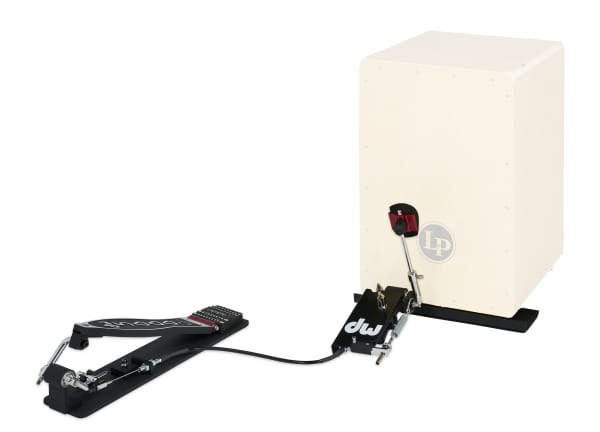
DW 5000CJ Cable Cajon Pedal
The 5000CJ is a cajon pedal: it lets you play the front face of the instrument with your foot while your hands keep playing. It first solves a geometry problem — the player sits on the box, and the area to strike is between their legs. A remote cable therefore separates the footboard, placed where your foot is comfortable, from the beater, placed where the sound is.
What sets it apart
- Cable drive, footboard and beater independent of each other
- Pivot Drive system with a smooth response
- Cajon platform with a tension-adjustable beater hub
- Soft-Touch beater that imitates the sound of a palm stroke
- Aluminum baseplate
- Compatible with nearly every cajon on the market
Separating the foot from the beater
On a cajon, the area that responds best is near the top of the front face. That is also where the player's hands are working. Setting a regular pedal in front of the instrument would force a choice between a comfortable foot position and the right striking point.
The cable removes that choice. The footboard goes where your leg falls naturally, including off to the side; the beater mounts independently on the face, at the height that sounds right.
What the cable costs and what it gives back
A flexible drive absorbs part of the motion: what your foot does arrives with a very short delay and a little roundness. The manufacturer speaks of a low-latency response, which is an honest way of saying it is not zero.
What you get in exchange is complete freedom of placement, and a setup that restricts neither how you sit nor what your hands play.
A beater that does not mark the face
The front face of a cajon is a thin wooden plate tuned by its tension. A hard felt beater would leave a mark on it within a few rehearsals and change its tone.
The supplied soft beater strikes with the roundness of a palm and draws out a full low end without punishing the plywood. The hub's tension adjustment also lets you set how hard it returns.
Specifications
| Drive | Remote cable |
|---|---|
| Mechanism | Pivot Drive |
| Mounting | External, platform on which the cajon rests |
| Beater adjustment | Offset hub, adjustable tension |
| Beater | Soft-Touch, tone close to a palm stroke |
| Base | Aluminum plate |
What it is for
- Cajon played in acoustic groups
- Percussionists who want both hands free for the high tones
- Coffee-house gigs and small stages
- Accompanying songs as a duo
- Drummers moving over to percussion who are used to a regular footboard
Compare with other manufacturers
Cajon pedals from other manufacturers:
| Manufacturer | Comparable model | What differs |
|---|---|---|
| Meinl | Cable cajon pedal | Beater and platform in a single piece |
| Schlagwerk | Cajon pedal | Strap mounting instead of a platform |
| Latin Percussion | Cajon pedal | Shorter stroke, simplified tension adjustment |
| Pearl | Cable cajon pedal | Single beater, no set of interchangeable faces |
Frequently asked questions
- Do I have to drill or modify my cajon?
- No. Everything mounts on the outside: the instrument rests on a platform and the beater is clamped against the face.
- Does a cajon pedal work with any cajon?
- The manufacturer states compatibility with nearly every model on the market. A cajon with very unusual dimensions should still be checked.
- Does the cable wear out?
- It is the part that works the hardest. A clean cable that is not kinked lasts a long time; avoid tight bends when you pack it away.
- Cable or direct link: what is the difference?
- The cable lets you place the footboard wherever you want, with a very slight delay. The direct link has no delay but dictates where the footboard goes.
Avis clients
Playing cajon with your foot? Tell us where you ended up placing the footboard.
Aucun avis pour le moment. Soyez le premier à partager votre expérience après votre achat.