
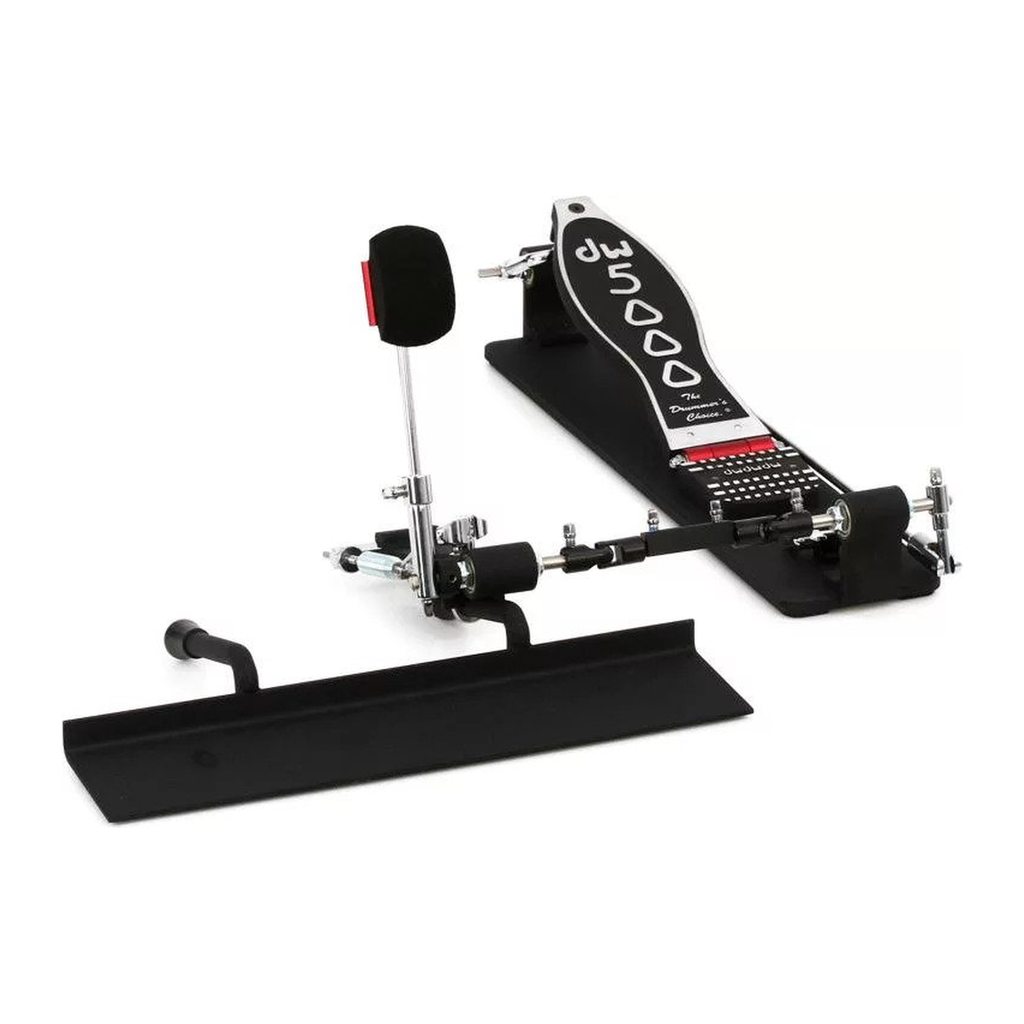
DW 5000CJDL Direct Link Cajon Pedal
The 5000CJDL is a direct link cajon pedal: a rigid linkage connects the footboard to the beater, with no cable in between. The manufacturer built it on the linkage from its double bass drum pedals, so your foot's motion reaches the face of the instrument intact, with no lag and no give.
What sets it apart
- Rigid linkage, direct transfer of your foot's energy
- Pivot Drive system, immediate response
- Glide Track drive
- Telescoping beater hub, to set the striking height
- Cushioned beater with a warm but articulate tone
- Built-in platform that holds the cajon
Rigid means accurate
A steel linkage does not stretch, give or flex. Everything your foot gives it goes to the beater at the same instant, with the same amplitude.
You feel it most on fast figures and very soft dynamics: the beater follows the small movements of the ankle that a flexible cable would round off. The player gets the same precision as a high-end bass drum pedal.
A telescoping hub, because no two cajons are alike
Rigidity has a price: the geometry becomes fixed and has to be adjusted to the instrument. Cajon heights vary, and the area that responds best is not in the same place from one model to the next.
Hence the telescoping beater hub: you extend or retract it until the beater lands right on the bass zone, then lock it. The adjustment is made once, at setup, and stays put.
A cushioned beater, and what it protects
The front face of a cajon is a thin wooden plate tuned by its tension. A hard beater would leave a mark on it within a few rehearsals and eventually change its tone.
The supplied cushioned beater strikes gently while keeping the articulation of the attack: the low end stays full, the outline of the note stays clear, and the plywood does not wear prematurely.
Specifications
| Drive | Direct link via rigid linkage |
|---|---|
| Origin of the mechanism | Linkage from the double bass drum pedals |
| Mechanism | Pivot Drive |
| Drive system | Glide Track |
| Beater hub | Telescoping |
| Beater | Cushioned, warm and articulate tone |
What it is for
- Percussionists who demand precision from the foot
- Fast figures and doubles on the face of the cajon
- Recording, where the attack has to stay clean
- Mixed cajon and drum kit playing in the same show
- Permanent setups, adjusted once and for all
Compare with other manufacturers
The direct link, as other manufacturers offer it:
| Manufacturer | Comparable model | What differs |
|---|---|---|
| Meinl | Direct drive cajon pedal | Fixed beater height, no telescoping hub |
| Schlagwerk | Direct pedal | Single beater fitted as standard |
| Pearl | Rigid cajon pedal | Platform built into the pedal's frame |
| Gibraltar | Direct percussion pedal | Intended for accessories more than for a tuned cajon |
Frequently asked questions
- What does a direct link add compared with the cable version?
- A truer feel. The rigid linkage holds nothing back and delays nothing, which you notice on fast figures and soft dynamics.
- How do you set the striking height?
- With the telescoping beater hub: extend or retract it until you find the spot that sounds best on the face, then lock it.
- Can the beater damage the cajon's face?
- It has a cushion, designed to protect the front plate of the cajon while keeping a clean attack.
- Does the cajon stay put while you play?
- A built-in platform holds it in front of the beater, which keeps it from sliding back under the strokes.
Avis clients
Switched from a cable pedal to direct link? Tell us what you gained.
Aucun avis pour le moment. Soyez le premier à partager votre expérience après votre achat.