
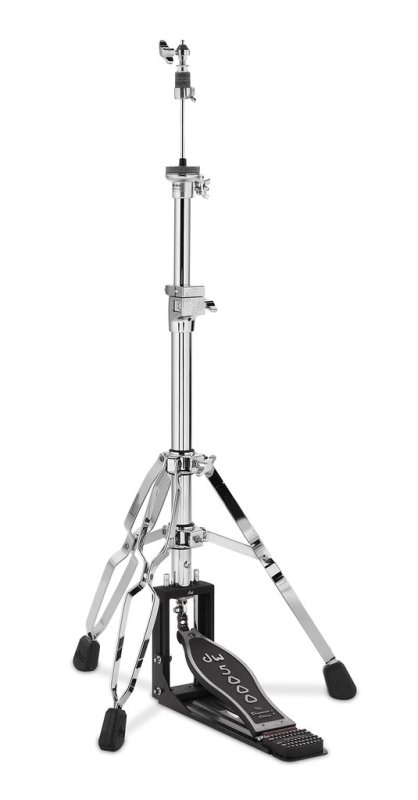
DW 5500D Hi-Hat Stand with Three Swivelling Legs
The 5500D is a three-leg hi-hat stand, with each leg rotating around the main tube. That independent rotation is what saves a tight setup: instead of moving the hi-hat to clear a cymbal stand, you swing the leg that is in the way and everything else stays put.
What sets it apart
- Three swivelling legs, each positioned separately
- Delta hinge with bearings on both sides of the axle
- Bearing connector between the chain and the pull rod
- Hinged memory locks, settings kept when you set up again
- Patented lateral adjustment of the cymbal seat
- Two pull rods included, 21 and 15 in
Three legs that move out of the way instead of claiming their spot
On a conventional stand, the legs sit 120 degrees apart and the whole thing occupies a fixed triangle. When a cymbal stand or the auxiliary pedal wants the same spot, you have to move the hi-hat back and rework the geometry of the whole kit.
Here, each leg rotates around the tube to the position you want. You can group two legs on one side to clear the other completely, while keeping the height and level of the hi-hat.
What bearings do for sensitivity
Between the footboard and the rod, the motion passes through a hinge and a linkage point. Those are the two places where friction builds up, and where a tired foot ends up no longer feeling what it is doing.
Ball bearings on both sides of the axle, plus a connector also mounted on a bearing, reduce that friction. The hi-hat then responds to small movements — a sustained half-open sound, a subtle sizzle at the end of a bar — that friction would swallow.
Two rods, two kit heights
The length of the pull rod sets the maximum usable height of the hi-hat. A short rod is enough for a drummer who sits low with cymbals close by; a long rod becomes essential when the hi-hat goes up to shoulder level.
Both lengths are included, so the question never comes up again if the kit changes. It is a detail you only really appreciate the day you raise the hi-hat by ten centimetres.
Specifications
| Number of legs | Three, swivelling |
|---|---|
| Hinge | Delta, bearings on both sides |
| Chain-to-rod linkage | Bearing connector |
| Setting memory | Hinged locks |
| Bottom cymbal seat | Patented lateral adjustment |
| Rods included | 21 in and 15 in |
What it is for
- Classic four- or five-piece kit, single pedal
- Tight setups where cymbal stands fight for space
- Nuanced hi-hat playing, half-open sounds and sizzles
- Shared stages, with settings kept from one night to the next
- Drummers who set the hi-hat high, at shoulder level
Compare with other manufacturers
Three-leg hi-hat stands from other manufacturers:
| Manufacturer | Comparable model | What differs |
|---|---|---|
| Tama | Iron Cobra Lever Glide | Swivelling legs as well, tension set by lever |
| Pearl | H-1030 | Direct drive, no chain |
| Yamaha | HS1200 | Base with three fixed legs, single rod |
| Gibraltar | 9707 | Cymbal seat angle set by a set screw |
Frequently asked questions
- Three-leg or two-leg hi-hat stand?
- Three legs give more stability. Two legs clear the area where the auxiliary pedal of a double pedal goes. If you do not play double pedal, three legs remain the better choice.
- Which of the two rods should I install?
- The shorter one for a low hi-hat, the longer one as soon as the height goes up. Too much rod sticking out above the cymbal is the sign it is time to switch.
- Do memory locks really make a difference?
- On a kit you take down often, yes: height and orientation come back without measuring, which saves long minutes at setup.
- What is the lateral cymbal seat adjustment for?
- To offset the bottom cymbal slightly so it does not close flat. Air escapes more easily and the sizzle gains definition.
Avis clients
How did you position the three legs in your setup?
Aucun avis pour le moment. Soyez le premier à partager votre expérience après votre achat.