
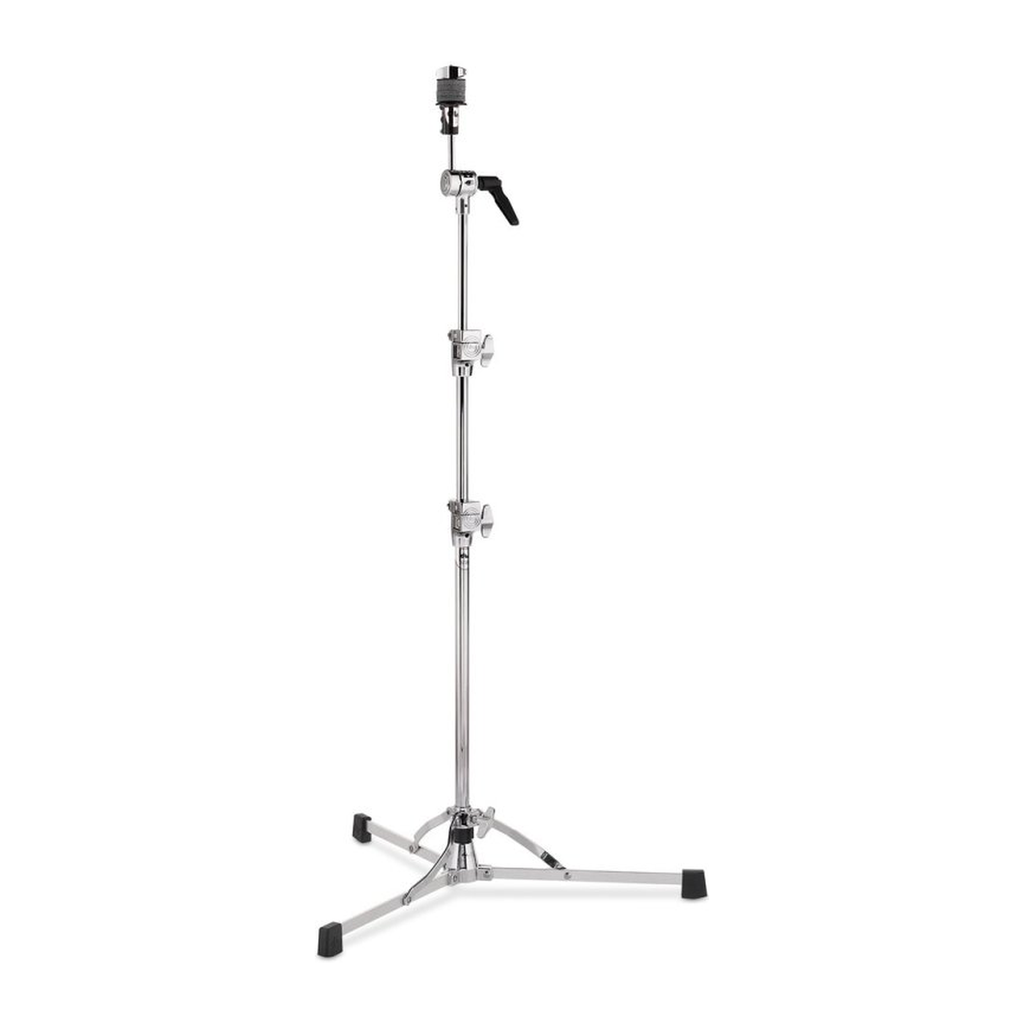
DW 6000 Flat-Base Straight Cymbal Stand
The DW 6710 is a straight cymbal stand with a flat aluminum base. The column rises straight above its three legs, which spread out at floor level: the cymbal's weight comes down the axis and nothing is cantilevered.
What sets it apart
- Straight column, cymbal weight in line with the stand
- Flat aluminum base, legs at floor level
- Toothless tilter with TechLock locking
- Patented adjustable cymbal seat, U.S. patent 4889028
- Wing nut and felts attached to the seat
- Hinged memory locks at the tube joints
In line: what the geometry gives you for free
When the cymbal sits directly above the column, all its weight goes straight down to the floor. No torque, no twisting, no need to compensate by pointing a leg in a particular direction.
That absence of stress lets the flat base do its best work. It can stay low and discreet because it is not asked to counter any leverage, only to hold a vertical load.
Three legs that get in nobody's way
A straight stand almost always ends up among other stands: between a tom stand and a hi-hat stand, or behind the snare. That is where the raised legs of an ordinary tripod cross with the neighbour's and keep you from getting down to the right height.
Flat legs slide underneath. The stand ends up where it really belongs rather than where the hardware leaves room for it, and that is what makes a tight kit playable.
What reaches the floor, and what does not
A straight column carries the cymbal's vibration down to the floor very directly. On a hollow stage, that can sometimes be heard as a dull rumble in the close mics.
The fix is well known and fits in one word: rug. It decouples the three legs from the floor without changing anything on the stand, and it takes care of slipping on a varnished stage at the same time.
Specifications
| Style | Straight |
|---|---|
| Base | Flat, aluminum |
| Tilt adjustment | Toothless, TechLock locking |
| Cymbal seat | Adjustable, U.S. patent 4889028 |
| Hardware | Attached wing nut and felts |
| Height memory | Hinged locks |
What it is for
- A ride cymbal set in its natural spot
- A vintage-style kit set up faithfully
- A stand placed between two stands already in position
- A stage where the footprint has to stay discreet
- A studio kit set up for the camera as much as for the sound
Compare with other manufacturers
The flat-base straight stand is back at several manufacturers:
| Manufacturer | Comparable model | What differs |
|---|---|---|
| Tama | The Classic Stand HC52F | Very light, compact straight stand with a vintage-style flat base |
| Ludwig | Classic Hardware LC25CS | Straight stand from the Classic line, built for transport |
| Tama | Spartan HC72S | Single-braced straight stand on a standard tripod, raised legs |
Frequently asked questions
- Can a flat base hold a heavy cymbal?
- In the straight position, yes: the weight comes down the axis and the base only takes a vertical load.
- Can I add a boom arm to it?
- This is a straight stand. The boom version in the same series is designed for cantilevered loads.
- Why is there a rumble in the close mics?
- A straight column carries vibration to the floor very well. A rug decouples the legs and makes the problem disappear.
- Do the felts stay with the stand?
- Yes. The wing nut and felts are attached to the cymbal seat and do not get lost at teardown.
Avis clients
Did this flat base solve a stand conflict on your kit? Tell us about it.
Aucun avis pour le moment. Soyez le premier à partager votre expérience après votre achat.