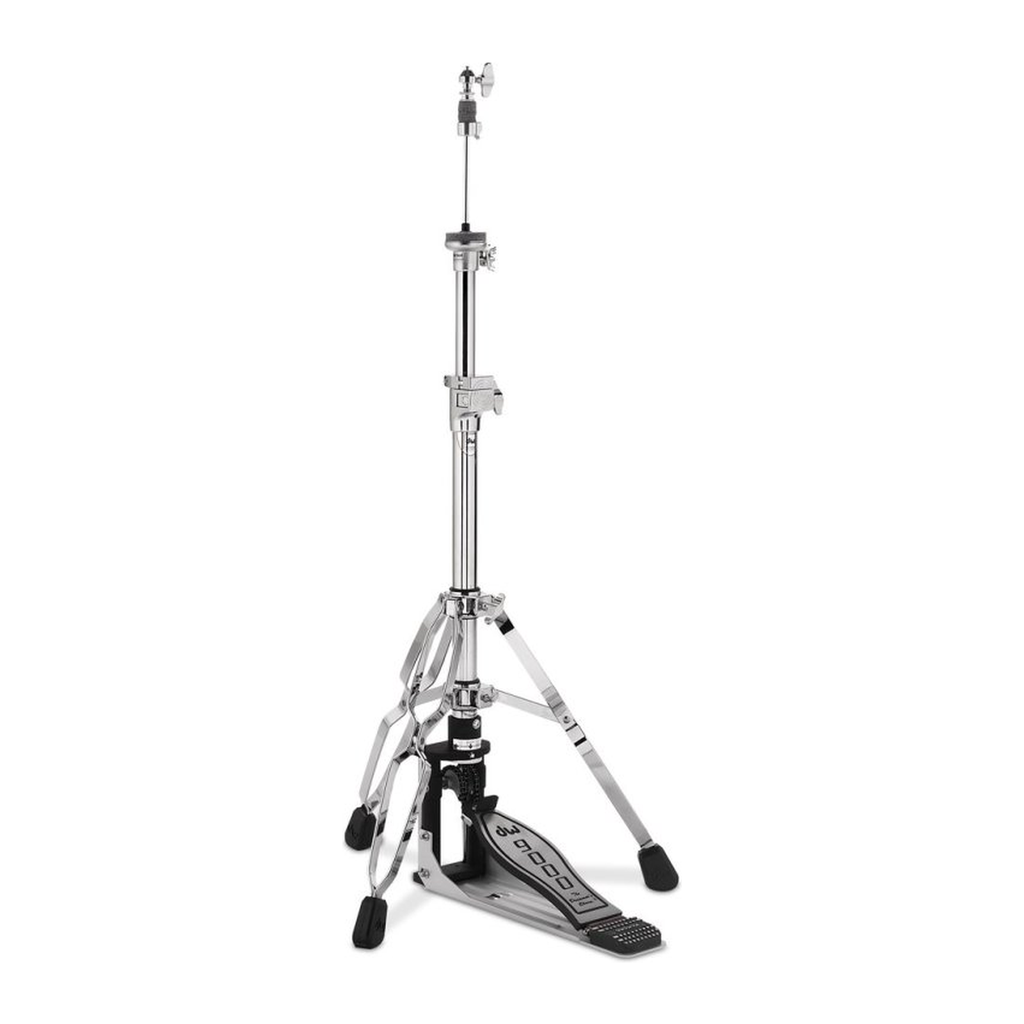
DW 9500D Three-Leg Hi-Hat Stand
The 9500D is a hi-hat stand with three swivelling legs. Each leg rotates around the centre tube, so you can spread them unevenly to make room for a pedal, a mic cable or another stand's leg, without losing any footing on the floor.
What sets it apart
- Three independently swivelling legs
- Patented double eccentric cam, U.S. Patent No. 5,266,733
- Infinitely adjustable, lockable spring tension
- One-piece folding footboard, U.S. Patent No. 5,105,706
- Side-mounted cymbal seat to tilt the bottom cymbal, U.S. Patent No. 6,570,075 B1
- Bearing hinge, U.S. Patent No. 5,431,081
- Two upper rods included, 21 in and 15 in
What a double eccentric cam does under your foot
On a hi-hat, the cam translates the footboard's travel into cymbal movement. The 9500D's cam is eccentric on two axes, and the manufacturer credits it with one specific thing: it increases the footboard's sensitivity relative to the cymbal's movement.
In practice, the drummer gets partial openings with very small movements. The spring tension, infinitely adjustable and then lockable, finishes the job by offsetting the weight of the top cymbal: that setting is what separates a hi-hat built for stage volume from one that can whisper.
Three legs that do more than stand up
A standard tripod locks its three legs at 120 degrees. On a crowded kit, one of the three always lands in the wrong spot: under the auxiliary pedal, on the snare stand's leg, across a cable.
Swivelling legs fix that without giving up stability: you group them to one side, push one close to the tube, and find three points of support somewhere else. On a shared stage riser, that freedom is worth more than an extra kilo of steel.
Two rods, two playing heights
The two upper rods included are not a spare part. The long one is for standard playing, hi-hat above the snare; the short one is for when the stand has to fit under a low cymbal or into a very tight kit. Swapping rods takes a minute.
Specifications
| Configuration | Three swivelling legs |
|---|---|
| Cam | Double eccentric, patented |
| Spring | Continuous tension, lockable |
| Upper rods | 21 in and 15 in |
| Bottom cymbal | Side-mounted tilting seat |
| Clutch | Locking, included |
What it is for
- The main hi-hat on a stage kit
- Crowded kits where the legs need to get out of the way
- Nuanced foot work, with half-open sounds
- Low setups, using the short rod
- Studio work, with fine adjustment of the bottom cymbal
Compare with other manufacturers
Other manufacturers' professional hi-hat stands:
| Manufacturer | Comparable model | What differs |
|---|---|---|
| Tama | Iron Cobra Lever Glide | Lever drive rather than chain over a cam |
| Pearl | Eliminator hi-hat | Interchangeable screw-in cams, response by parts |
| Yamaha | HS Series hi-hat stand | Legs fixed at 120 degrees on most versions |
| Sonor | 600 Series hi-hat stand | Thinner tube, much lighter overall |
Frequently asked questions
- What are the two included rods for?
- The long one for a normal playing height, the short one for a low or tight setup. One replaces the other.
- Can you adjust the tilt of the bottom cymbal?
- Yes, with the side-mounted seat. That setting is what makes the cymbals close evenly all the way around.
- Three legs or two: how do I choose?
- Three legs for maximum stability. Two legs if a double pedal has to go exactly where the third leg would sit.
- Is the clutch included?
- Yes, a locking clutch comes with the stand.
Avis clients
Are your half-open sounds easier to hold?
Aucun avis pour le moment. Soyez le premier à partager votre expérience après votre achat.