
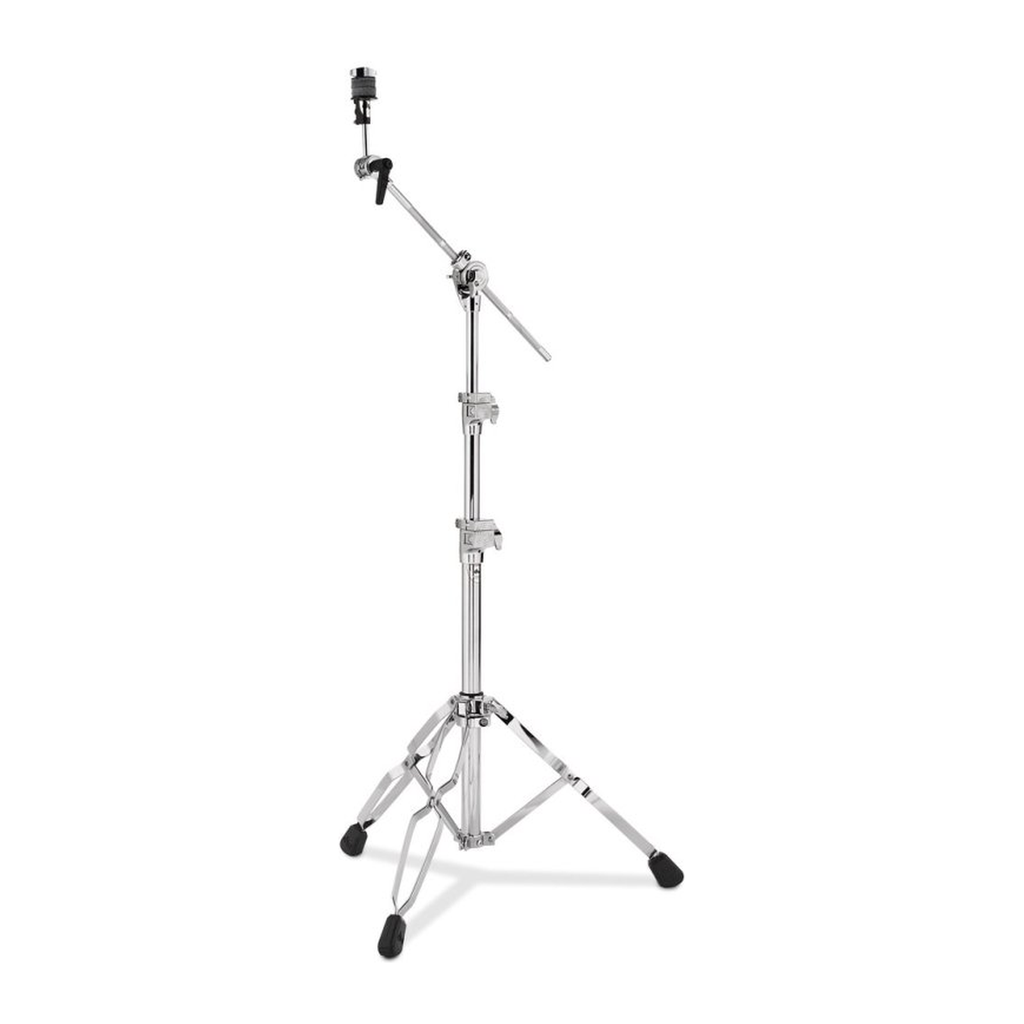
DW 9700 Convertible Straight/Boom Cymbal Stand
The 9700 is a convertible cymbal stand: slide the boom arm into the tube and it becomes a straight stand; pull it out, angle it, and it is a boom. A drummer who switches between Thursday's jazz trio and Saturday's rock band buys one stand instead of two.
What sets it apart
- Works as a straight or boom stand, on the same tube
- Toothless tilter, locked by the TechLock handle
- Patented adjustable cymbal seat, U.S. Patent No. 4,889,028
- Felt and wing nut attached to the seat, nothing to lose
- Hinged memory locks
- Plastic isolators against tube resonance
- Heavy-gauge steel
A toothless tilter, and what it changes for the cymbal
Most stands set the angle with a ratchet: the cymbal moves in steps, and the exact angle you wanted falls between two teeth. You end up choosing the least bad one.
A toothless tilter clamps by friction on a smooth surface: every angle is available. The TechLock handle then locks it in place, because friction alone would eventually slip under a heavy cymbal that is being hit hard.
The seat adjustment, often ignored, rarely useless
The patented cymbal seat sets how freely the cymbal can move, then locks at the value you find. More freedom, and the cymbal swings and rings longer; less freedom, and it is held back and its decay gets shorter.
It is a sound adjustment, not a mechanical one. On a crash that is too washy in a small room, a few millimetres are enough to get back some definition without changing cymbals.
A felt you can no longer lose
The top felt and wing nut are attached to the seat. It seems like a tiny detail until the night you are on your hands and knees under a riser looking for a felt, ten minutes before doors open.
Specifications
| Configurations | Straight or boom |
|---|---|
| Tilt | Toothless, TechLock handle |
| Cymbal seat | Adjustable, U.S. Patent No. 4,889,028 |
| Top felt | Built into the seat, wing nut included |
| Memory locks | Hinged memory locks |
| Anti-resonance | Plastic isolators in the tubes |
| Construction | Heavy-gauge steel |
What it is for
- Crash or ride, straight or offset
- Drummers who often change their setup
- Rental and loaner kits
- Stage use, with height memory locks
- Studio work, with sustain shaped by the seat
Compare with other manufacturers
Convertible stands from other manufacturers:
| Manufacturer | Comparable model | What differs |
|---|---|---|
| Tama | Roadpro convertible | Tilt by lockable ball joint |
| Pearl | 1030 Series convertible stand | Angle locked by a ring, no secondary handle |
| Gibraltar | 9600 Series convertible stand | Ratchet tilter, adjusted in steps |
| Yamaha | Crosstown cymbal stand | Aluminum frame, lower carrying weight |
Frequently asked questions
- How do you switch from straight to boom?
- The boom arm is stored inside the tube: you pull it out and angle it when you need it. That is what convertible means.
- Can the top felt get lost?
- No. The manufacturer builds it into the cymbal seat, wing nut included — one less part to look for under a riser.
- Does the seat adjustment really change the sound?
- It changes how freely the cymbal can swing, and therefore its decay. You hear it mostly on crashes.
Avis clients
Straight or boom: which do you use most often?
Aucun avis pour le moment. Soyez le premier à partager votre expérience après votre achat.