
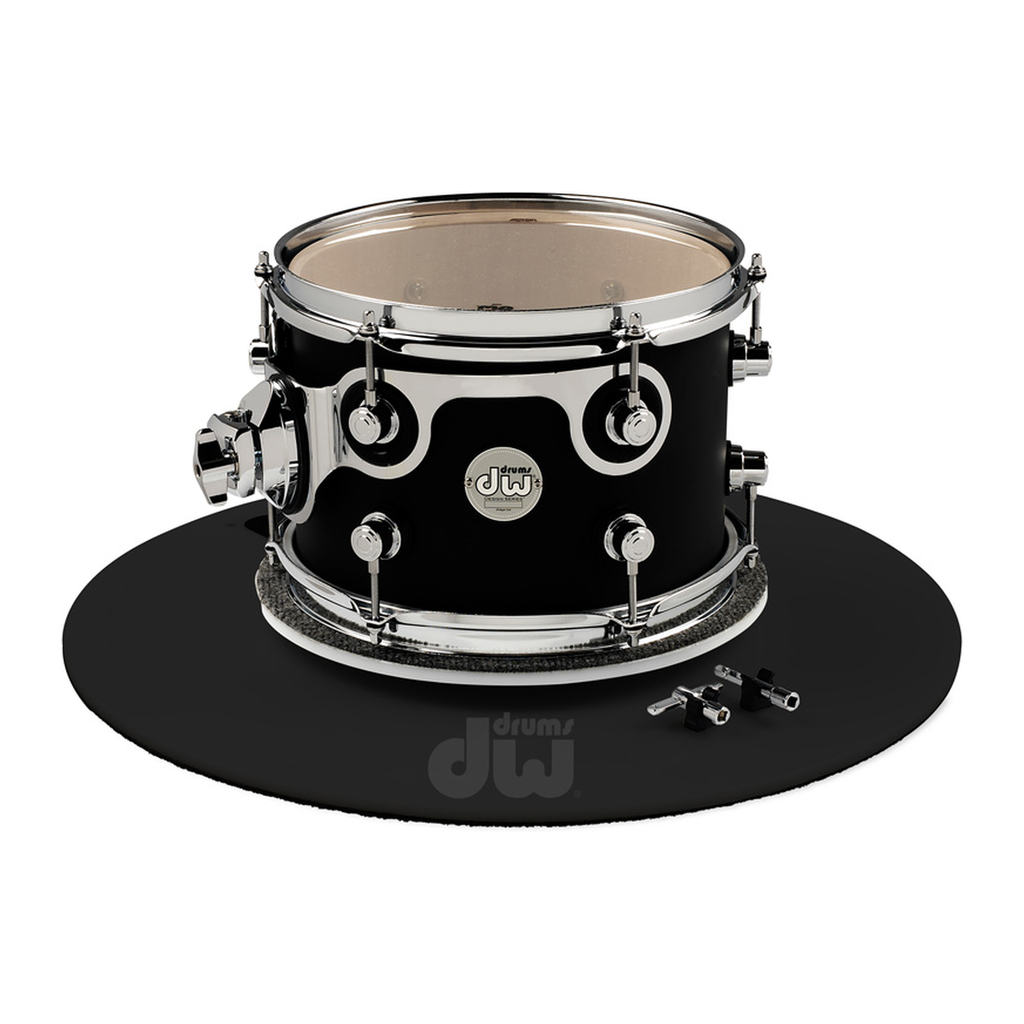
DW John Good Drum Tuning Table
The John Good drum tuning table is a 23-inch turntable in black Plexiglas, mounted on a ball-bearing pivot and covered with a padded surface. You set a tom or a snare on it, and the drum turns instead of the drummer.
What sets it apart
- 23 in top, in black Plexiglas
- Quality ball-bearing pivot, smooth rotation
- Soft, padded surfaces for the drum to rest on
- Drum keys included
- Carrying case included
Tuning means going around, again and again
Tuning a drum means moving from one tension rod to the opposite one, then starting over, often four or five times. Set on an ordinary table or on a rug, the drum forces you to walk around it, or to lift and turn it for every pair.
On a freely turning top, your hand stays where it is and the drum brings the next tension rod to you. What seems trivial on one drum becomes considerable on a full kit, where a serious tune-up adds up to dozens of full turns.
Why the padded surface changes what you hear
A drum sitting on the floor keeps its bottom head ringing. Every tuning tap wakes up that second head, whose resonances pile on top of the note you are trying to hear. Without knowing it, you are adjusting two things at once.
A soft surface damps the bottom head and isolates the one you are working on. The pitch you hear at each tension rod becomes that of the batter head alone, which makes the comparison from one rod to the next honest — and the whole tuning rests precisely on that comparison.
Twenty-three inches, drum keys and a case
Twenty-three inches is enough to take the common tom and snare sizes, with their hoops supported rather than hanging over the edge. The supplied drum keys spare you the silliest moment in drumming: owning a tuning table and looking for your key.
The case matters more than it seems for a Plexiglas top, a material that scratches from a single grain of dust caught between two surfaces. It also makes the tool portable, so it can be used backstage and not only at the shop counter.
Specifications
| Diameter | 23 in |
|---|---|
| Material | Black Plexiglas |
| Pivot | Ball bearings |
| Surface | Padded |
| Supplied with | Drum keys and carrying case |
What it is for
- A complete kit tune-up before a session
- Backstage tuning between sets
- Head changes, where every drum is tuned from scratch
- Teaching, to show the method rod by rod
- Drum techs and repair people who work on several drums a day
Compare with other manufacturers
Tuning tools from other manufacturers, and what they measure:
| Manufacturer | Comparable model | What differs |
|---|---|---|
| Tama | Tension Watch | Measures head tension, does not support the drum |
| Overtone Labs | Tune-Bot | Measures the pitch you hear, an electronic tool |
| DrumDial | Tension gauge | Mechanical measurement by deflection, no listening |
| Evans | Torque drum key | Controls tightening torque, not the drum's position |
Frequently asked questions
- What size drum can I put on it?
- The top measures 23 in, which covers the common tom and snare sizes. A bass drum is far larger than that.
- Is it really useful if I already tune by ear?
- The tool does not replace your ear: it gives it a cleaner signal. By muting the bottom head, it lets you hear the batter head alone, which makes the comparison between tension rods more accurate.
- Does the top turn freely under the weight of a drum?
- It sits on a ball-bearing pivot, chosen so it keeps turning under load.
- Do I need a measuring tool as well?
- No, but nothing stops you from combining both methods: the table handles the position and the listening, a measuring device adds a number.
Avis clients
How many times do you go around a drum to tune it?
Aucun avis pour le moment. Soyez le premier à partager votre expérience après votre achat.