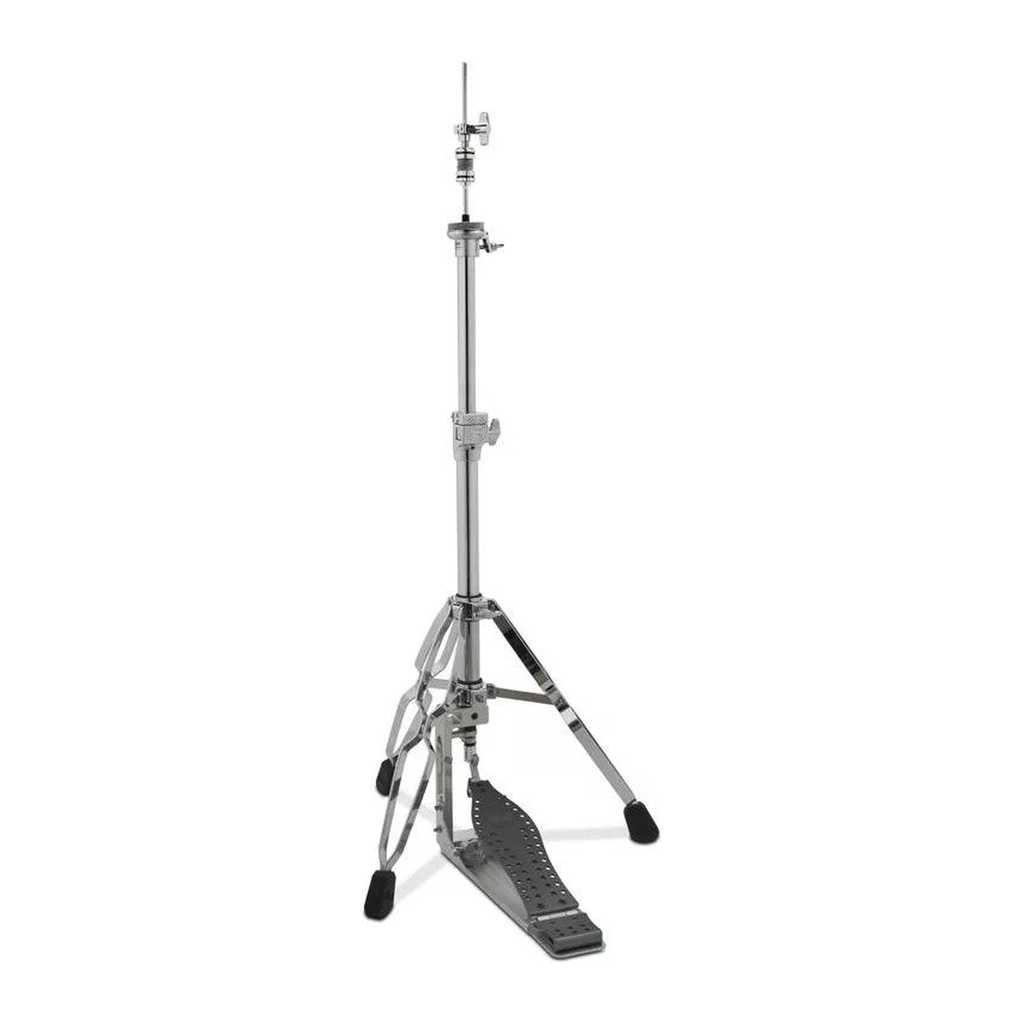
DW MFG MDD Three-Leg Hi-Hat Stand, Gun Metal
This three-leg hi-hat stand rests on a ball bearing hinge housed under its footboard. It is the most heavily used part of the whole stand: your left foot leans on it constantly, from the first song to the last, without ever leaving it.
What sets it apart
- Patented ball bearing hinge, under the footboard
- Interlocking parts, no play where the heel presses
- Cut-out footboard, machined from quality aluminum
- Gun Metal anodizing, matched to pedals from the same range
- Three-leg tripod base
- Patented clutch, operated in a single motion
The part that works hardest, and that nobody looks at
On a bass drum pedal, your foot leaves the footboard between strokes. On a hi-hat stand, it never leaves: it holds, half releases, picks up again, presses down firmly, keeps it closed for a full bar. The heel hinge absorbs all of that continuously.
An axle turning in a housing wears out exactly there. The play first shows up as a slight looseness, then as a small, sharp click on every release — the one you only hear once you play the take back in headphones. Ball bearings take that wear point out of the equation and keep the contact solid.
A footboard cut from solid stock, then lightened
The footboard is machined from quality aluminum, then cut out. The material removed carried no load: what remains is a rigid structure, lighter than the solid plate it came from.
On a hi-hat, a light footboard matters differently than on a bass drum. The left foot is not after power but finesse: the held half-open sound, the sharp chick, the slow return. Less mass to move means finer control, not a harder hit.
Gun Metal, and a setup that matches
This range comes in four anodized finishes, and the hi-hat stand is offered in each of them. The reason is practical: a drummer who chose a Gun Metal double pedal does not want to see a hi-hat stand in another colour fifty centimetres away from it.
This piece also stands taller than the pedals: its column reaches chest height, in line with the left arm. Whatever finish it carries is therefore more visible than what stays on the floor.
Specifications
| Type | Hi-hat stand |
|---|---|
| Frame | Three legs |
| Hinge | Ball bearings, interlocking parts |
| Footboard | Cut-out aluminum, machined |
| Clutch | Patented, single-motion operation |
| Finish | Anodized Gun Metal |
What it is for
- Steady left-foot playing over long sets
- Recording, where mechanical noises show up in the headphones
- Uneven floors, where the tripod keeps all three feet down
- A Gun Metal setup, matched to pedals from the same range
- Replacing a hi-hat stand that has gone loose at the heel
Compare with other manufacturers
How other manufacturers build the heel pivot on a hi-hat stand:
| Manufacturer | Comparable model | What differs |
|---|---|---|
| Yamaha | HS1200T | Conventional axle hinge, stamped heel plate |
| Tama | Iron Cobra Lever Glide | Bushing-type joint, cast footboard |
| Pearl | Eliminator Redline H-1050 | Double-braced base, Redline footboard with a grippy surface |
| Gibraltar | 9707 Series hi-hat stand | Assembled construction, spare parts easy to find |
Frequently asked questions
- What does a bearing hinge do on a hi-hat stand?
- It removes play at the spot where your heel presses constantly. That is where the looseness and the little click you hear on recordings come from.
- Three legs or two: how do I choose?
- Three legs hold better on an uneven floor. Two legs leave room for a double pedal under the hi-hat.
- Is a cut-out footboard slippery?
- No. The edges of the openings create grip points, which actually help your foot stay in place.
- Does this finish come on pedals from the same range?
- Yes, the four anodized finishes cover the manufacturer's entire machined range.
Avis clients
Has your hi-hat stand developed play at the heel?
Aucun avis pour le moment. Soyez le premier à partager votre expérience après votre achat.