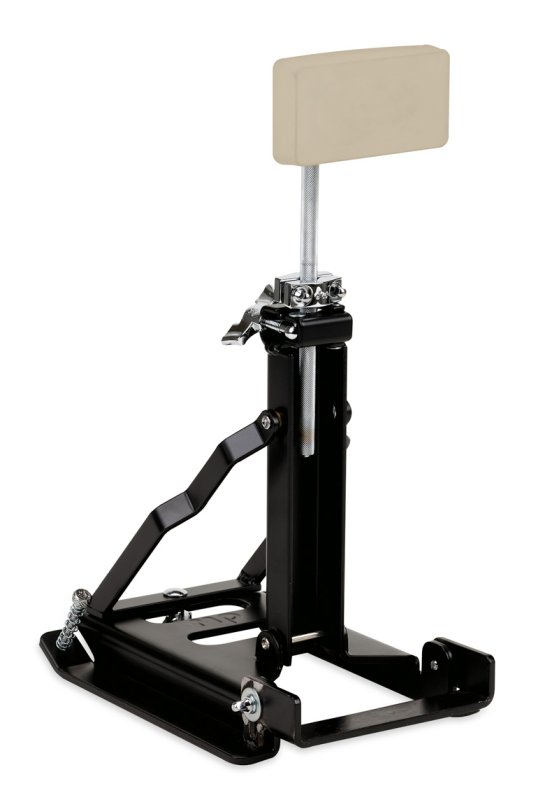
DW Steve Smith Bass Drum Practice Pad
The Steve Smith practice pad is a bass drum practice base you mount your own pedal on, single or double, to work on your foot without setting up a drum. The right foot is the limb drummers practise least, precisely because it is the only one that needs a bass drum: this pad puts an end to that excuse.
What sets it apart
- Steve Smith signature model
- Takes a single pedal as well as a double pedal
- Realistic feel, according to the manufacturer
- Sturdy build, ready for the road
- Compact format, ready to use right away
- Bass drum pedal: it is your own that goes on it
Working on the limb you neglect
A drummer who wants better hands grabs a pad and sticks. A drummer who wants a better foot has to set up a bass drum, which means finding a room, which means finding a time when the noise will not bother anyone. The result: the foot progresses much less than the hands, and you can hear it.
This pad turns that equation around. It sits on the floor, takes the pedal you already use, and lets you hear each stroke without making it loud. Exercises for evenness, doubles and heel-toe become something you can do in the evening, in an apartment, between other things.
Keeping your own pedal, and why it matters
You mount your own pedal on it, and that is a sound choice rather than a way to save money. Practising on a different pedal from the one you use on stage means improving on the wrong instrument: spring tension, cam profile and footboard length add up to a specific feel that your foot adapts to.
By bolting on your own pedal, you work on exactly the mechanism you will find again at the gig. The gain in consistency then carries over completely.
What it really lets you work on
Four areas suit this format well. Metronomic evenness on quarter notes held for a long time, the foundation of everything. Heel-toe doubles, which take weeks. Independence between both feet if you mount a double pedal. And control of soft dynamics, which you never work on with a real bass drum because the volume gets in the way.
What it does not replace, on the other hand, is the response of a head under the beater. The work carries over; the feel still needs recalibrating.
Specifications
| Use | Foot practice without a bass drum |
|---|---|
| Pedals accepted | Single or double |
| Pedal | Your own, single or double |
| Construction | Sturdy, travel-ready |
| Size | Compact |
| Setup | Immediate |
What it is for
- Foot practice in an apartment, without disturbing anyone
- Warming up backstage before going on
- Heel-toe and double-stroke exercises
- Independence work with a double pedal mounted
- Keeping your technique up on tour, in a hotel room
Compare with other manufacturers
Other manufacturers offering a practice surface for the foot:
| Manufacturer | Comparable model | What differs |
|---|---|---|
| Vic Firth | Bass drum pad | Pad placed in front of the pedal, with no dedicated frame |
| Evans | RealFeel pedal pad | Rubber surface only, to be braced against a wall |
| Gibraltar | Practice pad on stand | General-purpose stand, not designed specifically for the foot |
| Remo | Tensioned-head practice pad | Real drumhead response, larger footprint and higher cost |
Frequently asked questions
- Which pedal goes on it?
- Yours. The pad takes a single pedal as well as a double pedal, and that is the whole point: you practise with the feel you play with at gigs.
- Does it work with a double bass drum pedal?
- Yes. The pad is designed to take a single pedal as well as a double pedal.
- Is it really quiet?
- Each stroke can still be heard up close, but it is nothing like a bass drum. Evening practice becomes possible.
- Does it replace practising on the kit?
- No. It builds technique; the response of a head under the beater gets recalibrated on the drum kit.
Avis clients
How many minutes a day do you spend working on your foot?
Aucun avis pour le moment. Soyez le premier à partager votre expérience après votre achat.