DW Bass Drum Beater — Large Felt Head
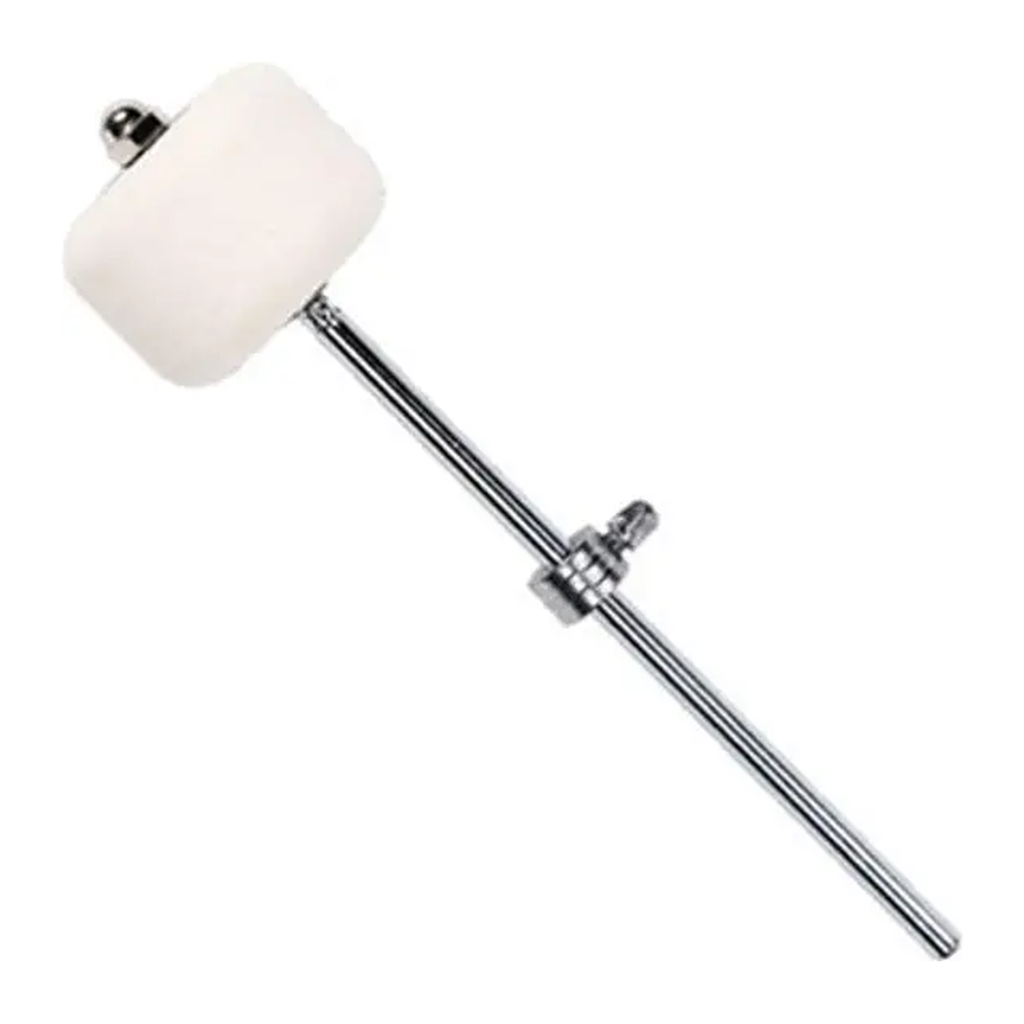
This beater carries a large white felt head. Size is the whole story: the wider the surface that meets the head, the more the impact spreads, and the more the note leans toward the low end rather than the point of attack.
What sets it apart
- White felt head, the largest size in the lineup
- Wider contact surface, impact spread over a larger area
- Fundamental brought forward, attack deliberately soft
- Shaft weight included
- A single striking surface: nothing to flip mid-gig
What contact width does to the note
A bass drum head responds differently depending on the surface that strikes it. A small head concentrates all the energy on a few square centimetres: the drumhead dips quickly and sharply at that spot, and the result is a very audible point of attack.
A large head pushes the drumhead over a wide area. The motion is broader and less abrupt, the click of the contact recedes, and the drum's fundamental takes over. It is a sound choice before it is a material choice: the same felt, in a smaller size, would sound different.
The music that calls for this kind of note
A bass drum tuned low, lightly muffled, played in a band that leaves room at the bottom: big band jazz, gospel, roots music, singer-songwriter accompaniment. There, a clicky attack would be out of place.
Conversely, a heavily muffled bass drum played in a loud band will swallow this beater without a trace. The right head is the one that makes up for what tuning and muffling do not provide — and here, what it provides is body.
One surface, and wear that stays even
With no second face, there is nothing to decide at setup and nothing that shifts during the night. The head always strikes on the same side, which also means its wear is spread over a single area and stays predictable.
Felt holds up over time: it compresses slowly, without cracking or flaking. A large head takes even longer to wear a dent, since it offers more material at the same spot.
Specifications
| Head | White felt, large size |
|---|---|
| Striking surface | Single |
| Character | Pronounced low end, soft attack |
| Weight | Shaft weight included |
| For use with | Bass drum pedals |
What it is for
- Bass drums tuned low and lightly muffled
- Jazz, gospel and large acoustic ensembles
- Recording that calls for body rather than a point of attack
- Drummers who find their bass drum too clicky
- Replacing a small felt head flattened by use
Compare with other manufacturers
Large felt beaters from other manufacturers:
| Manufacturer | Comparable model | What differs |
|---|---|---|
| Vic Firth | Large-head felt beater | The manufacturer's own felt density and head mass |
| Tama | Pro series felt beater | Mid-size head, slightly more defined attack |
| Pearl | Round-head felt beater | Spherical shape, narrower contact area |
| Gibraltar | Standard felt beater | Lighter head, less inertia at the end of the shaft |
Frequently asked questions
- Does a larger head hit harder?
- Not necessarily. It spreads the energy instead of concentrating it: perceived volume changes little, but the balance of the sound shifts toward the low end.
- Do I need an impact patch on the drumhead?
- With a felt head, wear is slow. A patch is still worth having if the same drumhead is used for years.
- How can I tell if my bass drum needs more body?
- If the drum sounds hollow in the headphones while the beater's contact is clearly audible, the attack is overpowering the fundamental.
- Can I use this beater on a double pedal?
- Yes, as long as you fit two identical ones. Two different head sizes on the same drumhead are immediately audible.
Avis clients
Is your bass drum short on body or attack?
Aucun avis pour le moment. Soyez le premier à partager votre expérience après votre achat.