
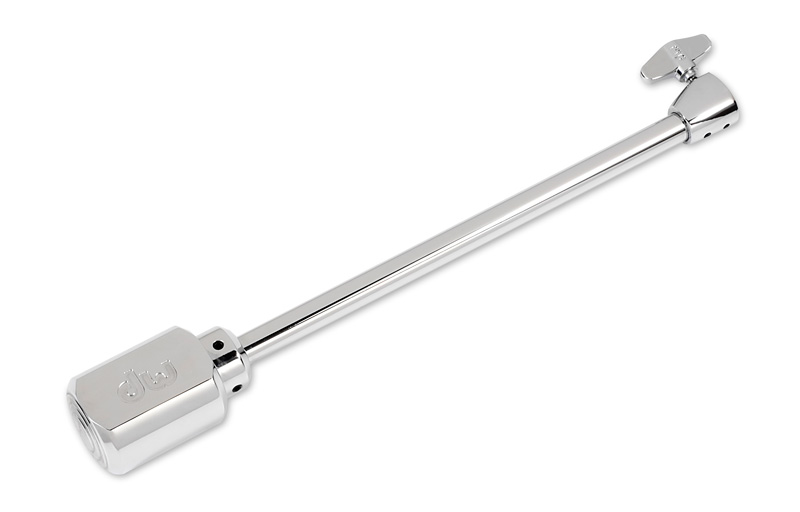
DW DWSM2030 Cymbal Boom Arm Counterweight
A boom arm extended far out turns a cymbal stand into a lever, and the lever always wins: the base lifts on one side, and the stand walks with every stroke. This counterweight mounts on the back end of the boom arm and puts the mass back on the right side of the pivot.
What sets it apart
- Mounts on the back end of a 1/2 in diameter boom arm
- Lets you extend the boom arm without the stand tipping
- Designed for 9000 series cymbal stands
- Makes far-reaching cymbal placements practical
- Extends the usable boom length while keeping the stand balanced
- Adds on to any DW 9000 series cymbal stand
The problem is not the cymbal's weight, it is the leverage
An 18 in crash cymbal weighs a little over a kilo. Set fifteen centimetres from the stand's centre tube, it bothers no one. Set seventy centimetres out, it puts four to five times more torque on the pivot.
That torque is not fought by tightening harder: it is offset by a mass placed on the other side of the pivot. That is the counterweight's entire job, and it is why a heavier base makes little difference.
What balance changes in your playing, not just in stability
A stand that walks does more than move: it absorbs some of the energy of the stroke and makes the cymbal's response unpredictable. The drummer compensates without thinking, hits harder, and tires the wrist.
Once the boom arm is balanced, the cymbal returns to the same spot after every stroke. The motion becomes consistent again, and the cymbal sounds the same way twice in a row.
Freeing up space around the drummer
Once balanced, a stand will take a longer boom arm. Its centre tube can move back, out of the way of arms and feet, while the cymbal stays exactly where it needs to be.
On a crowded setup — two bass drums, several toms, effects cymbals — it is often the only way to fit everything in without the bases overlapping.
Specifications
| Function | Boom arm counterweight |
|---|---|
| Boom arm diameter | 1/2 in |
| Stands | DW 9000 series cymbal stands |
| Mounting | On the back end of the boom arm |
| Finish | Chrome |
What it is for
- Cymbal placed far from the stand's centre tube
- Crowded setup where the bases get in each other's way
- Heavy cymbal on a boom arm that is already extended
- Stand that creeps over the course of a gig
- Placing a cymbal over a floor tom or a rack
Compare with other manufacturers
Counterweights and balancing solutions from other manufacturers:
| Manufacturer | Comparable model | What differs |
|---|---|---|
| Gibraltar | Boom arm counterweight | Thumbscrew clamping on boom arms of various diameters |
| Pearl | Eliminator series counterweight | Sold mainly with the brand's long boom stands |
| Tama | Roadpro boom arm counterweight | Fixed mass designed for the series' tripod bases |
| Yamaha | 900 series boom arm counterweight | Matched to the brand's own boom arm diameter |
Frequently asked questions
- Do I need a counterweight if the boom arm is short?
- Rarely. The need appears when the cymbal moves away from the centre tube: it is the distance, far more than the cymbal's weight, that throws the balance off.
- Will it fit a boom arm of a different diameter?
- It is made for a 1/2 in boom arm. On a different diameter, it will not clamp properly and can slip while you play.
- Can I put two on the same boom arm?
- Nothing prevents it mechanically, but one well-placed counterweight is almost always enough; doubling the mass mostly makes the stand heavier to carry.
- Does it replace a sandbag on the base?
- No, the two work differently. Weight on the floor keeps the whole stand from sliding; the counterweight keeps the boom arm from tipping the stand over.
Avis clients
Does your cymbal stand walk as soon as the boom arm goes out?
Aucun avis pour le moment. Soyez le premier à partager votre expérience après votre achat.