
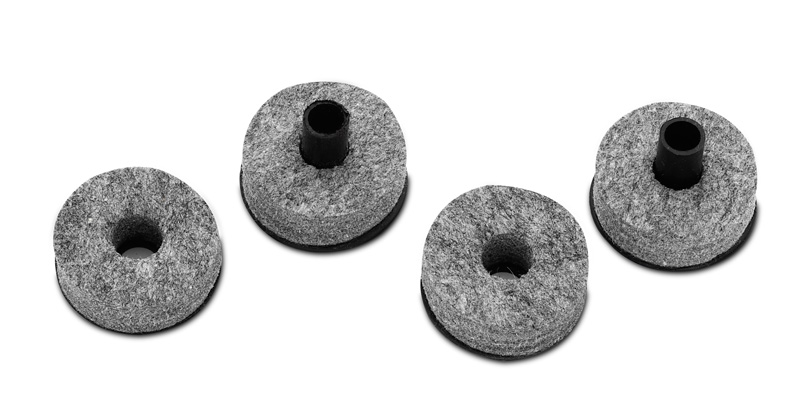
DW DWSM488 Cymbal Felts with Seat, Pair
A cymbal crack almost always starts at the centre hole, where metal touches metal. These cymbal felts and the plastic seat that comes with them sit between the cymbal and the rod, and that is all that separates a well-kept cymbal from one you have to replace.
What sets it apart
- Top felt and bottom felt, the complete pair
- Plastic cymbal seat and washer included
- Prevents direct contact between the cymbal and the stand
- Felt designed for DW cymbal boom arms
- Pack of two, enough for two boom arms or to keep a spare set
- The cheapest wear part in your setup, and the most decisive
What cracks a cymbal, and when
A cymbal's metal works with every stroke: the disc flexes, returns, flexes again. If the centre hole rests on a bare rod or a metal washer, every oscillation marks the edge of the hole.
Those marks become starting points. A crack that starts at the centre is almost never a playing accident: it is the slow result of mounting without a felt or seat, or of a crushed felt that was never replaced.
The crushed felt, a defect you cannot see
A new felt is soft and thick. After two or three years, sweat, heat and constant compression pack it down: it becomes hard and thin, and stops cushioning. From a distance it is still there; mechanically, it no longer does anything.
The test takes one gesture: pinch the felt between two fingers. If it barely compresses, it is dead. For a part this inexpensive, hesitating makes no sense next to the cost of a cymbal.
The felt also shapes the sound
Beyond protection, the thickness of the top felt determines how freely the cymbal can swing. Clamped between two hard felts, a crash opens up less, decays faster and sounds shorter.
Set on soft felts and left free, the same crash blooms. It is the simplest and most neglected adjustment in the whole cymbal setup.
Specifications
| Contents | Top felt and bottom felt |
|---|---|
| Included | Plastic cymbal seat and washer |
| Quantity | Pack of 2 |
| Designed for | DW cymbal boom arms |
| Role | Isolate the cymbal from the stand's metal |
What it is for
- Replacing packed-down felts on a cymbal stand
- Protecting a new cymbal from the first time it is mounted
- Spare set to keep in your emergency kit
- Reconditioning a used cymbal stand
- Adjusting the swing of a crash that is held too tight
Compare with other manufacturers
Cymbal felts and seats from other accessory manufacturers:
| Manufacturer | Comparable model | What differs |
|---|---|---|
| Gibraltar | Bagged cymbal felts | Sold in bulk, one density for all stands |
| Cympad | Cellular foam washers | Cellular foam instead of felt, several calibrated thicknesses |
| Danmar | Cymbal felts and seats | Range focused on repair parts and older dimensions |
| Pearl | Parts range felts | Sizes matched to the brand's own rods and nuts |
Frequently asked questions
- How often should I replace cymbal felts?
- As soon as they no longer compress between your fingers. With regular playing, that happens in two to three years; on tour, much sooner.
- Is the plastic seat really necessary?
- Yes. It is what keeps the cymbal's hole from rubbing on the threaded rod, and that rubbing is what starts most centre cracks.
- Should I tighten the wing nut all the way down on the felt?
- Definitely not. The cymbal needs to be able to tilt freely. Tightening all the way restricts the movement, shortens the sound and concentrates stress at the centre.
- Can I stack two felts to change the sound?
- Yes, it is a common adjustment. More material under the cymbal raises it and changes its swing angle; judge the effect by ear.
Avis clients
Do your felts no longer compress between your fingers?
Aucun avis pour le moment. Soyez le premier à partager votre expérience après votre achat.