
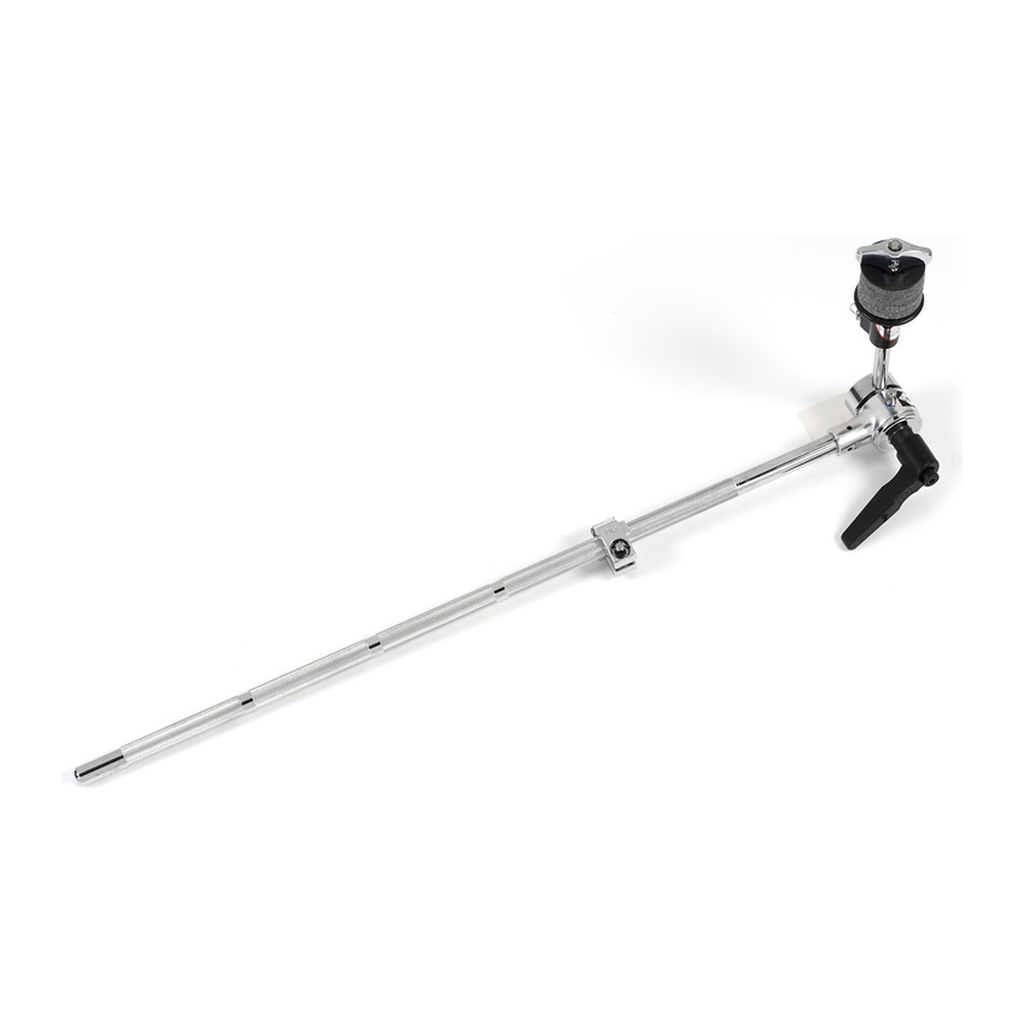
DW SM912L Cymbal Boom Arm, 22 in
The SM912L is a 22 in cymbal boom arm that puts a cymbal where no stand can go. Its 1/2 in knurled rod fits a boom tilter, a DogBone or the eyebolt of a Mega Clamp: instead of buying another stand, you extend the one already in place.
What sets it apart
- 1/2 in knurled rod, 22 in long
- Toothless tilter: the angle is set continuously, not notch by notch
- Memory lock included, to find the exact height again at setup
- Fits a boom tilter, a DogBone or a Mega Clamp eyebolt
- Long enough to reach over a floor tom or a rack bar
When 18 in is no longer enough
The standard length of a boom arm solves most cases: shifting a crash 30 cm over a tom, opening an angle to clear a drum. Then there is the situation where the stand cannot get any closer — a floor tom takes the floor space, a rack bar is in the way, a keyboard eats up the room on the left.
Four more inches is exactly what separates a cymbal placed in the right spot from a cymbal placed wherever there was room left. The SM912L exists for that last stretch and nothing else: on a setup that does not need it, the extra length just becomes needless overhang.
Overhang, and how to compensate for it
The farther the cymbal sits from the stand's column, the more it weighs on the base. This is not about the arm's strength: it is leverage. A solid hit on a cymbal at the end of 22 in will move the stand if nobody thought about how the legs are oriented.
The fix takes two seconds: turn the base so that one leg sits under the cymbal, in line with the arm. The load then goes straight into the floor instead of tipping the column. On a double-braced stand it is even simpler: the two front legs are enough.
A toothless tilter, and what it changes for your ear
A ratchet tilter imposes its positions: you land right on one, or half a notch off, and the cymbal does not respond the same way. Without teeth, the angle is chosen continuously and locks wherever you leave it.
For a ride placed far away, that angle is a matter of articulation: two or three degrees change where the stick meets the metal, and so how clearly the pattern speaks. It is the kind of setting you look for once and then want to find again — hence the memory lock that comes with it.
Specifications
| Arm length | 22 in |
|---|---|
| Rod | 1/2 in, knurled over the full usable length |
| Tilt adjustment | Toothless tilter |
| Included | One memory lock |
| Mounting points | Boom tilter, DogBone, Mega Clamp eyebolt |
What it is for
- Bringing a crash over a floor tom
- Placing a ride above a crowded rack bar
- Opening up a setup on the left when a keyboard takes the floor
- Extending a stand already in place instead of adding one
- Mounting a cymbal on a DogBone already installed
Compare with other manufacturers
Most hardware manufacturers make long boom arms; here is what sets them apart from this one:
| Manufacturer | Comparable model | What differs |
|---|---|---|
| Tama | Boom arms from its cymbal attachments | Smooth or knurled rod depending on the line, tilter often ratcheted |
| Gibraltar | Boom arms from its multi-clamps | Shorter lengths in the current catalogue |
| Yamaha | Boom arms from its cymbal stands | Designed for the brand's own stands, with different standard fittings |
| Pearl | Boom arms from its cymbal adapters | Tilting systems specific to the brand |
Frequently asked questions
- Will it fit any cymbal stand?
- It fits wherever a receiver accepts a 1/2 in rod: boom tilter, DogBone, Mega Clamp eyebolt. A stand designed for a rod of another diameter will not take it without an adapter.
- Do I need a counterweight on the end of the stand?
- Not on a properly oriented stand. What matters first is that one leg of the base sits under the cymbal. A counterweight helps when the cymbal is heavy and the arm is working almost horizontally.
- Is the memory lock really useful?
- Yes, as soon as you tear down. Once the height is set, the lock holds it: at the next setup, you lower the arm until it stops and the setting is back without measuring.
- Can I use it for something other than a cymbal?
- Yes, as long as the load stays reasonable. The arm takes anything that mounts on a threaded cymbal rod; a tom, on the other hand, needs an L-arm and a clamp designed for it.
Avis clients
A cymbal placement that gave you a hard time?
Aucun avis pour le moment. Soyez le premier à partager votre expérience après votre achat.