
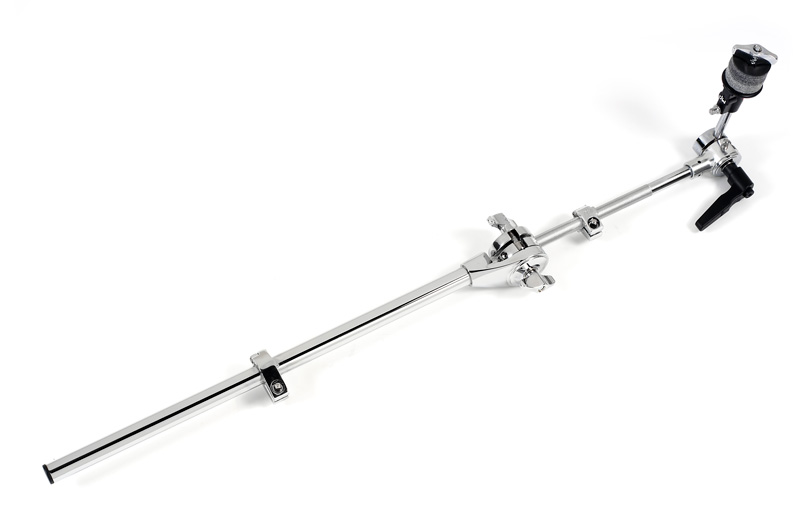
DW SM934 Cymbal Boom Arm and 3/4 in × 18 in Tube Set
The SM934 is a cymbal station set: the brand's standard 912 cymbal boom arm and its 3/4 in × 18 in support tube, matched at the factory. What you are buying here is not one more arm, but the column it was missing.
What sets it apart
- 3/4 in support tube, 18 in long
- Standard 912 boom arm, factory-matched to the tube
- The thicker tube resists twisting better than a plain rod
- Fits any clamp that accepts a 3/4 in tube
- Gives a cymbal station its height without a base on the floor
A clamp alone cannot hold a cymbal
A clamp grips a bar or a stand and offers a receiver. Between that receiver and the cymbal, the height is always missing, and the tube is what provides it.
Without it, you end up mounting an arm right at the clamp, and so placing the cymbal at the level of the bar — which is almost always too low and in the way of whatever is already mounted.
Why 3/4 in and not a thin rod
The tube's diameter decides how much it twists. A thin rod twists under the weight of a cymbal set out on an overhang: the cymbal slowly turns during the gig and the setting drifts away.
A 3/4 in tube resists that motion far better. That is why the lower section of a cymbal station is always thicker than the arm at its end: each section carries what sits above it, and no more.
Eighteen inches, the height that makes up for a rack
A rack bar or a stand's body usually sits well below striking height. Eighteen inches of tube cover that gap and still leave room to tilt.
That way you climb from a clamp set at mid-height to a realistic cymbal height, without adding a full stand on the floor — and so without adding another base in a space that is already crowded.
Specifications
| Support tube | 3/4 in diameter, 18 in long |
|---|---|
| Arm supplied | Standard 912 boom arm |
| Role | Creating a cymbal station from a clamp |
What it is for
- Creating a cymbal station on a rack bar
- Adding a cymbal from a clamp fixed on an existing stand
- Gaining height without adding another base
- Stabilizing a cymbal that kept twisting on a rod that was too thin
- Mounting a complete station in a setup with a crowded floor
Compare with other manufacturers
Tube and boom arm sets look alike from one manufacturer to another; the detail that matters is the tube diameter:
| Manufacturer | In-house solution | The difference |
|---|---|---|
| Gibraltar | Accessory tubes with tilter | Several diameters in the catalogue, to match yourself |
| Pearl | Cymbal extension tubes | Designed around the brand's own receivers |
| Tama | Short tubes from its cymbal attachments | Sets often shorter, intended as add-ons |
| Yamaha | Cymbal stand extensions | Designed first for the brand's own stands |
Frequently asked questions
- Do I need a clamp as well?
- Yes. The set provides the tube and the arm; it needs an anchor point, meaning a clamp tightened on a rack bar or on a stand's body.
- Which clamp accepts a 3/4 in tube?
- Any clamp whose receiver covers that diameter. The V-clamps in the line accept 1/2 in to 1.25 in, which includes 3/4 in.
- Is it more stable than an arm mounted on its own?
- Clearly, because the load-bearing section is thicker. Twisting, which makes a cymbal turn while you play, almost always comes from the thinnest section.
- Can it be shortened?
- You do not cut the tube; you slide it further into the clamp. That is the normal adjustment: the length outside the clamp is chosen at setup.
Avis clients
Building a rack and short one cymbal station?
Aucun avis pour le moment. Soyez le premier à partager votre expérience après votre achat.