
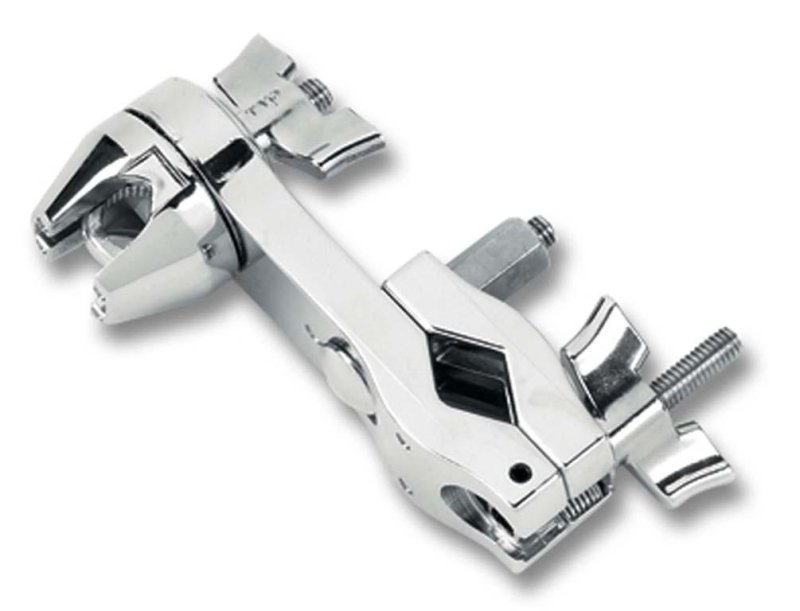
DW SMMG-3 Mega Clamp, V-Clamp to Eyebolt
The SMMG-3 multi-clamp bridges two systems that do not talk to each other: the V-clamp, which takes a tube, and the eyebolt, which takes the smooth rod of a cymbal arm. Its V-clamp adjusts in angle, and a V memory lock comes with it.
What sets it apart
- An angle-adjustable V-clamp on one side
- An eyebolt on the other, for an arm rod
- One V memory lock included
- Turns a tube anchor point into an arm anchor point
- The orientation is chosen before the rod is tightened
- Chrome finish
Two ways of holding, two parts to reconcile
A V-clamp closes around a tube and holds it by pressure on its circumference. An eyebolt lets a rod pass through and locks it with a screw. Both systems are excellent, but they do not take the same thing.
A boom arm has a rod: it needs an eye. A bar has a diameter: it needs a V. This part puts the two back to back, which lets you mount an arm where there was only a tube.
Angle first, rod second
The V-clamp can be oriented. So you fit it first, choose the general direction, tighten — and only then slide the arm's rod into the eye.
That order avoids the classic mistake of adjusting everything at once, loosening everything because one part will not line up, and losing along the way the two settings that were right.
One lock for the position, not for the rod
The V memory lock supplied works on the clamping side, where the clamp sits on its support. It keeps the height and the exact spot.
The arm's rod, for its part, is held by the memory lock that usually comes with the arm itself. The two settings are separate and are remembered separately, which is why each has its own part.
Specifications
| Clamping side | V-clamp, adjustable angle |
|---|---|
| Receiving side | Eyebolt |
| What it takes | A cymbal arm rod |
| Lock supplied | One, V type |
| Finish | Chrome |
What it is for
- Mounting a cymbal arm on a mounting tube
- Adding a boom arm where only V clamping is available
- Converting a tube clamp into a receiver for a rod
- Orienting an arm without touching its support
- Completing a setup built from parts of different origins
Compare with other manufacturers
Converters of this kind, where they exist elsewhere, are rarely separate from the clamp:
| Manufacturer | Equivalent part | What changes |
|---|---|---|
| Gibraltar | Eyebolt cymbal attachment clamps | Clamp and eye often form a single block that cannot be separated |
| Tama | Cymbal attachments with locking screw | Locked by a side screw rather than a through eye |
| Pearl | Cymbal arm adapters | Rod diameters specific to the brand |
Frequently asked questions
- How is it different from a two-way V-clamp?
- The receiving side. A double-V clamp takes tubes on both sides; this one takes a tube on one side and an arm rod on the other.
- Will the eyebolt mark the rod?
- A locking screw always leaves a mark on a smooth rod. It has no effect on grip, and the knurling on the rods in this line is designed precisely to take that pressure.
- Can I mount another brand's arm on it?
- If the rod diameter matches, yes. That is the thing to check before buying, more than the brand itself.
- Can the angle be adjusted once it is in place?
- Yes, as long as the clamp is not fully locked. That is the point of the angle adjustment: you correct the direction without taking everything apart.
Avis clients
A cymbal arm with nowhere to mount?
Aucun avis pour le moment. Soyez le premier à partager votre expérience après votre achat.