
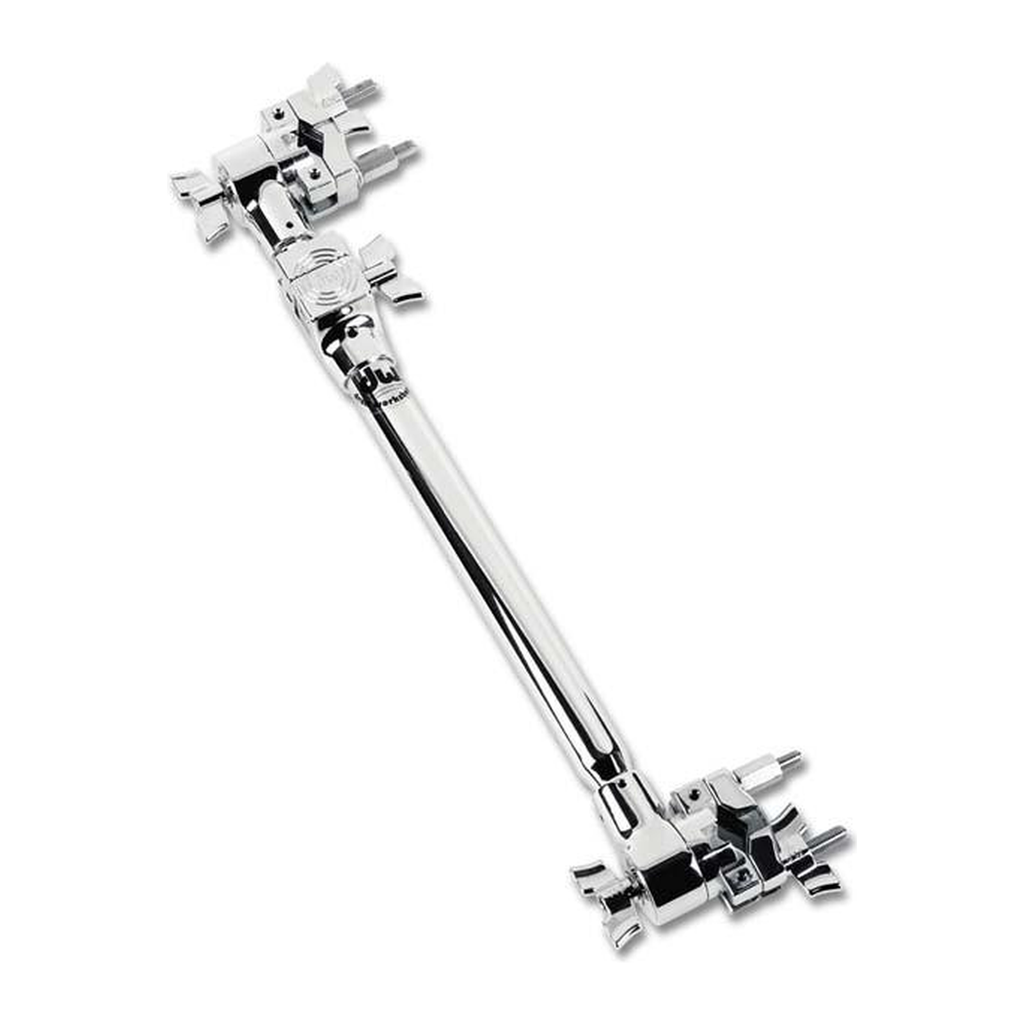
DW SMMG2234 Telescopic Mega Clamp — Dual Adjustable-Angle V-Clamps
The SMMG2234 has two V-clamps joined by a telescopic body that extends and retracts: you choose the distance between the two points, and each clamp sets its own angle. It is the part for setups where nothing lines up on the first try.
What sets it apart
- Telescopic body: you choose the distance between the two clamps
- Two V-clamps, both adjustable in angle
- Three degrees of freedom in a single part
- Covers gaps that short clamps cannot
- Saves you from stacking several connectors
- Chrome finish
The case short clamps do not solve
A short clamp dictates the distance: whatever it holds ends up tight against its support. As long as the geometry allows it, that is perfect. But some setups put the target fifteen centimetres away, and no fixed clamp lands on it.
That is when stacks appear: a clamp, a piece of tube, a second clamp. It works, and it adds three tightening points to check before every gig.
Three adjustments that work together
Length sets the distance, the first angle sets the direction of the arm, and the second sets the orientation of whatever you mount. Those three adjustments cover most of the positions a drummer is looking for.
The method that saves time: set the length first, because it determines everything else; then the angle on the support side; and only then the angle on the accessory side. Starting with the angles almost always means redoing it all.
The price of freedom, stated plainly
Every joint is a place where the setup can move. A part with three adjustments therefore needs more attention to tightening than a right-angle clamp, which can do nothing other than what it was built for.
The right way to use it: you reach for this clamp when the geometry demands it, not by default. On a simple connection, a more rigid part will serve you better.
Specifications
| Body | Telescopic |
|---|---|
| Number of clamps | Two, V-type |
| Angle adjustment | On both clamps |
| What it replaces | A stack of two or three connectors |
| Appearance | Chrome |
What it is for
- Joining two points that no short clamp connects
- Replacing a stack of connectors with a single part
- Setting distance and angle on an unusual setup
- Mounting an accessory at an angle and at a distance
- Adapting an inherited setup whose geometry is fixed
Compare with other manufacturers
Clamps with an adjustable body are rare; here is what comes closest elsewhere:
| Manufacturer | Comparable model | What differs |
|---|---|---|
| Gibraltar | Multi-clamps with adjustable arm | Length sometimes fixed, adjustment limited to angles |
| Tama | Articulated multi-clamps | Non-telescopic body on most lines |
| Pearl | Adapters with swivelling arm | Usually a single angle adjustment point |
Frequently asked questions
- How far does the body extend?
- The manufacturer describes a telescopic body without publishing its exact travel. You find the usable range during setup by extending the sliding section no further than its minimum safe insertion.
- Is it as rigid as a short clamp?
- No, and that is mechanical: a part that extends cannot be as stiff as a one-piece part. You choose it for geometry, not for maximum rigidity.
- How many adjustments need checking before I play?
- Three: the length and both angles. That is the trade-off for the freedom of adjustment.
- Can it hold a tom?
- For a heavy load, it is better to retract the body fully and bring the whole assembly closer to its anchor point. A rigid clamp remains preferable when the geometry allows it.
Avis clients
A setup where no clamp lines up?
Aucun avis pour le moment. Soyez le premier à partager votre expérience après votre achat.