
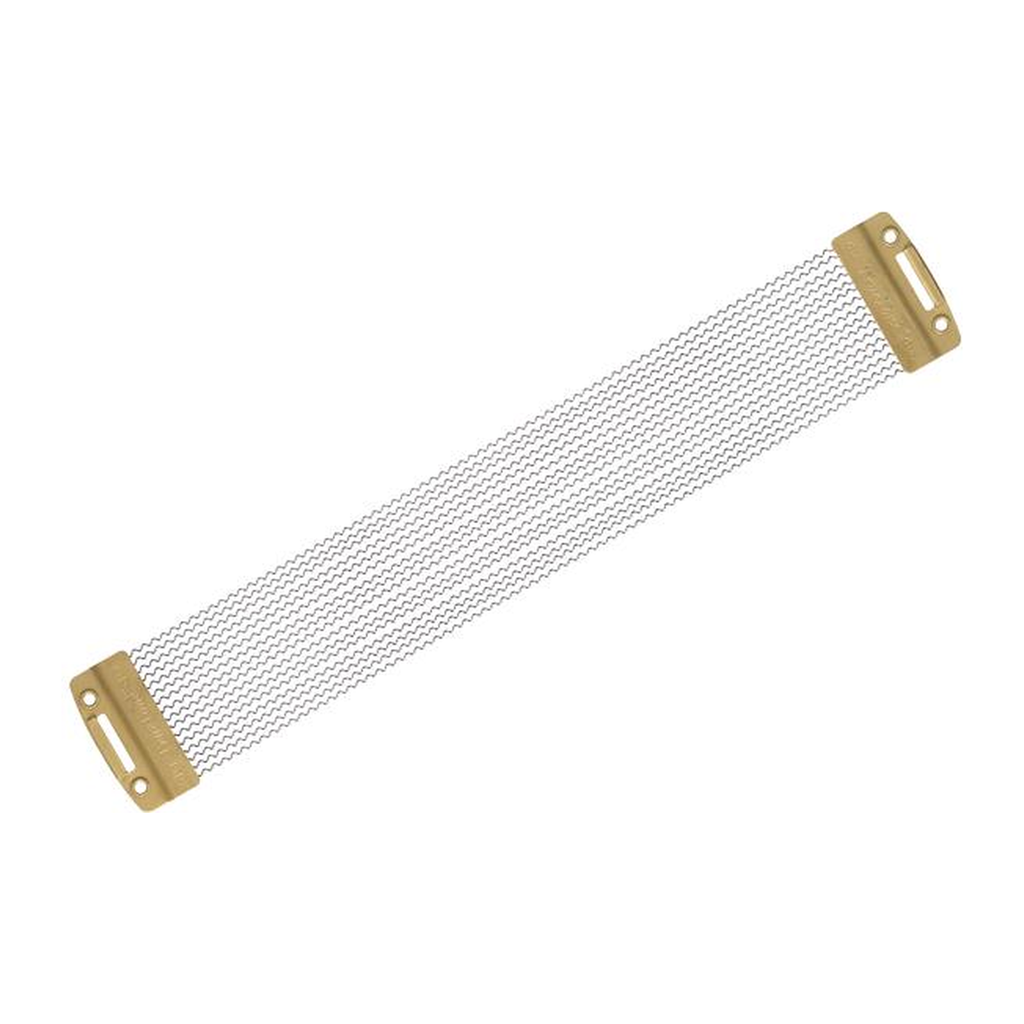
DW True-Tone 10 in Snare Wires, 16 Strands
The 16-strand True-Tone 10 in is the set of snare wires for small auxiliary snares, the ones placed to the left of the hi-hat for a high counter-voice. It is the smallest size in the range: across such a short width, sixteen strands already cover a good part of the snare-side head.
What sets it apart
- 10 in size, the smallest in the True-Tone range
- 16 strands
- Brass end plates at both ends
- Wires aligned one by one during manufacturing
- Direct replacement on a 10 in auxiliary snare
A small drum is not a small snare
A 10 in snare drum does not play the same role as the main drum. It serves as a second voice: a higher, shorter crack that answers the 14 in drum instead of replacing it.
That role calls for a clean response and a quick decay. Snare wires that are too dense on such a small shell choke the attack and leave a buzz that lingers under the other drums. Sixteen strands keep the crack dry.
Density is read in strands per inch
The count alone means nothing until you relate it to the width. Sixteen strands stretched across ten inches are much tighter than the same sixteen strands on a wider drum.
That is why the same count never gives the same character from one size to another. On this drum, sixteen wires already cover a good part of the snare-side head.
When to replace them
One broken strand throws the whole set off balance: the wires no longer lie flat, and one area of the head stops responding. You hear it first on soft strokes, on light hits near the edge.
Snare wires also lose tension over the years, even without breaking. If you have to tighten the throw-off more and more to get the old crack back, the set is worn out.
Specifications
| Size | 10 in |
|---|---|
| Number of strands | 16 |
| End plates | brass |
| Construction | wires cut and crimped, uniform alignment |
| Intended use | 10 in auxiliary snare |
What it is for
- A 10 in auxiliary snare
- A high counter-voice drum to the left of the hi-hat
- A small recording drum for rhythmic layers
- Replacing a damaged or incomplete set
Compare with other manufacturers
Other manufacturers offer small-size snare wires. What sets them apart:
| Manufacturer | Comparable model | What differs |
|---|---|---|
| Puresound | Fine-strand snare wires for small drums | Several densities available in this size |
| Gibraltar | Small-size replacement snare wires | A multi-brand parts catalogue rather than an in-house range |
| Pearl | Original auxiliary snare wires | Designed as a replacement part for its own catalogue |
| Canopus | Replacement snare wires | The choice of wire metal comes first, rather than the count |
Frequently asked questions
- Will 10 in snare wires fit a 12 in drum?
- No. The wires have to cover the snare bed cut into the shell without running over the bearing edge. A set that is too short leaves dead zones, and a set that is too long rides up on the edge and blocks the head.
- How many strands does such a small drum need?
- Sixteen, for this set. The manufacturer also offers the 10 in with twenty strands: at the same width, more wires mean more contact points, so a quicker response to soft strokes and a note that stops sooner.
- How often should you replace snare wires?
- There is no set schedule. You replace them when a strand breaks, when the set has stretched unevenly, or when the drum no longer responds to soft strokes.
- Cord or strap to attach them?
- Cord follows small changes in the setting better and can be replaced anywhere; a plastic strap transmits more crisply. On an auxiliary drum played with dynamics, cord remains the more flexible choice.
Avis clients
Does your small auxiliary snare sound flabby instead of cracking?
Aucun avis pour le moment. Soyez le premier à partager votre expérience après votre achat.