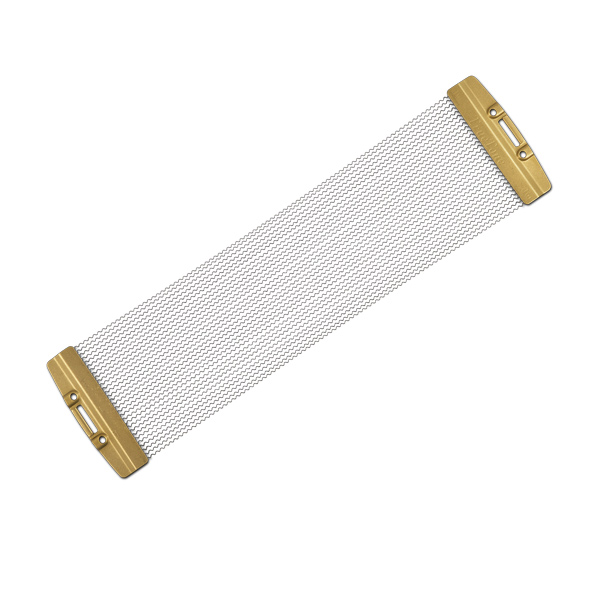
DW True-Tone 13 in Snare Wires, 30 Strands
The 13 in True-Tone with 30 strands is the middle snare wire count for this size, between the 18 strands of the entry set and the 42 of the densest. The drum gains response under soft strokes, and at the same time becomes chattier when the other drums sound around it.
What sets it apart
- 30 strands on a 13 in shell
- Middle count of the three offered in 13 in: 18, 30, 42
- More response to ghost notes and light buzz strokes
- Brass end plates
- Also offered in 14 in to match two snares
What density does for quiet playing
Ghost notes, those barely placed strokes between the main hits, hardly move the head at all. If the strands are spaced apart, much of that motion passes between them without exciting them, and the nuance disappears.
Tightening the coverage lowers the threshold at which the snare wires respond. The drum then tells you what the left hand is doing, instead of only reproducing the full strokes.
The trade-off, stated plainly
Denser snare wires also react to what does not come from the snare. A well-tuned bass drum, an open floor tom, a bass guitar on stage: all of it makes the snare-side head vibrate, and thirty strands make it quicker to show.
This is not a manufacturing defect, it is physics. The fix lies in tom tuning, snare-side head tension and the throw-off setting, not in going back to a lighter set.
A denser 13 in, for what use
This size is played tight, and therefore bright. Adding density produces a very articulate drum: every stroke is clean, rolls stay clear, and the drum holds its place in a busy mix without having to be hit harder.
It is a combination fusion and stage drummers look for, where precision matters more than raw volume.
Specifications
| Snare | 13 in |
|---|---|
| Strands | 30 |
| Other densities in 13 in | 18 and 42 |
| Ends | brass |
| Intended effect | denser response under the snare-side head |
What it is for
- A 13 in snare played with dynamics
- Ghost notes and light buzz strokes to bring out
- Fast playing where every stroke must stay distinct
- An articulate auxiliary drum in a kit with several snares
Compare with other manufacturers
Other manufacturers' dense 13 in snare wires:
| Manufacturer | Comparable model | What differs |
|---|---|---|
| Puresound | High-density 13 in snare wires | Intermediate counts offered between the steps |
| Canopus | 13 in replacement snare wires | Character sought through the wire itself rather than the count |
| Sonor | Stock snare wires for a student drum | Standard density, designed for durability |
| Tama | Snare wires for a fast-playing drum | Work on wire tension rather than count |
Frequently asked questions
- What is the difference between 18 and 30 strands on a 13 in snare?
- How much of the snare-side head is covered. At 30 strands, the drum responds to softer strokes; it also picks up more of the vibration coming from the other drums.
- Do dense snare wires choke the drum?
- They shorten the sustain a little and tighten the texture. On a tight 13 in, the effect stays moderate: it is on deep, low-tuned drums that you hear it most.
- How do I reduce the snare buzz coming from the toms?
- Move the tom tuning away from the snare's, bring the snare-side head up a little, and check that the set is properly centred. Lowering the density is the last resort, not the first.
- Should both my snares have the same strand count?
- Nothing requires it. Many drummers deliberately choose two different densities so the drums do not blur into each other.
Avis clients
Can you hear your ghost notes under the sticks but not in the room?
Aucun avis pour le moment. Soyez le premier à partager votre expérience après votre achat.