
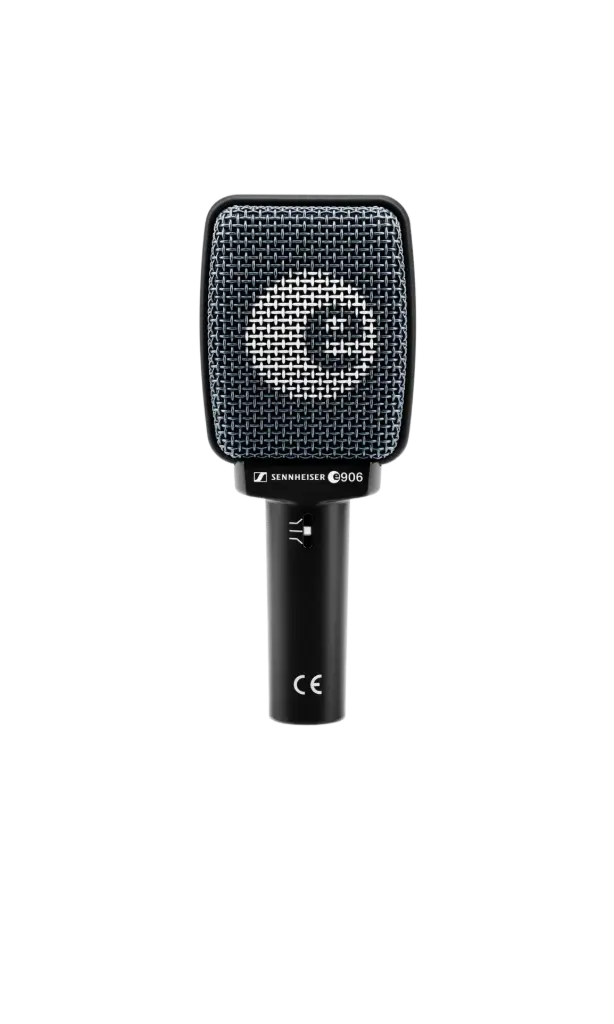
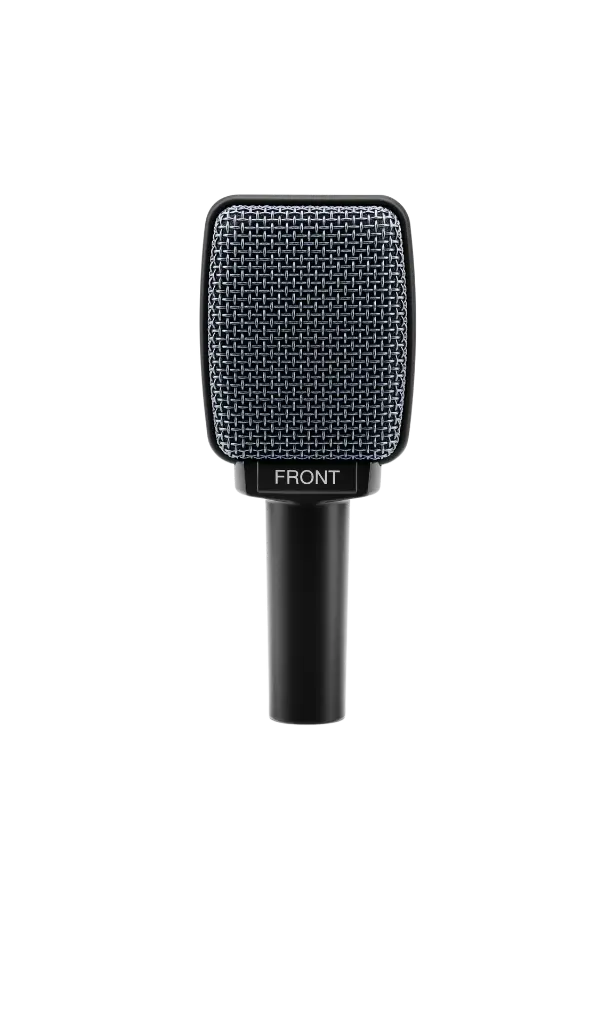
Sennheiser E 906 - Supercardioid Dynamic Microphone - Precise Recording
The ultimate weapon to capture the soul of your amplifier.
The Sennheiser e 906 is a premium supercardioid dynamic microphone designed specifically for guitar amps, percussion, and brass instruments. Thanks to its unique flat design, allowing for direct suspension in front of the speaker cabinet, and its three-position presence switch, it offers sonic versatility and clarity of attack that few microphones can match. (Ready to copy into the "Customer Description" field.)
The Sound Authority: Why the e 906 is essential
The Sennheiser e 906 is more than just a microphone; it's the industry standard that solves real-world problems for musicians and sound engineers. No more bulky tripods that slip on stage: its flat design allows it to be suspended directly from the cable in front of your speaker.
It solves the age-old tonal dilemma with its side-mounted filter switch. Whether you're looking for a sharp, cutting sound for metal (Bright setting), a faithful and balanced tone (Normal setting), or a velvety warmth for blues and jazz (Smooth setting), the e 906 adapts to your signal before it even reaches the mixing console. It's the ultimate tool for cutting through sonic mud and making your guitar stand out in a dense mix.
Full Technical Specifications
| Category | Characteristic | Technical Details |
| Audio | Transducer principle | Dynamic |
| Audio | Directivity | Supercardioid |
| Audio | Frequency response | 40 - 18,000 Hz |
| Audio | Sensitivity (free field, no load, 1 kHz) | 2.2 mV/Pa |
| Electronic | Nominal impedance | 350 Ω |
| Electronic | Minimum terminal impedance | 1000 Ω |
| Connectivity | Connector | XLR-3 |
| Physical | Dimensions | 55 x 34 x 134 mm |
| Physical | Weight | 140 g |
| Features | Presence switch | 3 positions (Boost, Flat, Cut) |
| Construction | Body material | Reinforced metal |
Comparative Analysis
Based on consensus from Sound on Sound, Gearspace and MusicRadar.
| Alternative Product | Market Segment | Comparative Analysis | Available at Garage à Musique |
| Shure SM57 | Dynamic Standard | More midrange, requires a stand, less EQ versatility than the e 906. | Available here |
| Sennheiser e 609 | Mid-range | Little brother of the e 906; does not have the presence switch, narrower frequency response. | Available here |
| Beyerdynamic M160 | Ribbon | Its sound is much darker and more vintage, very fragile, and the price is significantly higher. | Product not listed |
| Audix i5 | Instrument Dynamics | "V-shape" frequency response (more bass and treble), less natural on clean amps. | Available here |
| Heil PR30 | Dynamic Wide Diaph. | Excellent rear rejection, but wide format makes it difficult to place on confined stages. | Product not listed |
| Sennheiser MD 421-II | Premium Dynamics | Ideal for toms and amps, but bulky size and fragile clamp compared to the e 906. | Available here |
| Royer R-121 | Studio Ribbon | The holy grail for amplifiers, but requires a high-end preamp and a controlled environment. | Available here |
| Shure Beta 57A | Supercardioid Dynamics | More gain before feedback, but a fixed presence bump that can be aggressive on some amps. | Available here |
| Telefunken M80-SH | High-End Dynamics | Exceptional clarity like a condenser, but a less "rock" sound profile than the Sennheiser. | Available here |
| Lewitt MTP 440 DM | Modern Dynamics | Very robust, competitively priced, but lacks the history and signature sound of the e 906. | Product not listed |
History & Evolution
The Sennheiser e 906 is the direct successor to the legendary MD 409 , a cult microphone of the 70s and 80s, now impossible to find at a reasonable price. After the introduction of the e 609 (which aimed to capture the essence of the 409 at an affordable price), Sennheiser engineers developed the e 906 to restore absolute fidelity and, above all, add the filtering flexibility that was lacking in previous versions. It represents the culmination of 50 years of German engineering dedicated to capturing high-SPL instruments.
Cultural References & Artists
The sound of the e 906 (and its ancestor the MD 409) is deeply rooted in music history:
Pink Floyd : David Gilmour utilisait le MD 409 sur "Live at Pompeii" (1972) pour son baffle Leslie et ses amplis Hiwatt.
The Who : Pete Townshend a souvent utilisé cette lignée de micros pour sa clarté en environnement de scène bruyant.
Dire Straits : Mark Knopfler pour capturer l'attaque précise de ses doigts sur la Stratocaster.
Genesis : Steve Hackett utilisait le prédécesseur pour ses textures de guitare progressives.
Tom Petty : Mike Campbell utilise régulièrement le e 906 pour ses sons de guitare classiques et définis.
John Mayer : Utilisé fréquemment en configuration combinée pour ses sonorités "bluesy" et riches en harmoniques.
Foo Fighters : Présent sur de nombreuses scènes pour la robustesse et la gestion des SPL élevés des amplis Mesa Boogie.
Metallica : James Hetfield pour le "bite" supplémentaire en position "Bright".
U2 : The Edge a utilisé le e 906 pour isoler le delay complexe de ses Vox AC30.
Green Day : Billie Joe Armstrong pour le punch des médiums.
Rush : Alex Lifeson pour la précision chirurgicale en studio.
Guns N' Roses : Slash (utilisé en complément pour le corps du son).
Radiohead : Jonny Greenwood pour ses textures expérimentales.
Steely Dan : Reconnu pour l'exigence technique, le e 906 est un choix de session fréquent.
Joe Bonamassa : Pour la fidélité de la reproduction des amplis de collection.
FAQ (Frequently Asked Questions)
Does the Sennheiser e 906 require phantom power?
No. Like any robust dynamic microphone, it does not require +48V. This eliminates the risk of accidental damage to passive circuits and ensures easy use with any mixer or audio interface.
What is the difference between the e 609 and the e 906?
The e 906 is the top-of-the-range model. Unlike the e 609, it features a 3-position presence switch and a superior quality capsule offering a wider and more detailed frequency response, particularly in the high frequencies.
Can it be used on a snare drum?
Absolutely. Its supercardioid directivity offers exceptional hi-hat rejection, while its ability to handle extreme sound pressure levels (SPL) makes it a perfect choice for powerful drummers.
Can I hang it by the cable without a microphone stand?
Yes, that's one of its major advantages. Its design is balanced to hang vertically in front of the speaker. Just make sure the side marked "Front" faces the amplifier grille.
What switch position should I choose for a metal sound?
The "Bright" (upward) position accentuates the presence frequencies (around 4 kHz), allowing saturated guitars to cut through the mix without increasing the overall gain, thus avoiding unnecessary feedback.
Is the microphone sensitive to RF interference?
The e 906 incorporates a hum compensating coil which minimizes electromagnetic interference and background noise, even in the immediate vicinity of massive amplifier transformers.
How to reduce the "boom" of low frequencies?
Use the "Smooth" (downward) position to attenuate high frequencies and round out the sound, or move the microphone slightly away from the center of the speaker to reduce the proximity effect inherent in directional microphones.
Is it suitable for brass instruments (trumpet, trombone)?
Yes, its rapid response to transients captures the "punchy" attack of brass instruments without distortion, offering an organic sound that is highly appreciated in live brass sections.
What is the warranty on this product at Garage à Musique?
By purchasing from Garage à Musique, you benefit from the official Sennheiser Canada warranty and our local expert support to ensure total reliability on your tours.
Is the e 906 manufactured in Germany?
Yes, this model is part of the Evolution 900 series, proudly designed and assembled in Germany, guaranteeing superior manufacturing precision and exceptional longevity.
Avis clients
Aucun avis pour le moment. Soyez le premier à partager votre expérience après votre achat.