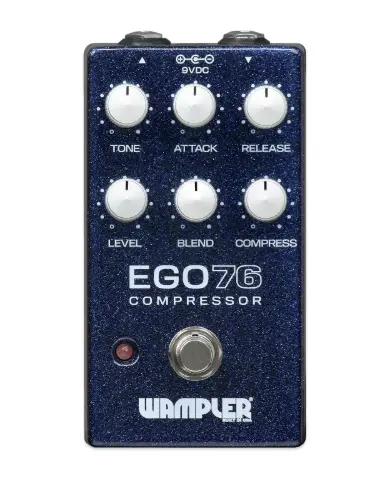
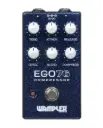
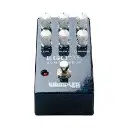
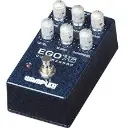
Wampler Ego '76 Compressor | Classic Compression 1176
The legendary tone of Studio 1176, now at your feet. The Wampler Ego '76 Compressor is more than just a pedal: it's a faithful recreation of the most famous FET transistor compressor in music history. Designed for discerning guitarists, it delivers the punchy attack and endless sustain that defined the greatest studio recordings. With its blend control, preserve the integrity of your original dynamics while adding the brightness and consistency of a professional production.
The Studio Authority: Why Ego '76 is Essential
For any serious musician, compression is the secret ingredient to a "finished" sound. The Wampler Ego '76 tackles the holy grail: the 1176-style compressor. Where other pedals generically crush your signal, the Ego '76 delivers rich harmonic coloration and dynamic responsiveness normally found only in expensive rack units.
Whether you're looking for the perfect rhythmic "squash" for funk, a singing sustain for your solos, or simply subtle dynamic EQ for your pedalboard, the Ego '76 acts like a dedicated studio engineer for your sound. Its ability to handle fast transients while remaining musical makes it the new standard for tone purists.
Full Technical Specifications
Here is the complete extraction of technical data for surgical precision.
Audio Features & Controls
| Setting | Details |
| Circuit Type | FET (Field Effect Transistor) technology inspired by the 1176 |
| ATTACK control | Adjusts the compression trigger speed |
| Release Control | Adjusts the return time to the uncompressed signal |
| BLEND control | Mixes the dry signal and the compressed (wet) signal |
| TONE control | Adjusts the brightness and presence of the signal |
| Control Level | Overall output volume |
| COMPRESSION CONTROL | Defines the threshold and compression ratio |
Nutrition & Fitness
| Setting | Details |
| Food | 9V - 18V DC (Center Negative) |
| Power consumption | 10mA at 9V / 13mA at 18V |
| True Bypass | Yes (Silent mechanical relay) |
| Dimensions | 63.5mm x 114.3mm x 38.1mm (2.5" x 4.5" x 1.5") |
| Case material | High-strength metal |
| Origin | Designed and assembled in the United States |
Comparative Analysis (Rigorous Protocol)
Sources: Sound on Sound, MusicRadar, Gearspace.
| Alternative Product | Market Segment | Comparative Analysis | Available at Garage à Musique |
| Origin Effects Cali76 CD | Premium FET Compression | Larger, more expensive, the absolute studio benchmark. The Ego '76 is more compact and affordable. | View product |
| Keeley Compressor Plus | Standard Industry | Simpler, less control over attack/release. The Ego '76 is more "vintage" in style. | View product |
| Universal Audio 1176 Pedal | Digital/Analog Emulation | Excellent modeling, but the Ego '76 remains 100% analog for zero latency. | View product |
| MXR M1176 Studio Comp | Compact Size | Very precise, but lacks Wampler's specific "Tone" control for sculpting the mix. | View product |
| Walrus Audio Deep Six | Parallel Compression | Very good for dry/wet mixing, but the colouring is less "76" than the Wampler. | View product |
| JHS Pulp 'N' Peel V4 | Orange Squeezer Compression | Based on a different circuit. More "grain", less "punch" FET. | View product |
| Wampler Ego Compressor | Brand standard | The versatile big brother. The '76 is more specific to the character of the original 1176. | View product |
| Peterson StroboStomp | (Not comparable) | Different use (Tuner). | Product not listed |
| Empress Compressor MKII | Total Control | Extremely transparent, whereas the '76 brings a sought-after harmonious color. | View product |
| Xotic SP Compressor | Ultra-Compact | Very small, but fewer fine adjustments (Attack/Release). | View product |
History & Evolution
The 1176 Peak Limiter circuit, launched in 1967 by Universal Audio, revolutionized recording studios with its ultra-fast attack times. Brian Wampler, renowned for his perfect pitch when it comes to analog circuits, spent years perfecting a pedal version that not only simulates the effect but also replicates the electrical behavior of FET transistors. The Ego '76 represents the culmination of this research, offering the fidelity of a 1970s rack unit in a robust and modern pedal format.
Cultural References & Artists (Heritage 1176/Ego)
The sound of the 1176 (of which the Ego '76 is the direct heir) is everywhere:
Led Zeppelin (Jimmy Page) - Black Dog (1971) : Direct dans la console avec compression 1176.
Pink Floyd (David Gilmour) - The Wall (1979) : Utilisation massive pour le sustain des solos.
The Rolling Stones - Exile on Main St. (1972) : Compression FET sur les guitares acoustiques et électriques.
Nirvana - Nevermind (1991) : Omniprésent sur les voix et guitares clean/crunch.
Steely Dan - Aja (1977) : Pour la précision rythmique légendaire de leurs pistes de guitare.
Guns N' Roses - Appetite for Destruction (1987) : Utilisé pour l'épaisseur des pistes de Slash.
Red Hot Chili Peppers (John Frusciante) - Blood Sugar Sex Magik : Le "snap" du funk blanc.
U2 (The Edge) - Utilisé pour lisser les répétitions de delay.
Police (Andy Summers) - Pour la brillance caractéristique des accords de Telecaster.
Tom Petty - Le son "jangle" des guitares 12 cordes.
Michael Jackson - Thriller : Présent sur presque chaque piste de guitare rythmique.
Dire Straits (Mark Knopfler) - Le sustain propre sans distorsion.
AC/DC - Pour la consistance des rythmiques massives de Malcolm Young.
Prince - Le "pop" ultime sur ses lignes de guitare funk.
The Beatles - Abbey Road : Les premières expérimentations avec des compresseurs FET rapides.
Augmented FAQ: The expert's opinion
1. Why choose the '76 over the original Ego Compressor? The original Ego is an OTA compressor (very clean, versatile). The '76 is a FET compressor. It's faster, adds a slight "vintage" harmonic coloration, and has that punchy character typical of old rock and funk records.
2. Does the Tone control affect my original signal? No, the Tone control primarily affects the compressed signal, allowing you to compensate for any loss of natural brightness during heavy compression.
3. Can I use it with a bass? Absolutely. FET compressors are favorites for bass because they handle dynamic peaks (slap, pick attacks) extremely well.
4. What is the difference between 9V and 18V? At 18V, you increase the "headroom". This means that the pedal will saturate less if you have high-output pickups (active humbuckers, etc.).
5. What is the Blend knob really for? It's the key to your sound. It allows you to keep the natural attack of your guitar (the initial "click") while adding the sustain from the compressor underneath.
6. Does this pedal make any noise (hiss)? Wampler is known for its quiet circuitry. However, like any compressor, it will boost the level of quieter sounds (including background noise from your microphones).
7. Where should I place the Ego '76 in my effects chain? Generally at the very beginning, right after the tuner, to stabilize the signal before the overdrives.
8. Is it a transparent compressor? It can be, but its strength lies in its ability to add that sonic "weight" typical of 70s studios.
9. Is the bypass transparent? Yes, it's a True Bypass via relay, so your signal is not altered when it is switched off.
10. Can I get a "limiter" sound with this pedal? Yes, by setting the Attack quickly and the Compression to a high level, it acts as a very effective peak limiter.
Avis clients
Aucun avis pour le moment. Soyez le premier à partager votre expérience après votre achat.