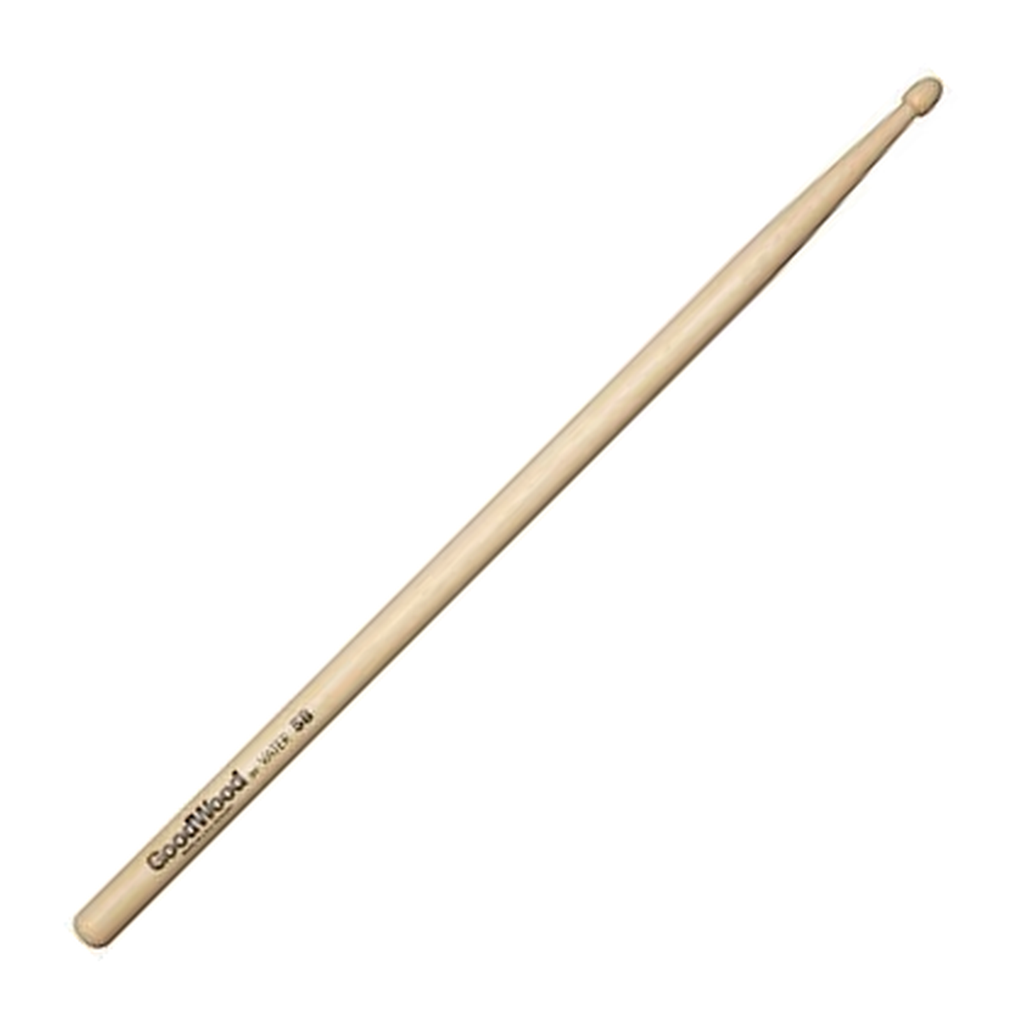
Vater Goodwood 2B Drumsticks — Wood Tip, Hickory
The Goodwood 2B is a heavy drumstick, the thickest of the four common sizes. You rarely choose it for comfort and almost always for what it demands: a full stroke, a wrist that works against weight, and a stroke that forgives nothing.
What sets it apart
- The 2B, the thickest of the four common sizes
- A recognized practice tool for pad work
- Develops the weak hand faster than a light stick
- Hickory: shock absorption and durability, a thousand strokes per session
- Wood tip, full contact on a tight head
- Moderate cost for a stick you are going to wear out on purpose
A stick you use to train
Practising on a pad with a heavy stick is a long-standing habit among teachers, and it holds up: the weight forces you to bring the stick back up with your wrist and fingers instead of relying on the rebound. What is hard on a 2B becomes easy afterwards on a 5A.
The amount is what matters. An hour a day on a heavy stick builds strength; three hours tighten the motion and lock in bad habits. The 2B is a training tool, not a stick to train with all the time.
The weak hand, exposed
A heavy stick immediately exposes the gap between your two hands. What the lead hand makes up for without you noticing, the weak hand does not: the volume drops, the placement slips, and fatigue sets in on one side only.
It is unpleasant, and it is useful. An imbalance you can see is one you can work on; the same imbalance on a thin stick stays hidden for months.
Beyond the pad
The 2B does not live only at home. It also serves on stage where the volume is extreme, in street marching bands, in ensemble percussion, and anywhere the snare drum has to cover a whole group.
What it does not do is nuance. Fast passages and fine rolls cost effort; that is the accepted price of the mass.
Specifications
| Wood | Hickory |
|---|---|
| Size | 2B — the heaviest of the common sizes |
| Tip | Turned from the wood |
| Typical use | Technical work and high-intensity playing |
| Sold | As a pair |
What it is for
- Daily work on a practice pad
- Building up the weak hand and the wrist
- Ensemble percussion and street marching band
- Very loud music, with no dynamic playing
- Drum lessons, strength and consistency exercises
Compare with other manufacturers
Every range has a heavy size; the approaches differ:
| Manufacturer | Equivalent | What changes |
|---|---|---|
| Vic Firth | American Classic 2B | The manufacturer's own 2B profile and taper |
| Promark | Classic Forward 2B | Weight carried toward the front of the shaft |
| Zildjian | 2B Hickory | Range from the cymbal manufacturer |
| Los Cabos | 2B Red Hickory | Heat-treated hickory, turned in Canada |
Frequently asked questions
- Are 2B drumsticks good for beginners?
- For practice pad work, often yes: they build strength and consistency. For playing on a drum kit, they are usually too heavy and push a beginner to hit instead of letting the stick bounce.
- How long should I practise with heavy sticks?
- In short blocks, never a whole session. The goal is to build strength, not to tense up your hand. As soon as the motion stiffens, go back to your usual size.
- Are 2B sticks harder on heads and cymbals?
- They leave more marks; that is simple mechanics. On a rubber pad, no problem. On a stage kit, it is wear you have to accept.
- Why is a 2B thicker than a 5A?
- Because the number goes down as the stick gets thicker, a legacy of an old classification by circumference. A 2 is thicker than a 5, and a 7 is thinner still.
Avis clients
Working on the pad with heavy sticks? Tell us about your results.
Aucun avis pour le moment. Soyez le premier à partager votre expérience après votre achat.