
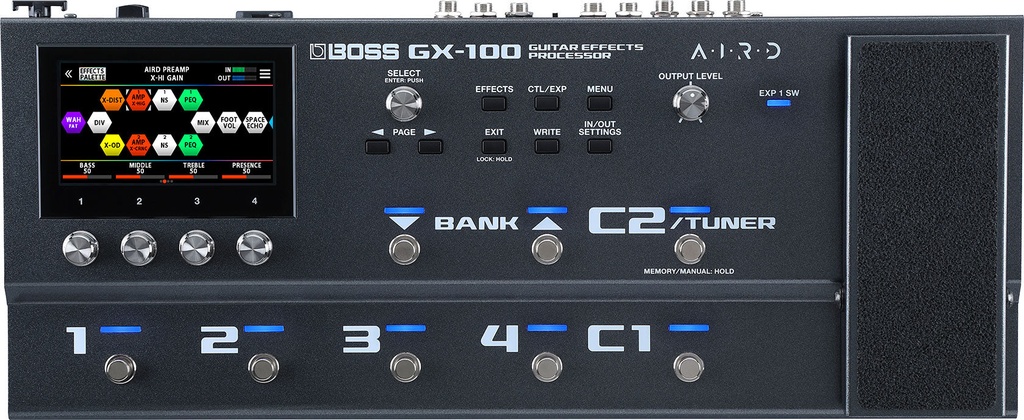
Boss GX-100 - Guitar Effects Processor -
The perfect balance of raw power and tactile intuition. The Boss GX-100 takes your rig to a new dimension with its AIRD sound engine, inherited from the GT-1000 flagship, and its ultra-responsive colour touchscreen. With over 150 effects and 23 world-class amplifiers, you can sculpt professional tones in seconds, whether in the studio or on stage. It is the ultimate tool for the modern guitarist who refuses to choose between technological depth and ease of use, available now at Garage à Musique.
Why the Boss GX-100 Is the New Standard
For years, high-end multi-effects meant complex menus and tedious navigation. The Boss GX-100 solves this problem once and for all. By combining a high-resolution colour touchscreen with an ultra-flexible signal architecture, Boss finally lets musicians focus on what matters: creating.
Under the hood, AIRD (Augmented Impulse Response Dynamics) technology ensures an organic interaction between the amplifier and the speaker, faithfully reproducing the playing feel and dynamic response of a traditional tube amp. With 24-bit AD/DA conversion and internal 32-bit floating point processing, your signal stays clear, even with 15 effect blocks active at once. At Garage à Musique, we see the GX-100 as the perfect bridge for guitarists who want the power of the GT-1000 in a more intuitive, modern format.
Complete Technical Specifications
Audio Processing & Sound Engine
| Feature | Technical Detail |
| Sampling Frequency | 48 kHz |
| AD Conversion | 24 bits + AF method (Adaptive Focus method) |
| DA Conversion | 24 bits |
| Internal Processing | 32-bit floating point |
| Modelling Technology | AIRD (Augmented Impulse Response Dynamics) |
| Number of Effects | 154 types |
| Number of Amplifiers | 23 types |
| Maximum Simultaneous Effects | 15 effect blocks |
| Memories (Patches) | 200 (User) + 100 (Preset) |
| Phrase Looper | 38 sec. (Mono), 19 sec. (Stereo) |
Interfaces & Controls
| Element | Feature |
| Display | Graphic colour LCD touchscreen (480 x 272 dots) |
| Switches | 8 assignable footswitches + expression pedal switch |
| Expression Pedal | Built-in, with toe switch activation |
| Navigation Interface | Touchscreen + 4 rotary parameter knobs |
Complete Connectivity
| Port | Connector Type |
| INPUT | 1/4" phone-type jack |
| OUTPUT (L/MONO, R) | 1/4" phone-type jack |
| SEND / RETURN | 1/4" phone-type jack (effects loop) |
| PHONES | 1/4" stereo phone-type jack |
| CTL3, 4 / EXP2 | 1/4" TRS phone-type jack |
| AMP CTL 1, 2 | 1/4" TRS phone-type jack |
| MIDI (IN, OUT) | 5-pin DIN connectors |
| USB COMPUTER | USB Type-B (Audio / MIDI interface / data transfer) |
| Bluetooth Adaptor Slot | For optional BT-DUAL adaptor |
| DC IN | AC adaptor jack |
Physical & Dimensions
| Feature | Measurement |
| Width | 460 mm (18-1/8 inches) |
| Depth | 193 mm (7-5/8 inches) |
| Height | 73 mm (2-7/8 inches) |
| Maximum Height | 94 mm (3-3/4 inches) |
| Weight | 3.5 kg (7 lbs 12 oz) |
| Power Supply | AC adaptor (PSB-1U series + cord included) |
| Current Draw | 1200 mA |
Comparative Analysis: The Experts' Verdict
Data drawn from the consensus of Sound on Sound, MusicRadar and Gearspace.
| Alternative Product | Market Segment | Comparative Analysis | Availability at Garage à Musique |
| Line 6 Helix LT | Pro / Touring | More dual-DSP routing power. Interface less intuitive than the Boss touchscreen. | Available here |
| HeadRush MX5 | Compact / Touchscreen | Very capable touchscreen. Fewer physical switching options than the GX-100. | Available here |
| Boss GT-1000 | Flagship / Pro | Better audio resolution (32-bit AD/DA). No touchscreen, more rigid navigation. | Available here |
| Fender Tone Master Pro | High-End | Giant touchscreen and rotary knobs. Significantly higher price than the GX-100. | Available here |
| Neural DSP Quad Cortex | Boutique / Capture | Unmatched capture power. Compact format, but twice the investment. | Available here |
| Kemper Profiler Stage | Profiling / Studio | The king of real-amp profiling. Less focused on building complex effects. | Available here |
| Valeton GP-200 | Budget / Versatile | Excellent value for money. Boss software and AIRD dynamics are superior. | Available here |
| Mooer GE300 | Mid-Range | Built-in guitar synthesizer. Update ecosystem less robust than Boss. | Available here |
| Zoom G11 | Hybrid / Modern | Several dedicated screens. Sound processing a notch below AIRD technology. | Available here |
| NUX MG-30 | Compact / Practical | Very effective for the price. Fewer switches for live control. | Available here |
History & Evolution: The Boss Legacy
The history of Boss processors begins with the legendary GP-8 in 1987, followed by the iconic GT series that dominated pedalboards for three decades. The GX-100 marks a major historic turning point for the brand: it is the first Boss processor to integrate a colour touchscreen, answering worldwide demand for a more visual interface. By inheriting the GT-1000 sound engine while simplifying the ergonomics, Boss proves its authority by adapting studio power to the pragmatic needs of today's stage musician.
Cultural References & Artists
The Boss sound has shaped music history. Here are the artists and bands whose sonic identity relies on the Boss/Roland ecosystem:
Steve Vai: Uses Boss pedals to sculpt his virtuoso overdrive tones.
Joe Satriani: A devotee of the DS-1 and Boss delay processors.
Robert Smith (The Cure): His iconic chorus sound is pure Boss.
Prince: Used a pedalboard made up entirely of colourful Boss pedals.
Josh Homme (Queens of the Stone Age): For his unique gain textures.
Johnny Marr (The Smiths): Architect of the Boss clean sound.
Kurt Cobain (Nirvana): The DS-1 and the Small Clone (often paired with Boss utility pedals).
The Edge (U2): For MIDI management and precision delays.
John Frusciante (RHCP): Uses Boss switchers for his complex rigs.
Steve Lukather: Loyal to Boss/Roland modulation effects and racks.
Guthrie Govan: Has often used Boss multi-effects on tour for their reliability.
Billy Duffy (The Cult): The quintessential SD-1 sound.
Yngwie Malmsteen: Has used the Boss Noise Suppressor for decades.
Alex Hutchings: Virtuoso demonstrator of AIRD technology.
Herman Li (Dragonforce): For the versatility of digital effects live.
FAQ - Musical & Technical Expertise
What is the real difference between the GX-100 and the GT-1000? AIRD technology is present in both. The difference lies mainly in ergonomics and converter resolution. The GT-1000 has 32-bit AD/DA converters, while the GX-100 uses 24-bit. However, the GX-100 gains the colour touchscreen, making preset creation much faster. At Garage à Musique, we recommend the GX-100 for its modern ease of use.
Can I use the GX-100 with the 4-cable method (4CM)? Absolutely, thanks to its effects loop (Send/Return). This lets you insert your own tube amplifier's preamp anywhere in the GX-100's signal chain. You keep your own overdrive tones while using Boss time-based and modulation effects, with no audible latency.
Is the touchscreen sturdy enough for heavy use? Boss is renowned for its legendary durability. The screen is protected and designed to withstand stage vibrations. Although it is a touchscreen, the main functions can be controlled via the reinforced footswitches, ensuring maximum longevity for touring in Quebec.
Can I load my own impulse responses (IRs)? Yes, the GX-100 supports third-party IRs. You can import your WAV files via the Boss Tone Studio software. This lets you fully customize the sound of your cabinets for total sonic immersion, a feature we systematically validate here in the store.
Is Bluetooth built in by default? No, it requires the optional BT-DUAL adaptor. Once installed, you can edit your sounds wirelessly from your smartphone or stream music to practise with. It is a valuable addition for the connected musician.
How does "Power Amp Control" work? It lets you switch the channels of your physical amp. Via the AMP CTL jacks, the GX-100 can send a switching signal to your traditional amplifier, synchronizing your preset changes with the channels of your amp head. It is total system integration.
Is the GX-100 also suitable for bassists? Yes, it includes algorithms specific to bass. It features models of legendary amps and effects dedicated to low frequencies, ensuring that gain and dynamics are perfectly suited to 4-, 5- or 6-string instruments.
Can it be used as a recording interface? Absolutely, via the USB Type-B port. It provides a multichannel audio interface, letting you record your processed sound and a "dry" signal simultaneously for later reamping in your favourite software (DAW).
What is the actual current draw for a pedalboard power supply? It draws 1.2A (1200 mA). This is a high draw due to the touchscreen and the powerful DSP processor. We recommend using the included PSB-1U adaptor to avoid any signal instability or background noise.
How does Garage à Musique provide after-sales support? We are certified Boss experts in Canada. When you buy from us, you benefit from technical assistance with your firmware updates and MIDI configuration. Our authority rests on your long-term satisfaction with your sound.
Avis clients
Aucun avis pour le moment. Soyez le premier à partager votre expérience après votre achat.