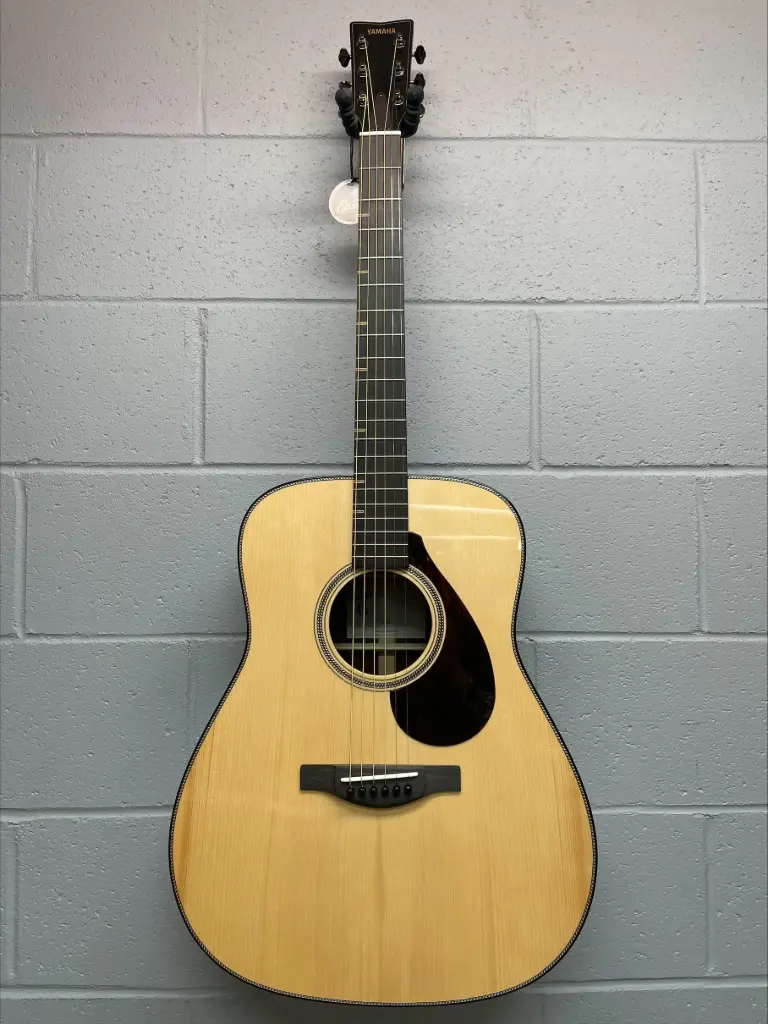
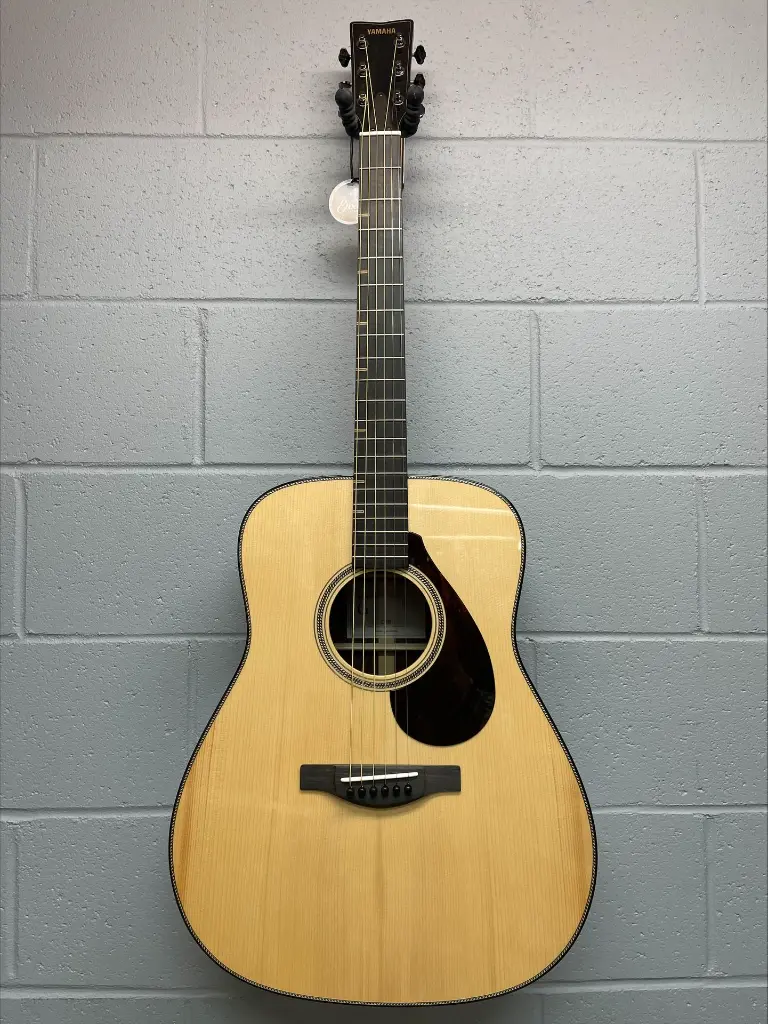
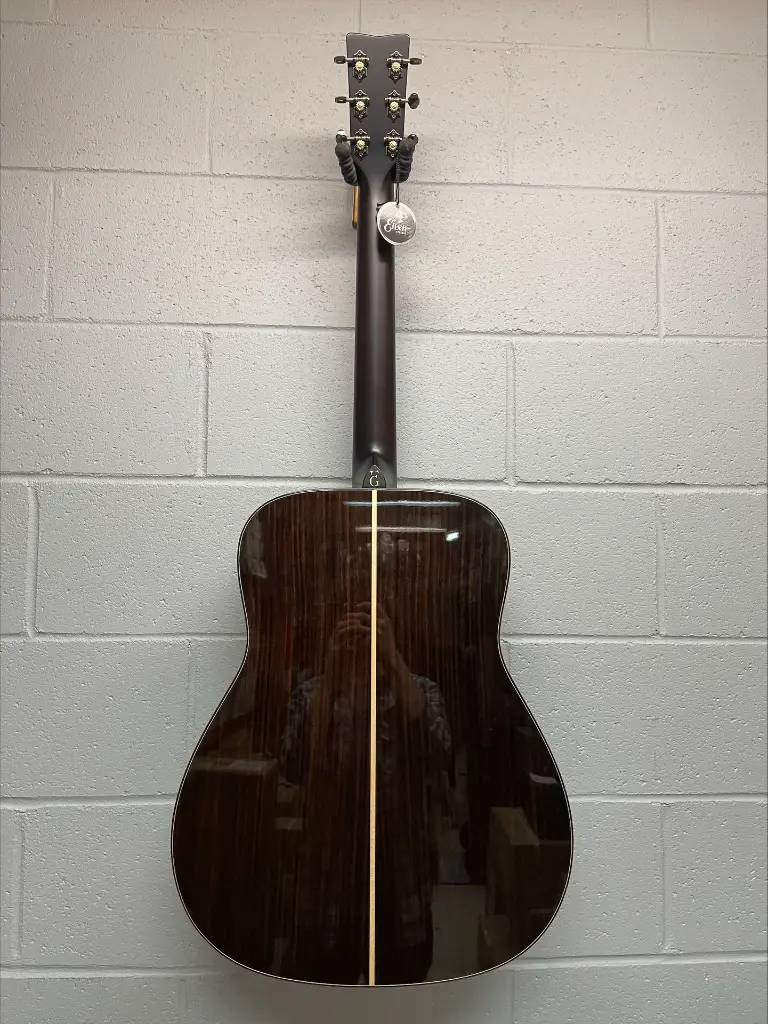
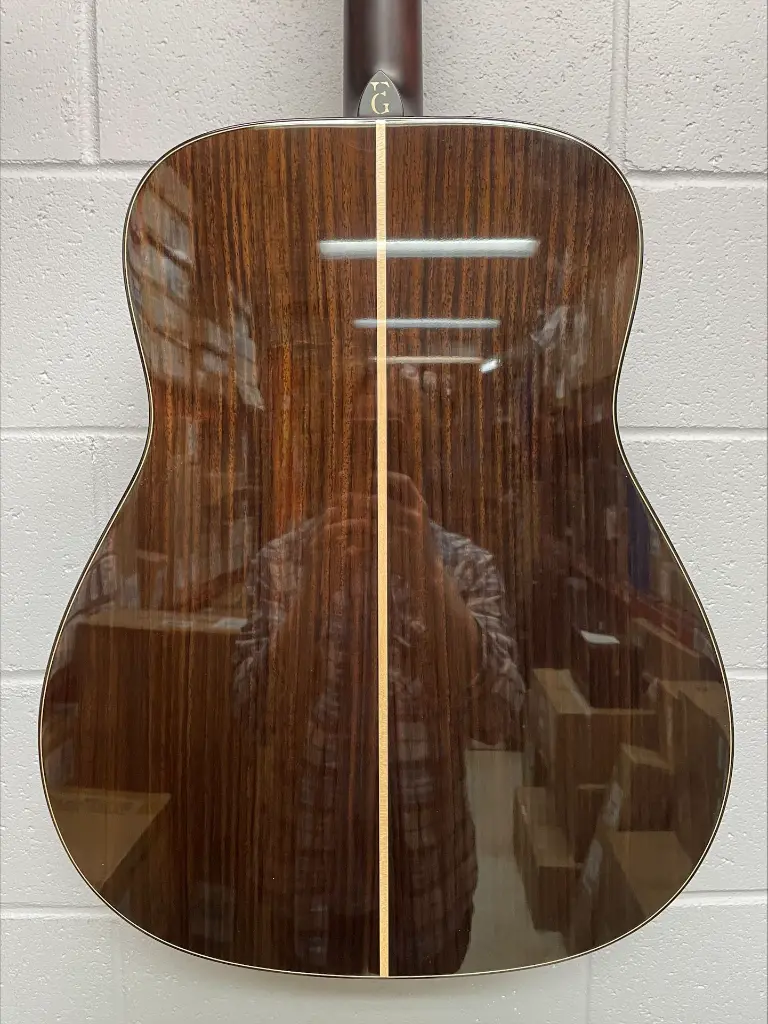
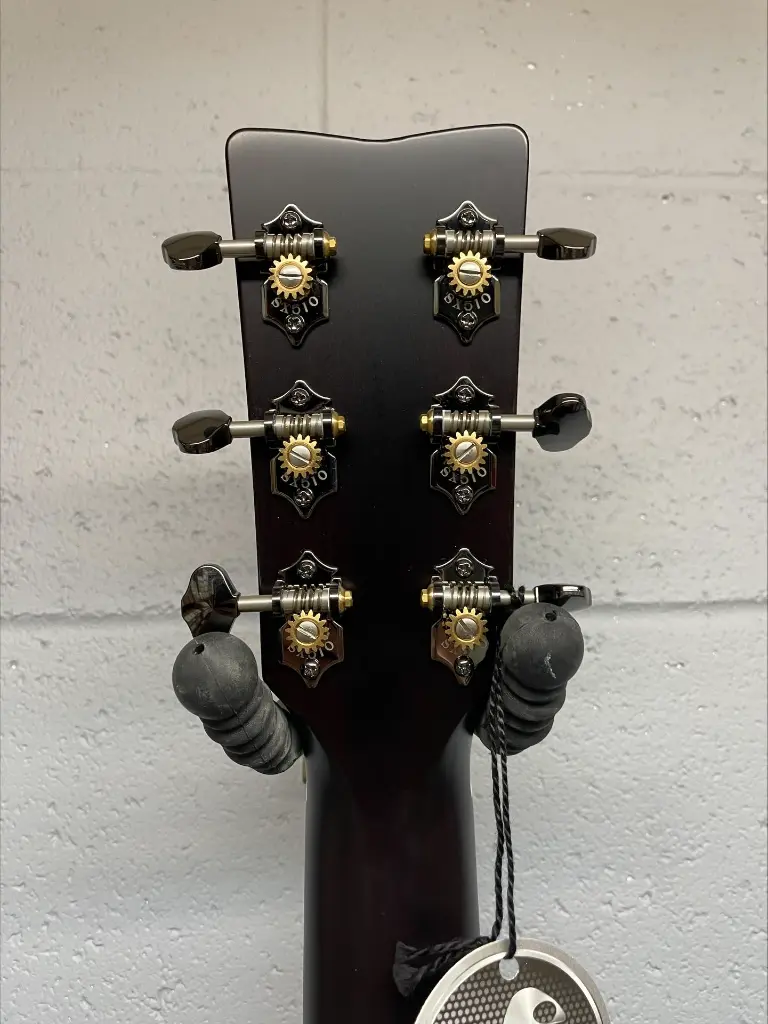
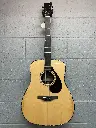
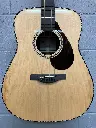

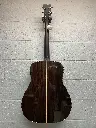
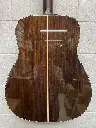

Yamaha FG9R - Acoustic Guitar - Exceptional Performance
The new gold standard for professional singer-songwriters. Elevate your vocal performance with the Yamaha FG9R, a boutique-class dreadnought guitar crafted with surgical precision in Japan. Thanks to its solid Adirondack spruce top and Indian rosewood back, this instrument delivers monumental projection while maintaining exceptional clarity in the high frequencies, solving the age-old problem of muddy bass in the studio. Finished with an ultra-thin nitrocellulose lacquer and featuring a unique hybrid neck joint, the FG9R is the ultimate tool for the discerning musician seeking the perfect balance of raw power and crystal-clear articulation, available at Garage à Musique.
This content will be shared across all product pages.
A Revolution in Acoustic Design
The Yamaha FG9R is not simply an addition to an existing series; it marks a paradigm shift in how a high-end acoustic guitar is designed and produced. Historically, professional musicians, and especially singer-songwriters, faced a major technical dilemma: the Dreadnought body shape, while necessary for bass projection and power, often tends to "mask" the human voice with a saturation of the mid-low frequencies. The FG9R was specifically developed to solve this structural problem.
The major innovation lies in the integration of traditional Japanese lutherie techniques with cutting-edge 3D acoustic and structural measurement processes. Unlike classic handcrafted approaches based solely on intuition, the luthiers at Yamaha's Custom Shop in Hamamatsu used digital simulations to understand precisely how each modification to the bracing and wood thickness affected the frequency response. The result is an instrument with a forward projection and surgical clarity, allowing the guitar to support the vocals without ever competing with them.
The use of Adirondack spruce for the soundboard is a key factor in this model's authoritative tone. This wood, once the standard in the golden age of pre-war American guitars, boasts a superior stiffness-to-weight ratio compared to traditional Sitka spruce. On the FG9R, the soundboard's edges are tapered. This technical detail allows the soundboard to vibrate more freely around its perimeter, offering increased sensitivity to the most subtle playing nuances while retaining the power needed for intense strumming. This ability to transition from a whisper of fingerstyle to a burst of flatpicking power is what positions the FG9R as one of the finest dreadnought instruments ever produced by Yamaha.
Full Technical Specifications (Absolute Extraction)
Every technical data point of the FG9R has been extracted with absolute precision from manufacturer sources to guarantee total transparency towards the expert musician.
Case Specifications and Dimensions
| Component | Technical Data |
| Box shape | FG Dreadnought Style |
| Total length | 1039 mm (40 7/8") |
| Body length | 505 mm (19 7/8") |
| Body width | 412 mm (16 1/4") |
| Body depth | 100mm - 125mm (3 15/16" - 4 15/16") |
| Nut width | 44 mm (1 3/4") |
| String spacing | 11.0 mm |
| Table thickness | Graduated with tapered edges |
| Dam | Scalloped X Bracing |
High-Quality Materials and Finish
| Element | Selected Material |
| Table material | Solid Adirondack Spruce |
| Back material | Solid Indian Rosewood |
| Rib material | Solid Indian Rosewood |
| Handle material | One-piece mahogany |
| Key material | Ebony |
| Easel material | Ebony |
| Nut material | Bone |
| Bridge nut material | Bone |
| Easel pegs | Ebony |
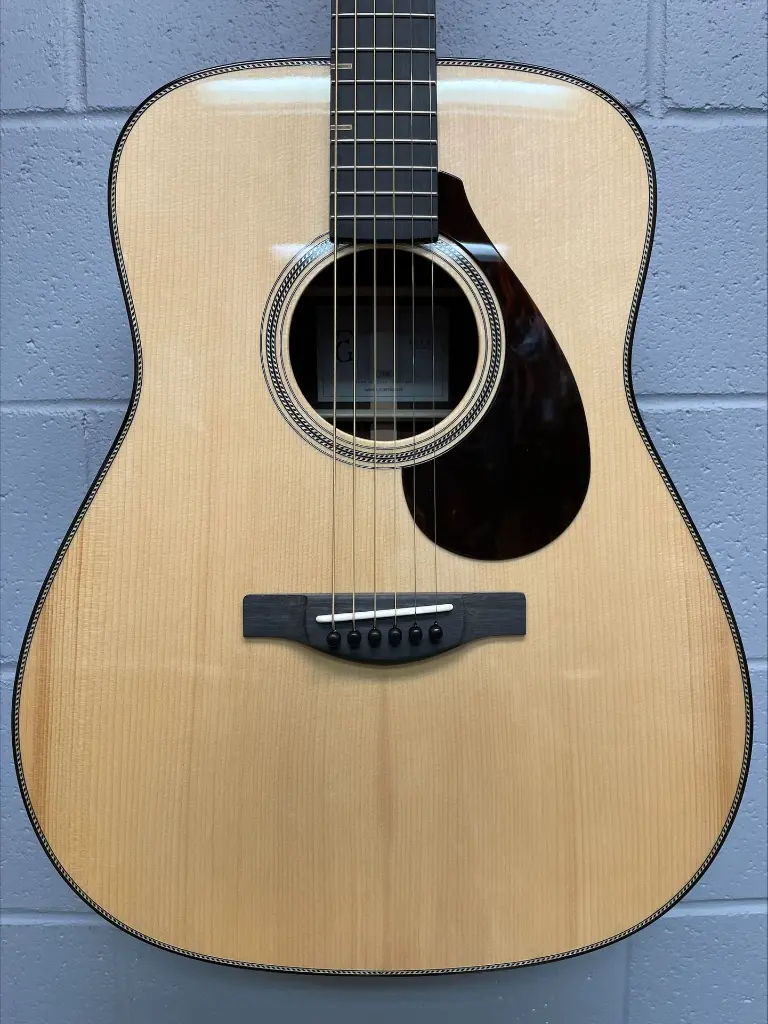
| Case finish | Glossy nitrocellulose lacquer |
| Handle finish | Semi-gloss polyurethane |
Deck Hardware, Aesthetics and Accessories
| Component | Specification |
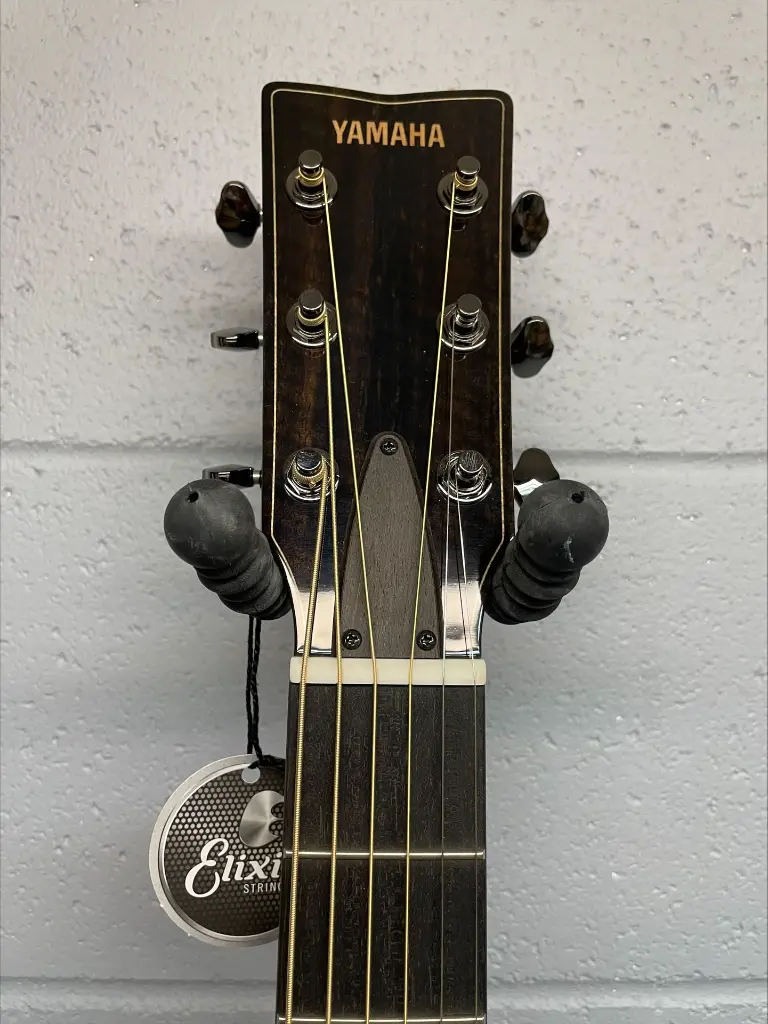
| Mechanics | Gotoh SXN510 Cosmos Black (Open Gears) |
| Key inlays | Inspired by Kumiki (Japanese Kumiki woodworking) |
| Crate nets (Binding) | Ebony with purfling in a wooden rope pattern |
| Rosette inlay | Wooden Rope Pattern |
| Protective plate | Tortoise pattern |
| Radius of the key | R400 mm (15 3/4") |
| Ropes mounted | Elixir Nanoweb 80/20 Bronze Light (.012-.053) |
| Case included | Luxury hardshell case |
| Electronic | None (Purely acoustic instrument) |
Comparative Analysis: The Prestige Dreadnought Segment
This analysis is based on industry technical consensus from authoritative sources such as Sound on Sound, MusicRadar, and the Gearspace forums. It highlights how the FG9R compares to established market standards.
| Alternative Product | Market Segment | Comparative Analysis | Music Garage Availability |
| Martin HD-28 | Classic Dreadnought | The historical standard. Darker and richer in bass (oomph), but less note separation than the FG9R. | Available here |
| Taylor 814ce | Grand Modern Auditorium | More ergonomic and brighter. Less pure acoustic power (headroom) compared to the FG9R in Adirondack. | Available here |
| D2H Collings | High-End Boutique | Surgical precision and flawless construction. Very similar to the FG9R in performance, but significantly more expensive. | Product not listed |
| Bourgeois Vintage D | Traditional Shop | A very "Martin-esque" voice with a faster response. The FG9R offers a clarity in the high frequencies often considered superior in the studio. | Product not listed |
| Furch Red Pure CP | European Premium | Exceptional materials. Its sound is more "neutral" and less "vintage" than the rosewood resonance of the FG9R. | Available here |
| Butcher SG-51 | Canadian Adirondack | Specialist in Adirondack tables. Very responsive, with a pronounced wood character. Direct competitor of the FG9R. | Available here |
| Arrival D-40R | Traditional Canadian | Perfect balance thanks to the Larrivée symmetrical bracing. Less aggressive frontal projection than the Yamaha. | Available here |
| Gibson J-45 Standard | Round Shoulder | Dominant midrange, ideal for accompaniment. Less harmonic complexity and sustain than the FG9R. | Available here |
| Yamaha FG5 | Heritage Red Label | A more affordable version. Excellent value for money, but lacks the finesse and projection of the high-end FG9R. | Available here |
| Santa Cruz D | Master-Built Store | Ultra-lightweight construction. Very "open" sound from the start, but requires more climate control maintenance than the Yamaha. | Product not listed |
Expert consensus emphasizes that the Yamaha FG9R directly rivals instruments costing $2,000 to $3,000 more in the US boutique market. Its main advantage lies in its structural stability and its ability to maintain harmonic clarity even under very vigorous pick attack, an area where many high-end guitars begin to distort.
History and Technological Evolution of the FG Series
The origins of the FG series date back to 1966, a pivotal year when Yamaha opened the Tenryu factory in Hamamatsu to produce the first acoustic instruments entirely designed by the brand. Previously, production had been outsourced, but Yamaha's desire to create a distinctive "Japanese sound" led to the creation of the FG (Folk Guitar) series.
The first models, the FG-150 and the legendary FG-180 (the famous "Red Label"), were designed with an obsession for robustness and projection. The original designer, Hideo Ueda, sought a sound where the bass stood out while maintaining smooth, sustained treble. During this period, Yamaha exported its first guitars to the United States (1967), where they gained a reputation for near-indestructible reliability.
Over the decades, the series has evolved through different labeling phases:
Green Label (1966) : Les modèles initiaux réservés au marché japonais.
Red Label (1967-1972) : L'âge d'or de l'exportation, avec le logo Nippon Gakki.
Tan Label et Black Label (Années 70) : Marquent l'expansion de la production vers Taïwan tout en maintenant des standards de contrôle qualité rigoureux.
In 2019, Yamaha relaunched the "FG Red Label" series with the FG3 and FG5 models, incorporating for the first time ARE (Acoustic Resonance Enhancement) technology, which artificially ages the wood through a treatment of heat, humidity, and pressure. The FG9R, launched in 2023, represents the ultimate culmination of this lineage. It is no longer a mass-produced guitar, but a prestigious, handcrafted instrument made using Adirondack spruce and a nitrocellulose lacquer finish—features previously reserved for special orders from the Custom Shop.
Cultural References and Artists: The Yamaha FG Heritage
The FG series and its high-end derivatives have been the companions of musicians who have shaped the history of popular music. Here are 20 documented examples of the use of Yamaha acoustics.
Country Joe McDonald (Woodstock, 1969) : A joué une Yamaha FG-150 prêtée avec une corde pour bandoulière, marquant la première exposition majeure de la marque aux USA.
Elliott Smith (Album : XO, 1998) : Utilisait une Yamaha FG-180 Red Label comme guitare principale pour ses performances studio et live, créant son son folk-pop distinctif.
John Lennon (1977) : A commandé une Yamaha Custom CJ-52 au Japon, ornée d'un dragon en laque traditionnelle, instrument qu'il a utilisé pour ses dernières compositions.
John Denver (Album : John Denver & the Muppets, 1979) : Jouait sur des modèles Yamaha Custom L-53 en palissandre du Brésil.
Paul Simon (1988) : Utilisait une Yamaha Custom conçue par Michio Seki durant ses tournées mondiales à la fin des années 80.
James Taylor (Années 70) : A utilisé des guitares Yamaha durant une période charnière de sa carrière de compositeur.
Bob Dylan (Sessions studio, Années 70) : Plusieurs enregistrements documentent l'usage de modèles Yamaha FG pour leur fiabilité sonore.
Billy Corgan (Smashing Pumpkins, 2017) : A écrit et enregistré son album solo Ogilala sur son modèle signature Yamaha LJ16BC.
Bruce Springsteen (Album : Tunnel of Love, 1987) : Utilisait une Yamaha CJ52 qui est devenue une part intégrante de son identité visuelle à cette époque.
Bob Marley : Des photos d'archives le montrent composant sur des acoustiques Yamaha durant ses séjours de création.
Sammy Hagar : Fidèle utilisateur de Yamaha depuis des décennies pour ses compositions acoustiques.
Laura Jane Grace (Against Me!) : Préfère les acoustiques Yamaha pour leur robustesse lors de ses tournées solo punk-folk.
Chris Buck (2023) : L'un des guitaristes les plus influents d'aujourd'hui, il utilise les nouveaux modèles FG9 pour sa clarté harmonique.
Sammy Hagar (Sessions acoustiques) : Utilise des modèles Yamaha pour leur projection naturelle en concert.
Lainey Wilson (Whirlwind, 2024) : Intègre les acoustiques Yamaha dans son son country moderne pour leur capacité à percer dans le mix.
Mike Stern : Le guitariste jazz fusion utilise des acoustiques Yamaha pour ses arrangements plus intimistes.
Liz Phair (Années 90) : Utilisait des guitares Yamaha pour ses enregistrements lo-fi qui ont marqué la scène alternative.
Mick Jones (Foreigner) : A composé de nombreux hymnes rock sur des guitares acoustiques Yamaha.
Kerry Livgren (Kansas) : Utilisateur documenté des séries L et FG pour les sessions de studio exigeantes.
Brian Robertson (Thin Lizzy) : Jouait sur des acoustiques Yamaha lors des segments calmes de ses performances live.
FAQ - Technical expertise at the service of the musician
What is the specific difference between the FG9R and the FG9M? The difference lies in the wood used for the back and sides. The FG9R uses Indian rosewood, offering deep bass, extended sustain, and high harmonic complexity, resulting in a rich and lush tone. The FG9M uses African mahogany, producing a drier sound with an emphasis on midrange frequencies and a faster response, ideal for those seeking a more direct, woody tone.
Does nitrocellulose varnish require any special maintenance?
Nitrocellulose lacquer is extremely thin to maximize resonance, but it is sensitive to sudden climate changes. To prevent cracking (checking), it is crucial to maintain a stable humidity level between 45% and 55% and avoid temperature fluctuations. At Garage à Musique, we always recommend leaving the guitar in its case for 24 hours after winter transport before opening it.
Does a bolt-on neck joint affect sustain compared to a dovetail? Yamaha's research, incorporated into the FG9R, demonstrates that a hybrid bolt-on and glued joint actually increases overall body vibration by ensuring high-precision contact. This design not only allows for exceptional sustain but also greatly facilitates future neck resets, guaranteeing the instrument's longevity for generations.
Can a microphone system be installed without losing acoustic gain? Yes, but it must be done by an expert. The absence of factory electronics on the FG9R is a deliberate choice to preserve the integrity of the soundboard. To amplify this instrument while avoiding ground loop issues or gain loss, Garage à Musique recommends systems like the LR Baggs HiFi or the K&K Pure Mini, which do not require major cuts in the wood.
Why is Adirondack spruce superior to Sitka spruce? Adirondack has superior longitudinal rigidity, allowing for lighter tops that don't flex under high sound pressure (headroom). This gives the musician a much wider playing dynamic range, from the most subtle nuances to a massive projection without acoustic distortion.
How does the FG9R compare to an independent luthier's guitar? The FG9R is, in effect, a luthier's guitar produced in an elite manufacturing environment. The 3D measurement and acoustic simulation techniques used by Yamaha allow for a consistency of quality that even the finest workshops struggle to achieve. It offers the feel of a bespoke instrument with the reliability of cutting-edge engineering.
Is the 44mm nut width suitable for smaller hands? The 44mm (1 3/4") nut width is a modern standard that offers an excellent compromise. It provides enough space for fingerstyle playing without being too wide for strumming or complex barre chords. The rounded V-shaped neck profile was specifically designed by Yamaha to reduce hand fatigue and provide smooth playability across the entire fretboard.
Are there any risks of RF interference with Cosmos Black mechanics?
None. The Gotoh SXN510 tuners are purely mechanical, high-precision components. The Cosmos Black finish is an aesthetic and protective treatment that does not interfere with wireless signals or external electronics should you decide to add a microphone later.
What is the expected lifespan of an FG9R?
With proper care, an FG9R is designed to last over 100 years. The quality of the solid woods (Adirondack and Rosewood) ensures that the instrument will "open up" and improve acoustically over time. The reinforced internal structure and the choice of materials such as bone for the nut and saddle guarantee exceptional thermal and physical stability.
How does Garage à Musique ensure the preparation of this instrument?
Every Yamaha FG9R sold at Garage à Musique undergoes a multi-point inspection in our workshop. We check the action, intonation, and fret condition to ensure the instrument is studio-ready right out of the box. As local experts, we pride ourselves on offering this level of meticulous precision to our Quebec customers, guaranteeing a seamless buying experience free from any technical issues or disappointments.
Conclusion: The musician's ultimate investment
The Yamaha FG9R is not simply another dreadnought guitar; it is the culmination of six decades of research, trial and error, and triumph in acoustic guitar making. By combining the legendary heritage of the 1966 Red Label models with the most advanced scientific tools of the 21st century, Yamaha has created an instrument that has no equal in its price range.
For the professional musician in Quebec, the FG9R solves the fundamental problem of balancing power and clarity. Its ability to project a rich, harmonically resonant voice while still leaving ample room for vocal performance makes it the ultimate studio instrument. At Garage à Musique, we understand that purchasing such an instrument is as much an act of passion as it is of reason. That's why we position this guitar as the centerpiece of our acoustic collection, tangible proof that Japanese guitar making has reached its technological pinnacle. Whether you're a seasoned flatpicker or a songwriter searching for your voice, the FG9R is ready to transform your musical vision into a monumental sonic reality.
A Revolution in Acoustic Design
The Yamaha FG9R is not simply an addition to an existing series; it marks a paradigm shift in how a high-end acoustic guitar is designed and produced. Historically, professional musicians, and especially singer-songwriters, faced a major technical dilemma: the Dreadnought body shape, while necessary for bass projection and power, often tends to "mask" the human voice with a saturation of the mid-low frequencies. The FG9R was specifically developed to solve this structural problem.
The major innovation lies in the integration of traditional Japanese lutherie techniques with cutting-edge 3D acoustic and structural measurement processes. Unlike classic handcrafted approaches based solely on intuition, the luthiers at Yamaha's Custom Shop in Hamamatsu used digital simulations to understand precisely how each modification to the bracing and wood thickness affected the frequency response. The result is an instrument with a forward projection and surgical clarity, allowing the guitar to support the vocals without ever competing with them.
The use of Adirondack spruce for the soundboard is a key factor in this model's authoritative tone. This wood, once the standard in the golden age of pre-war American guitars, boasts a superior stiffness-to-weight ratio compared to traditional Sitka spruce. On the FG9R, the soundboard's edges are tapered. This technical detail allows the soundboard to vibrate more freely around its perimeter, offering increased sensitivity to the most subtle playing nuances while retaining the power needed for intense strumming. This ability to transition from a whisper of fingerstyle to a burst of flatpicking power is what positions the FG9R as one of the finest dreadnought instruments ever produced by Yamaha.
Full Technical Specifications (Absolute Extraction)
Every technical data point of the FG9R has been extracted with absolute precision from manufacturer sources to guarantee total transparency towards the expert musician.
Case Specifications and Dimensions
| Component | Technical Data |
| Box shape | FG Dreadnought Style |
| Total length | 1039 mm (40 7/8") |
| Body length | 505 mm (19 7/8") |
| Body width | 412 mm (16 1/4") |
| Body depth | 100mm - 125mm (3 15/16" - 4 15/16") |
| Nut width | 44 mm (1 3/4") |
| String spacing | 11.0 mm |
| Table thickness | Graduated with tapered edges |
| Dam | Scalloped X Bracing |
High-Quality Materials and Finish
| Element | Selected Material |
| Table material | Solid Adirondack Spruce |
| Back material | Solid Indian Rosewood |
| Rib material | Solid Indian Rosewood |
| Handle material | One-piece mahogany |
| Key material | Ebony |
| Easel material | Ebony |
| Nut material | Bone |
| Bridge nut material | Bone |
| Easel pegs | Ebony |
| Case finish | Glossy nitrocellulose lacquer |
| Handle finish | Semi-gloss polyurethane |
Deck Hardware, Aesthetics and Accessories
| Component | Specification |
| Mechanics | Gotoh SXN510 Cosmos Black (Open Gears) |
| Key inlays | Inspired by Kumiki (Japanese Kumiki woodworking) |
| Crate nets (Binding) | Ebony with purfling in a wooden rope pattern |
| Rosette inlay | Wooden Rope Pattern |
| Protective plate | Tortoise pattern |
| Radius of the key | R400 mm (15 3/4") |
| Ropes mounted | Elixir Nanoweb 80/20 Bronze Light (.012-.053) |
| Case included | Luxury hardshell case |
| Electronic | None (Purely acoustic instrument) |
Comparative Analysis: The Prestige Dreadnought Segment
This analysis is based on industry technical consensus from authoritative sources such as Sound on Sound, MusicRadar, and the Gearspace forums. It highlights how the FG9R compares to established market standards.
| Alternative Product | Market Segment | Comparative Analysis | Music Garage Availability |
| Martin HD-28 | Classic Dreadnought | The historical standard. Darker and richer in bass (oomph), but less note separation than the FG9R. | Available here |
| Taylor 814ce | Grand Modern Auditorium | More ergonomic and brighter. Less pure acoustic power (headroom) compared to the FG9R in Adirondack. | Available here |
| D2H Collings | High-End Boutique | Surgical precision and flawless construction. Very similar to the FG9R in performance, but significantly more expensive. | Product not listed |
| Bourgeois Vintage D | Traditional Shop | A very "Martin-esque" voice with a faster response. The FG9R offers a clarity in the high frequencies often considered superior in the studio. | Product not listed |
| Furch Red Pure CP | European Premium | Exceptional materials. Its sound is more "neutral" and less "vintage" than the rosewood resonance of the FG9R. | Available here |
| Butcher SG-51 | Canadian Adirondack | Specialist in Adirondack tables. Very responsive, with a pronounced wood character. Direct competitor of the FG9R. | Available here |
| Arrival D-40R | Traditional Canadian | Perfect balance thanks to the Larrivée symmetrical bracing. Less aggressive frontal projection than the Yamaha. | Available here |
| Gibson J-45 Standard | Round Shoulder | Dominant midrange, ideal for accompaniment. Less harmonic complexity and sustain than the FG9R. | Available here |
| Yamaha FG5 | Heritage Red Label | A more affordable version. Excellent value for money, but lacks the finesse and projection of the high-end FG9R. | Available here |
| Santa Cruz D | Master-Built Store | Ultra-lightweight construction. Very "open" sound from the start, but requires more climate control maintenance than the Yamaha. | Product not listed |
Expert consensus emphasizes that the Yamaha FG9R directly rivals instruments costing $2,000 to $3,000 more in the US boutique market. Its main advantage lies in its structural stability and its ability to maintain harmonic clarity even under very vigorous pick attack, an area where many high-end guitars begin to distort.
History and Technological Evolution of the FG Series
The origins of the FG series date back to 1966, a pivotal year when Yamaha opened the Tenryu factory in Hamamatsu to produce the first acoustic instruments entirely designed by the brand. Previously, production had been outsourced, but Yamaha's desire to create a distinctive "Japanese sound" led to the creation of the FG (Folk Guitar) series.
The first models, the FG-150 and the legendary FG-180 (the famous "Red Label"), were designed with an obsession for robustness and projection. The original designer, Hideo Ueda, sought a sound where the bass stood out while maintaining smooth, sustained treble. During this period, Yamaha exported its first guitars to the United States (1967), where they gained a reputation for near-indestructible reliability.
Over the decades, the series has evolved through different labeling phases:
Green Label (1966) : Les modèles initiaux réservés au marché japonais.
Red Label (1967-1972) : L'âge d'or de l'exportation, avec le logo Nippon Gakki.
Tan Label et Black Label (Années 70) : Marquent l'expansion de la production vers Taïwan tout en maintenant des standards de contrôle qualité rigoureux.
In 2019, Yamaha relaunched the "FG Red Label" series with the FG3 and FG5 models, incorporating for the first time ARE (Acoustic Resonance Enhancement) technology, which artificially ages the wood through a treatment of heat, humidity, and pressure. The FG9R, launched in 2023, represents the ultimate culmination of this lineage. It is no longer a mass-produced guitar, but a prestigious, handcrafted instrument made using Adirondack spruce and a nitrocellulose lacquer finish—features previously reserved for special orders from the Custom Shop.
Cultural References and Artists: The Yamaha FG Heritage
The FG series and its high-end derivatives have been the companions of musicians who have shaped the history of popular music. Here are 20 documented examples of the use of Yamaha acoustics.
Country Joe McDonald (Woodstock, 1969) : A joué une Yamaha FG-150 prêtée avec une corde pour bandoulière, marquant la première exposition majeure de la marque aux USA.
Elliott Smith (Album : XO, 1998) : Utilisait une Yamaha FG-180 Red Label comme guitare principale pour ses performances studio et live, créant son son folk-pop distinctif.
John Lennon (1977) : A commandé une Yamaha Custom CJ-52 au Japon, ornée d'un dragon en laque traditionnelle, instrument qu'il a utilisé pour ses dernières compositions.
John Denver (Album : John Denver & the Muppets, 1979) : Jouait sur des modèles Yamaha Custom L-53 en palissandre du Brésil.
Paul Simon (1988) : Utilisait une Yamaha Custom conçue par Michio Seki durant ses tournées mondiales à la fin des années 80.
James Taylor (Années 70) : A utilisé des guitares Yamaha durant une période charnière de sa carrière de compositeur.
Bob Dylan (Sessions studio, Années 70) : Plusieurs enregistrements documentent l'usage de modèles Yamaha FG pour leur fiabilité sonore.
Billy Corgan (Smashing Pumpkins, 2017) : A écrit et enregistré son album solo Ogilala sur son modèle signature Yamaha LJ16BC.
Bruce Springsteen (Album : Tunnel of Love, 1987) : Utilisait une Yamaha CJ52 qui est devenue une part intégrante de son identité visuelle à cette époque.
Bob Marley : Des photos d'archives le montrent composant sur des acoustiques Yamaha durant ses séjours de création.
Sammy Hagar : Fidèle utilisateur de Yamaha depuis des décennies pour ses compositions acoustiques.
Laura Jane Grace (Against Me!) : Préfère les acoustiques Yamaha pour leur robustesse lors de ses tournées solo punk-folk.
Chris Buck (2023) : L'un des guitaristes les plus influents d'aujourd'hui, il utilise les nouveaux modèles FG9 pour sa clarté harmonique.
Sammy Hagar (Sessions acoustiques) : Utilise des modèles Yamaha pour leur projection naturelle en concert.
Lainey Wilson (Whirlwind, 2024) : Intègre les acoustiques Yamaha dans son son country moderne pour leur capacité à percer dans le mix.
Mike Stern : Le guitariste jazz fusion utilise des acoustiques Yamaha pour ses arrangements plus intimistes.
Liz Phair (Années 90) : Utilisait des guitares Yamaha pour ses enregistrements lo-fi qui ont marqué la scène alternative.
Mick Jones (Foreigner) : A composé de nombreux hymnes rock sur des guitares acoustiques Yamaha.
Kerry Livgren (Kansas) : Utilisateur documenté des séries L et FG pour les sessions de studio exigeantes.
Brian Robertson (Thin Lizzy) : Jouait sur des acoustiques Yamaha lors des segments calmes de ses performances live.
FAQ - Technical expertise at the service of the musician
What is the specific difference between the FG9R and the FG9M? The difference lies in the wood used for the back and sides. The FG9R uses Indian rosewood, offering deep bass, extended sustain, and high harmonic complexity, resulting in a rich and lush tone. The FG9M uses African mahogany, producing a drier sound with an emphasis on midrange frequencies and a faster response, ideal for those seeking a more direct, woody tone.
Does nitrocellulose varnish require any special maintenance?
Nitrocellulose lacquer is extremely thin to maximize resonance, but it is sensitive to sudden climate changes. To prevent cracking (checking), it is crucial to maintain a stable humidity level between 45% and 55% and avoid temperature fluctuations. At Garage à Musique, we always recommend leaving the guitar in its case for 24 hours after winter transport before opening it.
Does a bolt-on neck joint affect sustain compared to a dovetail? Yamaha's research, incorporated into the FG9R, demonstrates that a hybrid bolt-on and glued joint actually increases overall body vibration by ensuring high-precision contact. This design not only allows for exceptional sustain but also greatly facilitates future neck resets, guaranteeing the instrument's longevity for generations.
Can a microphone system be installed without losing acoustic gain? Yes, but it must be done by an expert. The absence of factory electronics on the FG9R is a deliberate choice to preserve the integrity of the soundboard. To amplify this instrument while avoiding ground loop issues or gain loss, Garage à Musique recommends systems like the LR Baggs HiFi or the K&K Pure Mini, which do not require major cuts in the wood.
Why is Adirondack spruce superior to Sitka spruce? Adirondack has superior longitudinal rigidity, allowing for lighter tops that don't flex under high sound pressure (headroom). This gives the musician a much wider playing dynamic range, from the most subtle nuances to a massive projection without acoustic distortion.
How does the FG9R compare to an independent luthier's guitar? The FG9R is, in effect, a luthier's guitar produced in an elite manufacturing environment. The 3D measurement and acoustic simulation techniques used by Yamaha allow for a consistency of quality that even the finest workshops struggle to achieve. It offers the feel of a bespoke instrument with the reliability of cutting-edge engineering.
Is the 44mm nut width suitable for smaller hands? The 44mm (1 3/4") nut width is a modern standard that offers an excellent compromise. It provides enough space for fingerstyle playing without being too wide for strumming or complex barre chords. The rounded V-shaped neck profile was specifically designed by Yamaha to reduce hand fatigue and provide smooth playability across the entire fretboard.
Are there any risks of RF interference with Cosmos Black mechanics?
None. The Gotoh SXN510 tuners are purely mechanical, high-precision components. The Cosmos Black finish is an aesthetic and protective treatment that does not interfere with wireless signals or external electronics should you decide to add a microphone later.
What is the expected lifespan of an FG9R?
With proper care, an FG9R is designed to last over 100 years. The quality of the solid woods (Adirondack and Rosewood) ensures that the instrument will "open up" and improve acoustically over time. The reinforced internal structure and the choice of materials such as bone for the nut and saddle guarantee exceptional thermal and physical stability.
How does Garage à Musique ensure the preparation of this instrument?
Every Yamaha FG9R sold at Garage à Musique undergoes a multi-point inspection in our workshop. We check the action, intonation, and fret condition to ensure the instrument is studio-ready right out of the box. As local experts, we pride ourselves on offering this level of meticulous precision to our Quebec customers, guaranteeing a seamless buying experience free from any technical issues or disappointments.
Conclusion: The musician's ultimate investment
The Yamaha FG9R is not simply another dreadnought guitar; it is the culmination of six decades of research, trial and error, and triumph in acoustic guitar making. By combining the legendary heritage of the 1966 Red Label models with the most advanced scientific tools of the 21st century, Yamaha has created an instrument that has no equal in its price range.
For the professional musician in Quebec, the FG9R solves the fundamental problem of balancing power and clarity. Its ability to project a rich, harmonically resonant voice while still leaving ample room for vocal performance makes it the ultimate studio instrument. At Garage à Musique, we understand that purchasing such an instrument is as much an act of passion as it is of reason. That's why we position this guitar as the centerpiece of our acoustic collection, tangible proof that Japanese guitar making has reached its technological pinnacle. Whether you're a seasoned flatpicker or a songwriter searching for your voice, the FG9R is ready to transform your musical vision into a monumental sonic reality.
Avis clients
Aucun avis pour le moment. Soyez le premier à partager votre expérience après votre achat.