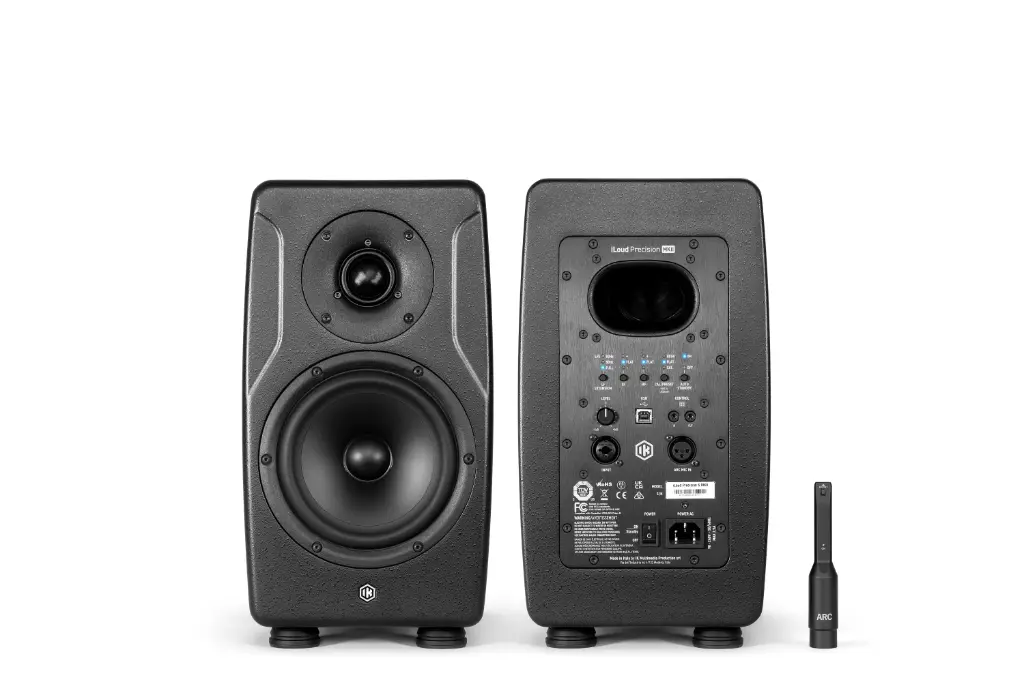
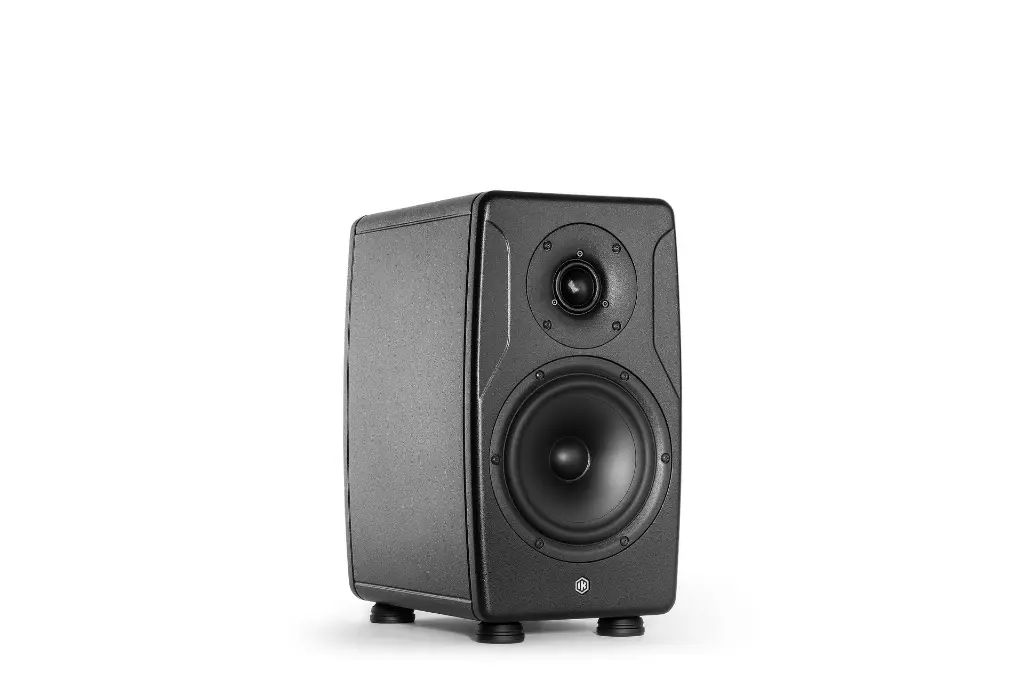
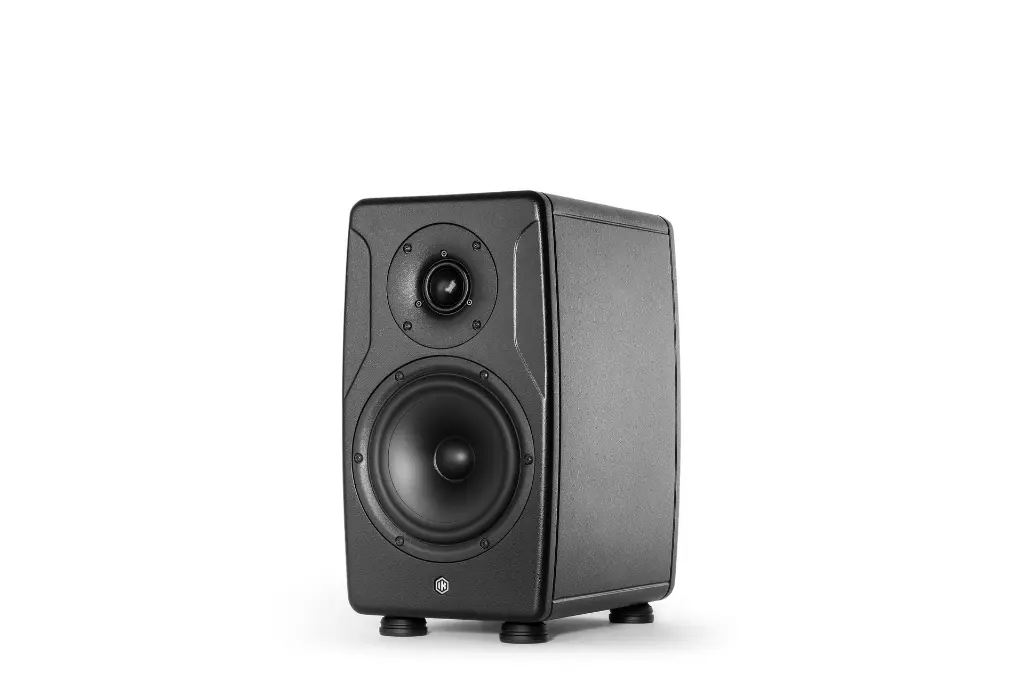
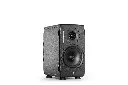
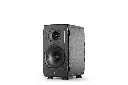
IK iLoud Precision 6 - Studio Monitor - Precise Sound
Achieve absolute acoustic neutrality with the iLoud Precision 6 MKII, the studio monitor that eliminates guesswork in your mixes.
This near-field monitoring system, handcrafted in Italy, combines a high-tech graphene tweeter with an internal 96 kHz DSP to deliver an ultra-linear frequency response from 45 Hz to 30 kHz (±1 dB). Thanks to native integration of the ARC X calibration system and fully linear phase management, the iLoud Precision 6 MKII ensures your mixing decisions translate with surgical precision to any listening system, from smartphones to club setups.
This content will be shared across all product pages.
Technical Expertise at the Service of Music
Authority Section: Why the iLoud Precision 6 MKII is the ultimate tool for the professional musician
In today's production environment, the biggest obstacle is no longer the quality of virtual instruments or preamps, but the engineer's ability to hear the acoustic truth of their work. Most studio monitors, even in high-price ranges, introduce flattering colorations or phase shifts that mask frequency and dynamic range issues. IK Multimedia's iLoud Precision 6 MKII was designed with a radical philosophy: to transform the monitor into a pure measurement instrument, capable of disappearing behind the sound.
The first pillar of this acoustic authority is frequency linearity. With a tolerance of ±1 dB between 45 Hz and 30 kHz, this monitor offers a "flat" response that doesn't favor any frequency at the expense of another. This precision allows the mixer to instantly detect excess energy in the low-midrange or aggressive sibilance in the high frequencies, thus drastically reducing the time needed to finalize a project. Unlike passive monitors or traditional active systems, the iLoud Precision uses a state-of-the-art DSP (Digital Signal Processor) operating at 96 kHz to handle filtering and equalization with a temporal resolution that analog cannot match.
The second pillar is phase and time coherence. A major problem with two-way speakers is the time lag between the woofer and tweeter at the crossover point. The iLoud Precision 6 MKII corrects this phenomenon with digital time alignment, ensuring that all frequencies reach the listener's ear simultaneously. This phase linearity, maintained at ±20° above 150 Hz, is crucial for transient perception. When a snare drum hits, you hear the initial attack and the body resonance with three-dimensional clarity, allowing for precise placement within the stereo image.
Finally, this model's authority lies in its adaptability via the ARC X (Acoustic Room Correction) system. The room is often the weakest link in the audio chain. Standing waves and primary reflections create artificial peaks and dips. Using the included measurement microphone, the iLoud Precision 6 MKII analyzes your studio's acoustics at three different heights to create a custom correction profile. This correction is more than just equalization; it adjusts the impulse response to compensate for room imperfections, transforming an ordinary office or bedroom into a reliable mixing console.
Full Technical Specifications
The following tables detail all the technical specifications of the iLoud Precision 6 MKII, as provided by the manufacturer.
Acoustic and Frequency Performance
| Setting | Value / Detail |
| Frequency response (±1 dB) | 45 Hz – 30 kHz |
| Low-frequency extension (-4 dB) | 37 Hz |
| Low-frequency extension (-10 dB) | 32 Hz |
| Maximum continuous sound pressure level (SPL) (1m) | 103 dB |
| Maximum peak sound pressure level (SPL) (1m) | 115.2 dB |
| Phase coherence (above 150 Hz) | ±20° |
| Total latency (full system) | < 2.5 ms |
| Unit-to-unit precision | ±0.5 dB |
Transducers and Amplification
| Component | Specifications |
| Tweet | 1.5" graphene-reinforced textile dome, high output, low distortion |
| Woofer | 6.5" ultra-lightweight coated paper, high excursion |
| Total RMS power | 150 W |
| Bass (LF) amplification | 120 W RMS (Class D) |
| High-frequency (HF) amplification | 30 W RMS (Class D) |
| Crossover | Digital, linear phase, 2.1 kHz |
| DSP treatment | Internal, 96 kHz / 24 bits |
Connectivity and Software Interface
| Port / Function | Connector Type |
| Main Audio Input | Combo XLR-1/4" TRS (Balanced) |
| Measurement Microphone Input | Dedicated XLR (for ARC system) |
| Communication Port / Update | USB Type-B |
| External Control | 3.5 mm jack input/output for optional remote control |
| Control Software | X-MONITOR (macOS and Windows compatible) |
| Food | Internal, 90V to 240V AC, 50/60 Hz |
Physical Characteristics and Materials
| Attribute | Detail |
| Cabinet Material | High-density HDF (High Density Fiberboard) |
| Speaker type | Bass-Reflex / Front-Wound |
| Finishing | Black (Handcrafted in Italy) |
| Dimensions (H x W x D) | 35.3cm x 20.1cm x 28.2cm (13.89" x 7.91" x 11.1") |
| Weight | 7.7 kg (17 lb) per monitor |
| Assembly | Lower and rear mounting points (M6) for Atmos brackets |
| Status indicator | Front LED logo (customizable via software) |
Comparative Analysis: 10 Alternatives and Direct Competitors
Choosing a studio monitor is a critical decision. This analysis draws on industry technical consensus from sources such as Sound on Sound , MusicRadar , and Gearspace to compare the iLoud Precision 6 MKII to its most notable rivals.
| Alternative Product | Market Segment | Comparative Analysis | Available at Garage à Musique |
| Focal Shape 65 | Nearfield Premium | Points Forts : Radiateurs passifs excellents pour les petites pièces. Points Faibles : Pas de DSP ou de calibration auto ; image stéréo plus étroite. | Available here |
| Genelec 8040B | Industry standard | Points Forts : Châssis en aluminium robuste, très fiable. Points Faibles : Conception ancienne sans correction acoustique numérique intégrée. | Product not listed |
| Neumann KH 120 II | Surgical precision | Points Forts : DSP puissant, linéarité exemplaire. Points Faibles : Woofer plus petit (5,25") ; nécessite un sub pour égaler l'extension de l'iLoud. | Available here |
| Adam Audio A7V | Versatile Nearfield | Points Forts : Tweeter à ruban très détaillé, DSP Ethernet. Points Faibles : Hautes fréquences parfois perçues comme trop brillantes (fatigue auditive). | Available here |
| Kali Audio IN-8 V2 | 3-Way Coaxial | Points Forts : Design coaxial offrant une cohérence de phase superbe. Points Faibles : Encombrement massif, électronique moins silencieuse que l'iLoud. | Product not listed |
| Yamaha HS8 | Studio Classic | Points Forts : Révèle impitoyablement les erreurs de mixage. Points Faibles : Port arrière problématique près des murs ; manque de détails dans le haut du spectre. | Available here |
| Barefoot Footprint 02 | High-End Monitoring | Points Forts : Technologie MEME pour émuler d'autres enceintes. Points Faibles : Prix nettement plus élevé ; moins de flexibilité de calibration auto. | Product not listed |
| JBL 306P MkII | Professional budget | Points Forts : Guide d'onde Image Control superbe. Points Faibles : Bruit de fond (hiss) audible ; précision spectrale moindre que la série Precision. | Available here |
| Focal Alpha 80 Evo | Powerful semi-professional | Points Forts : Grande réserve de puissance, basses amples. Points Faibles : Moins de détails fins dans les médiums ; pas de correction de pièce. | Available here |
| Genelec 8331A (The Ones) | Point Source Ultra-Pro | Points Forts : Le summum de la technologie coaxiale et SAM. Points Faibles : Coût deux fois supérieur à l'iLoud Precision 6. | Product not listed |
History & Evolution: From software emulation to hardware perfection
IK Multimedia, based in Modena, Italy, began its journey in 1996 by revolutionizing the software world with AmpliTube and T-RackS. This expertise in analog modeling and digital signal processing is the very DNA of the iLoud range.
In 2014, IK Multimedia revolutionized the market with the iLoud Micro Monitor, proving that a speaker the size of a brick could produce reference-quality sound thanks to intelligent DSP. In 2019, the iLoud MTM introduced built-in ARC calibration, quickly becoming a favorite for immersive setups and home studios.
The iLoud Precision 6 MKII, launched in 2025, represents the culmination of this lineage. Unlike previous, more compact versions, the Precision series is handcrafted in Italy using high-density fiberboard (HDF) and audiophile-grade drivers. The MKII version introduced the graphene tweeter, offering structural rigidity that pushes the boundaries of high-frequency clarity, and the new ARC X software, which enables 3D measurement (three different heights) for unprecedented correction accuracy in this price range.
Cultural References & Artists: They trust IK's ear
The iLoud ecosystem has become a de facto standard for many renowned producers and engineers, attracted by the reliability of the translation of their mixes.
Eddie Kramer (Producteur de Jimi Hendrix et Led Zeppelin) : Utilise les moniteurs iLoud pour leur précision mobile.
Chris Lord-Alge (Ingénieur de mixage pour Green Day, Muse) : Adopte la gamme iLoud pour vérifier ses mixages sur une référence de confiance.
IRKO (Ingénieur de Kanye West, Donda, 2021) : Utilise les Precision MTM pour leur rendu incroyable des basses fréquences sans subwoofer.
Hugh Padgham (Producteur de Phil Collins et The Police) : S'appuie sur la transparence d'IK pour ses travaux de studio.
Dave Pensado (Ingénieur de mixage, Pensado's Place) : A qualifié les iLoud de "classiques instantanés" pour leur capacité à révéler les détails.
German Tarazona (Ingénieur de Maluma) : Déclare que le bas du spectre des Precision est spectaculaire pour ses besoins de production urbaine.
Eddie "El Brujo" Caipo (Ingénieur pour No Doubt) : Utilise les iLoud lors de la performance à Coachella 2024.
Will Madera (Ingénieur FOH de Pitbull) : Dépend de la gamme IK pour la précision de ses réglages en tournée.
Massimo Barbieri (Ingénieur de Mika) : Intègre les moniteurs IK dans ses configurations de mixage de façade.
Ilan Rubin (Batteur de Nine Inch Nails) : Utilise les outils IK en tournée pour ses sessions de création mobiles.
Maria Elisa Ayerbe (Nominée aux Grammy) : Affirme qu'il n'y a pas un seul mix qu'elle ne vérifie sur ses moniteurs iLoud.
David Loy (Ingénieur de Kane Brown) : A utilisé les Precision MTM pour le mixage du Super Bowl et de Thursday Night Football.
Warren Huart (Produce Like A Pro) : A vanté la réponse naturelle et l'absence de fatigue auditive de la série Precision 6.
Paul Special (Ingénieur pour Good Morning America) : Utilise les iLoud dans un contexte de diffusion télévisuelle critique.
Danny Cheung (Ingénieur playback du Super Bowl) : Ne part jamais en tournée sans ses moniteurs IK.
Brian Chirlo (7 fois gagnant aux Grammy) : Souligne que la clarté des iLoud rivalise avec les moniteurs de studio les plus imposants.
Atlantic Studios : Utilise les Precision pour leur imagerie stéréo exceptionnelle.
Luke Wooten (Ingénieur de Nashville) : Apprécie la clarté et l'absence de fatigue lors de longues sessions de mixage.
George Shilling (Producteur et musicien) : Utilise le modèle Precision 5 pour sa fidélité exemplaire.
Kent Hooper (Producteur) : Recommande la série Precision pour son caractère "impressionnant" et son utilité en studio professionnel.
FAQ - Expert Answers to Your Technical Questions
How does the ARC X system help eliminate a ground loop? The ARC X system doesn't physically fix a ground loop , but by correcting your room's frequency response, it makes it easier to distinguish electrical background noise from useful frequencies. If you hear a persistent hum, Garage à Musique recommends using a ground isolator or balanced XLR cables. The iLoud Precision 6 MKII, thanks to its internal DSP processing, maintains an extremely low noise floor, making it easier to identify and eliminate external interference.
Does the graphene tweeter require phantom power? No, the tweeter is a passive component powered by the monitor's internal Class D amplifier. Phantom power (+48V) from your audio interface is not required to operate the speakers. However, if you use the included ARC measurement microphone, it is powered directly from the dedicated "ARC Mic" XLR port on the back of the speaker, without interfering with your other equipment.
What is the actual impact of DSP latency on live monitoring? With a total latency of less than 2.5 ms, the iLoud Precision 6 MKII is virtually imperceptible to the human ear. This means you can record vocals or instruments in real time through the monitors without experiencing any annoying lag. This level of performance is made possible by the 96 kHz DSP processor, which handles phase and frequency correction with maximum efficiency for instantaneous response.
Why is phase linearity crucial for clarity? Phase linearity ensures that the high and low frequencies of the same sound (like the "clack" and "boom" of a bass drum) reach your ears at precisely the same time. Without it, the sound loses impact and sounds muddy. The iLoud Precision 6 MKII digitally aligns these frequencies, delivering a stable stereo image and transient definition that analog filters simply cannot achieve.
Can RF interference affect ARC X calibration? RF (Radio Frequency) interference can sometimes occur with unshielded measurement cables. To prevent this, IK Multimedia has shielded the internal circuitry of the iLoud Precision. When calibrating with the ARC X software, ensure your mobile phones are kept away to guarantee the purest possible room acoustic measurement. A successful calibration allows the monitor to compensate for room reflections for perfectly balanced sound.
What's the difference between the iLoud Precision 6 and an 8-inch monitor? Although it uses a 6.5-inch woofer, the iLoud Precision 6 MKII reaches down to 37 Hz (-4 dB) thanks to its optimized DSP and high-density HDF enclosure. It often matches the bass response of a traditional 8-inch monitor, while offering significantly better midrange definition and a smaller footprint, making it ideal for medium-sized studios in Quebec.
How do I configure the monitors for an Atmos system? Thanks to the integrated mounting points on the bottom and back, the monitors can be easily installed on wall or ceiling mounts. The X-MONITOR software allows you to manage bass management settings and apply ARC X calibration to your entire multi-channel system for total and precise immersion.
Can the front LED logo be turned off? Yes, via the X-MONITOR software, you can adjust the brightness or completely turn off the front LED logo if you are working in a dark environment or if you prefer a more discreet look. This LED also serves as an indicator for the ARC calibration status.
Why choose the iLoud Precision 6 over the MTM model? The Precision 6 has a wider horizontal dispersion, making it less demanding regarding the exact position of your head (the "sweet spot"). The MTM model, on the other hand, has limited vertical dispersion to minimize reflections from your desk, but requires perfect alignment with your ears. The choice depends on your desk setup and listening preferences.
Where can I get support for my IK Multimedia product in Canada? Although the products are manufactured in Italy, IK Multimedia has a strong distribution network in Canada, with service centers and experts available through Garage à Musique. By purchasing from a local expert, you benefit from the full manufacturer's warranty and technical advice tailored to the Quebec market.
The iLoud Precision 6 MKII isn't just a speaker; it's the acoustic mirror of your talent. By choosing this monitor from Garage à Musique, you're investing in technology proven by the biggest names in the industry, designed to last and evolve with your musical career.
Technical Expertise at the Service of Music
Authority Section: Why the iLoud Precision 6 MKII is the ultimate tool for the professional musician
In today's production environment, the biggest obstacle is no longer the quality of virtual instruments or preamps, but the engineer's ability to hear the acoustic truth of their work. Most studio monitors, even in high-price ranges, introduce flattering colorations or phase shifts that mask frequency and dynamic range issues. IK Multimedia's iLoud Precision 6 MKII was designed with a radical philosophy: to transform the monitor into a pure measurement instrument, capable of disappearing behind the sound.
The first pillar of this acoustic authority is frequency linearity. With a tolerance of ±1 dB between 45 Hz and 30 kHz, this monitor offers a "flat" response that doesn't favor any frequency at the expense of another. This precision allows the mixer to instantly detect excess energy in the low-midrange or aggressive sibilance in the high frequencies, thus drastically reducing the time needed to finalize a project. Unlike passive monitors or traditional active systems, the iLoud Precision uses a state-of-the-art DSP (Digital Signal Processor) operating at 96 kHz to handle filtering and equalization with a temporal resolution that analog cannot match.
The second pillar is phase and time coherence. A major problem with two-way speakers is the time lag between the woofer and tweeter at the crossover point. The iLoud Precision 6 MKII corrects this phenomenon with digital time alignment, ensuring that all frequencies reach the listener's ear simultaneously. This phase linearity, maintained at ±20° above 150 Hz, is crucial for transient perception. When a snare drum hits, you hear the initial attack and the body resonance with three-dimensional clarity, allowing for precise placement within the stereo image.
Finally, this model's authority lies in its adaptability via the ARC X (Acoustic Room Correction) system. The room is often the weakest link in the audio chain. Standing waves and primary reflections create artificial peaks and dips. Using the included measurement microphone, the iLoud Precision 6 MKII analyzes your studio's acoustics at three different heights to create a custom correction profile. This correction is more than just equalization; it adjusts the impulse response to compensate for room imperfections, transforming an ordinary office or bedroom into a reliable mixing console.
Full Technical Specifications
The following tables detail all the technical specifications of the iLoud Precision 6 MKII, as provided by the manufacturer.
Acoustic and Frequency Performance
| Setting | Value / Detail |
| Frequency response (±1 dB) | 45 Hz – 30 kHz |
| Low-frequency extension (-4 dB) | 37 Hz |
| Low-frequency extension (-10 dB) | 32 Hz |
| Maximum continuous sound pressure level (SPL) (1m) | 103 dB |
| Maximum peak sound pressure level (SPL) (1m) | 115.2 dB |
| Phase coherence (above 150 Hz) | ±20° |
| Total latency (full system) | < 2.5 ms |
| Unit-to-unit precision | ±0.5 dB |
Transducers and Amplification
| Component | Specifications |
| Tweet | 1.5" graphene-reinforced textile dome, high output, low distortion |
| Woofer | 6.5" ultra-lightweight coated paper, high excursion |
| Total RMS power | 150 W |
| Bass (LF) amplification | 120 W RMS (Class D) |
| High-frequency (HF) amplification | 30 W RMS (Class D) |
| Crossover | Digital, linear phase, 2.1 kHz |
| DSP treatment | Internal, 96 kHz / 24 bits |
Connectivity and Software Interface
| Port / Function | Connector Type |
| Main Audio Input | Combo XLR-1/4" TRS (Balanced) |
| Measurement Microphone Input | Dedicated XLR (for ARC system) |
| Communication Port / Update | USB Type-B |
| External Control | 3.5 mm jack input/output for optional remote control |
| Control Software | X-MONITOR (macOS and Windows compatible) |
| Food | Internal, 90V to 240V AC, 50/60 Hz |
Physical Characteristics and Materials
| Attribute | Detail |
| Cabinet Material | High-density HDF (High Density Fiberboard) |
| Speaker type | Bass-Reflex / Front-Wound |
| Finishing | Black (Handcrafted in Italy) |
| Dimensions (H x W x D) | 35.3cm x 20.1cm x 28.2cm (13.89" x 7.91" x 11.1") |
| Weight | 7.7 kg (17 lb) per monitor |
| Assembly | Lower and rear mounting points (M6) for Atmos brackets |
| Status indicator | Front LED logo (customizable via software) |
Comparative Analysis: 10 Alternatives and Direct Competitors
Choosing a studio monitor is a critical decision. This analysis draws on industry technical consensus from sources such as Sound on Sound , MusicRadar , and Gearspace to compare the iLoud Precision 6 MKII to its most notable rivals.
| Alternative Product | Market Segment | Comparative Analysis | Available at Garage à Musique |
| Focal Shape 65 | Nearfield Premium | Points Forts : Radiateurs passifs excellents pour les petites pièces. Points Faibles : Pas de DSP ou de calibration auto ; image stéréo plus étroite. | Available here |
| Genelec 8040B | Industry standard | Points Forts : Châssis en aluminium robuste, très fiable. Points Faibles : Conception ancienne sans correction acoustique numérique intégrée. | Product not listed |
| Neumann KH 120 II | Surgical precision | Points Forts : DSP puissant, linéarité exemplaire. Points Faibles : Woofer plus petit (5,25") ; nécessite un sub pour égaler l'extension de l'iLoud. | Available here |
| Adam Audio A7V | Versatile Nearfield | Points Forts : Tweeter à ruban très détaillé, DSP Ethernet. Points Faibles : Hautes fréquences parfois perçues comme trop brillantes (fatigue auditive). | Available here |
| Kali Audio IN-8 V2 | 3-Way Coaxial | Points Forts : Design coaxial offrant une cohérence de phase superbe. Points Faibles : Encombrement massif, électronique moins silencieuse que l'iLoud. | Product not listed |
| Yamaha HS8 | Studio Classic | Points Forts : Révèle impitoyablement les erreurs de mixage. Points Faibles : Port arrière problématique près des murs ; manque de détails dans le haut du spectre. | Available here |
| Barefoot Footprint 02 | High-End Monitoring | Points Forts : Technologie MEME pour émuler d'autres enceintes. Points Faibles : Prix nettement plus élevé ; moins de flexibilité de calibration auto. | Product not listed |
| JBL 306P MkII | Professional budget | Points Forts : Guide d'onde Image Control superbe. Points Faibles : Bruit de fond (hiss) audible ; précision spectrale moindre que la série Precision. | Available here |
| Focal Alpha 80 Evo | Powerful semi-professional | Points Forts : Grande réserve de puissance, basses amples. Points Faibles : Moins de détails fins dans les médiums ; pas de correction de pièce. | Available here |
| Genelec 8331A (The Ones) | Point Source Ultra-Pro | Points Forts : Le summum de la technologie coaxiale et SAM. Points Faibles : Coût deux fois supérieur à l'iLoud Precision 6. | Product not listed |
History & Evolution: From software emulation to hardware perfection
IK Multimedia, based in Modena, Italy, began its journey in 1996 by revolutionizing the software world with AmpliTube and T-RackS. This expertise in analog modeling and digital signal processing is the very DNA of the iLoud range.
In 2014, IK Multimedia revolutionized the market with the iLoud Micro Monitor, proving that a speaker the size of a brick could produce reference-quality sound thanks to intelligent DSP. In 2019, the iLoud MTM introduced built-in ARC calibration, quickly becoming a favorite for immersive setups and home studios.
The iLoud Precision 6 MKII, launched in 2025, represents the culmination of this lineage. Unlike previous, more compact versions, the Precision series is handcrafted in Italy using high-density fiberboard (HDF) and audiophile-grade drivers. The MKII version introduced the graphene tweeter, offering structural rigidity that pushes the boundaries of high-frequency clarity, and the new ARC X software, which enables 3D measurement (three different heights) for unprecedented correction accuracy in this price range.
Cultural References & Artists: They trust IK's ear
The iLoud ecosystem has become a de facto standard for many renowned producers and engineers, attracted by the reliability of the translation of their mixes.
Eddie Kramer (Producteur de Jimi Hendrix et Led Zeppelin) : Utilise les moniteurs iLoud pour leur précision mobile.
Chris Lord-Alge (Ingénieur de mixage pour Green Day, Muse) : Adopte la gamme iLoud pour vérifier ses mixages sur une référence de confiance.
IRKO (Ingénieur de Kanye West, Donda, 2021) : Utilise les Precision MTM pour leur rendu incroyable des basses fréquences sans subwoofer.
Hugh Padgham (Producteur de Phil Collins et The Police) : S'appuie sur la transparence d'IK pour ses travaux de studio.
Dave Pensado (Ingénieur de mixage, Pensado's Place) : A qualifié les iLoud de "classiques instantanés" pour leur capacité à révéler les détails.
German Tarazona (Ingénieur de Maluma) : Déclare que le bas du spectre des Precision est spectaculaire pour ses besoins de production urbaine.
Eddie "El Brujo" Caipo (Ingénieur pour No Doubt) : Utilise les iLoud lors de la performance à Coachella 2024.
Will Madera (Ingénieur FOH de Pitbull) : Dépend de la gamme IK pour la précision de ses réglages en tournée.
Massimo Barbieri (Ingénieur de Mika) : Intègre les moniteurs IK dans ses configurations de mixage de façade.
Ilan Rubin (Batteur de Nine Inch Nails) : Utilise les outils IK en tournée pour ses sessions de création mobiles.
Maria Elisa Ayerbe (Nominée aux Grammy) : Affirme qu'il n'y a pas un seul mix qu'elle ne vérifie sur ses moniteurs iLoud.
David Loy (Ingénieur de Kane Brown) : A utilisé les Precision MTM pour le mixage du Super Bowl et de Thursday Night Football.
Warren Huart (Produce Like A Pro) : A vanté la réponse naturelle et l'absence de fatigue auditive de la série Precision 6.
Paul Special (Ingénieur pour Good Morning America) : Utilise les iLoud dans un contexte de diffusion télévisuelle critique.
Danny Cheung (Ingénieur playback du Super Bowl) : Ne part jamais en tournée sans ses moniteurs IK.
Brian Chirlo (7 fois gagnant aux Grammy) : Souligne que la clarté des iLoud rivalise avec les moniteurs de studio les plus imposants.
Atlantic Studios : Utilise les Precision pour leur imagerie stéréo exceptionnelle.
Luke Wooten (Ingénieur de Nashville) : Apprécie la clarté et l'absence de fatigue lors de longues sessions de mixage.
George Shilling (Producteur et musicien) : Utilise le modèle Precision 5 pour sa fidélité exemplaire.
Kent Hooper (Producteur) : Recommande la série Precision pour son caractère "impressionnant" et son utilité en studio professionnel.
FAQ - Expert Answers to Your Technical Questions
How does the ARC X system help eliminate a ground loop? The ARC X system doesn't physically fix a ground loop , but by correcting your room's frequency response, it makes it easier to distinguish electrical background noise from useful frequencies. If you hear a persistent hum, Garage à Musique recommends using a ground isolator or balanced XLR cables. The iLoud Precision 6 MKII, thanks to its internal DSP processing, maintains an extremely low noise floor, making it easier to identify and eliminate external interference.
Does the graphene tweeter require phantom power? No, the tweeter is a passive component powered by the monitor's internal Class D amplifier. Phantom power (+48V) from your audio interface is not required to operate the speakers. However, if you use the included ARC measurement microphone, it is powered directly from the dedicated "ARC Mic" XLR port on the back of the speaker, without interfering with your other equipment.
What is the actual impact of DSP latency on live monitoring? With a total latency of less than 2.5 ms, the iLoud Precision 6 MKII is virtually imperceptible to the human ear. This means you can record vocals or instruments in real time through the monitors without experiencing any annoying lag. This level of performance is made possible by the 96 kHz DSP processor, which handles phase and frequency correction with maximum efficiency for instantaneous response.
Why is phase linearity crucial for clarity? Phase linearity ensures that the high and low frequencies of the same sound (like the "clack" and "boom" of a bass drum) reach your ears at precisely the same time. Without it, the sound loses impact and sounds muddy. The iLoud Precision 6 MKII digitally aligns these frequencies, delivering a stable stereo image and transient definition that analog filters simply cannot achieve.
Can RF interference affect ARC X calibration? RF (Radio Frequency) interference can sometimes occur with unshielded measurement cables. To prevent this, IK Multimedia has shielded the internal circuitry of the iLoud Precision. When calibrating with the ARC X software, ensure your mobile phones are kept away to guarantee the purest possible room acoustic measurement. A successful calibration allows the monitor to compensate for room reflections for perfectly balanced sound.
What's the difference between the iLoud Precision 6 and an 8-inch monitor? Although it uses a 6.5-inch woofer, the iLoud Precision 6 MKII reaches down to 37 Hz (-4 dB) thanks to its optimized DSP and high-density HDF enclosure. It often matches the bass response of a traditional 8-inch monitor, while offering significantly better midrange definition and a smaller footprint, making it ideal for medium-sized studios in Quebec.
How do I configure the monitors for an Atmos system? Thanks to the integrated mounting points on the bottom and back, the monitors can be easily installed on wall or ceiling mounts. The X-MONITOR software allows you to manage bass management settings and apply ARC X calibration to your entire multi-channel system for total and precise immersion.
Can the front LED logo be turned off? Yes, via the X-MONITOR software, you can adjust the brightness or completely turn off the front LED logo if you are working in a dark environment or if you prefer a more discreet look. This LED also serves as an indicator for the ARC calibration status.
Why choose the iLoud Precision 6 over the MTM model? The Precision 6 has a wider horizontal dispersion, making it less demanding regarding the exact position of your head (the "sweet spot"). The MTM model, on the other hand, has limited vertical dispersion to minimize reflections from your desk, but requires perfect alignment with your ears. The choice depends on your desk setup and listening preferences.
Where can I get support for my IK Multimedia product in Canada? Although the products are manufactured in Italy, IK Multimedia has a strong distribution network in Canada, with service centers and experts available through Garage à Musique. By purchasing from a local expert, you benefit from the full manufacturer's warranty and technical advice tailored to the Quebec market.
The iLoud Precision 6 MKII isn't just a speaker; it's the acoustic mirror of your talent. By choosing this monitor from Garage à Musique, you're investing in technology proven by the biggest names in the industry, designed to last and evolve with your musical career.
Avis clients
Aucun avis pour le moment. Soyez le premier à partager votre expérience après votre achat.