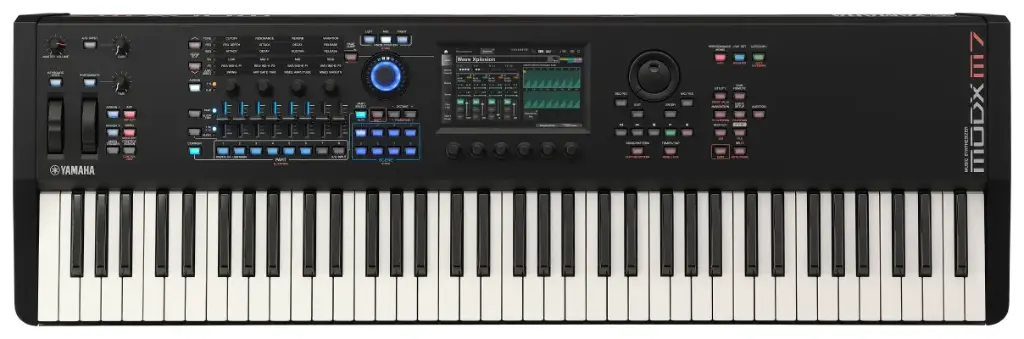
Yamaha MODX M7 - Synthesizer - Musical Performance
The perfect balance between melodic range and extreme portability for active keyboardists.
The Yamaha MODX M7 is the tactical choice for Quebec musicians, offering 76 semi-weighted FSB keys and the AN-X virtual analog engine. Go from studio to stage with this sound powerhouse weighing less than 17 lbs, fusing the raw power of the flagship Montage M into a format that doesn't require movers for every gig.
This content will be shared across all product pages.
Why the MODX M7 is the choice of session musicians
For professional keyboardists in Quebec, the number of keys is often a dilemma between the compactness of a 61-key keyboard and the bulk of an 88-key one. The Yamaha MODX M7 solves this equation by offering 76 keys, an essential range for complex arrangements and bold keyboard splits, without the restrictive weight of a hammer action.
The strength of this model lies in its new FSB (Future System Basic) keyboard. Unlike previous versions, the FSB action offers a firmer initial resistance and a more stable key travel, allowing for much more nuanced expression, both on fast synth leads and dynamic electric piano parts. It's an instrument designed for the player who "plays" their synthesizer as much as their piano.
Under the hood, the MODX M7 incorporates Yamaha's revolutionary sonic trio: the AN-X engine for authentic analog modeling with simulated voltage instability, the AWM2 engine with double the memory for incredibly realistic high-definition samples, and the FM-X engine for crystal-clear digital textures. With eight physical faders and six context-sensitive navigation buttons, you regain tactile control over your sound, eliminating tedious menu navigation mid-performance.
Full technical specifications of the Yamaha MODX M7
All technical data from the manufacturer's datasheets has been extracted with precision to meet the requirements of expert users.
Physical characteristics and dimensions
| Setting | Value (Metric) | Value (Imperial) |
| Width | 1089 mm | 42-7/8" |
| Height | 117 mm | 4-5/8" |
| Depth | 347 mm | 13-11/16" |
| Instrument weight | 7.6 kg | 16 lb 12 oz |
| Frame material | High-performance composite | - |
| Type of keys | FSB Semi-Weighted | 76 keys |
| Keyboard action | FSB (with improved initial resistance) | - |
| Aftertouch | No (receives data via MIDI) | - |
| Initial Touch | Yes | - |
Packaging and shipping specifications
| Shipping settings | Value |
| Gross Weight (Shipping Weight) | 11.7 kg (25.8 lbs) |
| Box width | 1244 mm (49") |
| Box height | 254 mm (10") |
| Box depth | 457 mm (18") |
| Accessories included | PA-300C AC Adapter, Quick Start Guide, ESP Code |
| SKU / MPN | MODX M7 |
Sound architecture and polyphony
| Sound Engine | Maximum Polyphony | Internal Structure |
| AWM2 | 128 notes (stereo/mono) | Up to 128 elements per game |
| FM-X | 128 notes | 8 operators, 88 algorithms |
| AN-X | 12 notes | 3 oscillators, 1 noise filter, 10 filter types |
| Total Global | 268 notes | Motion Control Synthesis System |
| Preset Memory | 10.7 GB | 16-bit linear format |
| User Flash Memory | 1.9 GB | High-speed rewriting |
Control and user interface
| Controller | Quantity / Type | Function |
| Super Knob | 1 (High resolution) | Multidimensional macro-modulation |
| Faders | 8 (Physics with LED bars) | Levels, operators, drawbars |
| Rotary knobs | 4 (Assignable) | Filters, effects, EQ |
| Display encoders | 6 (Display Knobs) | Contextual navigation below the screen |
| Touch screen | 7" TFT Color Wide VGA | Multi-point touch interface |
| Jump Page Button | 1 | Direct access to deep editing |
| Navigation Button | 1 | Performance overview |
Connectivity and digital audio
| Connection type | Format | Specifications |
| USB TO HOST | Type B (USB MIDI 2.0) | 10 audio outputs / 4 audio inputs |
| USB TO DEVICE | Type A | USB flash drive and external keyboard support |
| Audio Input A/D | 2x 6.35 mm jacks | External signal processing with FX |
| Main Exit | 2x 6.35 mm jacks | Balanced L/Mono, R outputs |
| Headphone Output | 1x 6.35 mm stereo jack | High-resolution amplifier |
| Pedals | 4 Jack inputs | Sustain, Assignable, Foot Controller 1 & 2 |
| NOON | DIN 5-pin | IN / OUT |
Comparative Analysis: The MODX M7 vs. Industry Standards
Analysis based on expert consensus ( Sound on Sound , MusicRadar ) for the 73/76 key synthesizer category.
| Alternative Product | Market Segment | Comparative Analysis (Strengths / Weaknesses) | Available at Garage à Musique |
| Roland Fantom-07 | Portable Workstation | + Advanced DAW integration, drum pads. - Limited sample memory (256 MB). | Available here. |
| Korg Nautilus 73 | Production workstation | + Nine synthesis engines, audio sequencer. - Very slow startup (3 min), less responsive screen. | Available here. |
| Nord Stage 4 Compact | Piano/Synth Stage | + Immediate physical controls, elite B3 organs. - Premium price, limited synth polyphony. | Available here. |
| Yamaha MOUNT M7 | Flagship Synthesizer | + Metal chassis, control ribbon, 400 polyphony. - Twice as heavy and much more expensive. | Available here. |
| Kurzweil PC4-7 | Performance workstation | + 256 voices of polyphony, deep VAST engine. - Small screen, less intuitive interface than the MODX. | Product not listed. |
| Akai MPC Key 61 | Production summary | + MPC workflow, direct sampling. - Only 61 keys, less focused on live performance. | Available here. |
| Roland Fantom-7 EX | Premium Workstation | + Integrated V-Piano modeling, robust construction. - Larger footprint, less flexible FM engine. | Available here. |
| Korg Krome EX 73 | Budget Workstation | + Solid piano samples, competitive price. - Lighter keyboard, no FM or AN synthesis. | Available here. |
| Dexibell S7 Pro M | Light Piano Stage | + 24-bit/96kHz audio outputs, piano sounds. - Negligible synthetic synthesis capabilities. | Product not listed. |
| Nord Electro 6D 73 | Stage Organ and Piano | + Waterfall keys ideal for the organ. - No pure synthesis engine (sample playback). | Available here. |
History and Evolution: From FM Synthesis to AN-X Modeling
The MODX M7 is the direct descendant of a lineage that has defined the sound of Quebec pop and rock for four decades.
L'héritage FM (1983) : Le logo MODX reprend les polices du DX7 original, le synthétiseur qui a tué l'analogique avec sa clarté numérique. Le moteur FM-X du M7 en est l'évolution directe à 8 opérateurs.
La domination Motif (2001-2015) : La série Motif a établi le standard du moteur AWM2. Le MODX M7 double aujourd'hui la capacité de mémoire wave de cette époque, atteignant 10,7 Go.
Le tournant Montage (2016) : L'introduction du Super Knob et du Motion Control a transformé le synthétiseur en instrument de performance dynamique.
La renaissance Analogique (2025) : Avec le MODX M, Yamaha intègre enfin le moteur AN-X, héritier spirituel du mythique AN1x, ramenant la chaleur des oscillateurs instables au sein d'une machine numérique.
Cultural References & Artists: MODX Sound in Action
The technologies integrated into the MODX M7 are used by the world’s leading creators for their signature sounds.
Matt Johnson (Jamiroquai) : Utilise les faders et le Super Knob du Montage/MODX pour recréer ses nappes Funk et ses leads Rhodes sur scène.
Michael Feiner : Producteur et DJ, il a développé des performances exclusives exploitant les moteurs AN-X et FM-X pour la musique électronique moderne.
Nicholas Semrad (Cory Henry & The Funk Apostles) : Exploite la polyvalence du moteur AWM2 pour ses sons de piano électrique saturés.
Richard Devine : Le maître du design sonore utilise le FM-X pour créer des textures extraterrestres et des interfaces sonores industrielles.
Domi Degalle (DOMi & JD BECK) : A démontré l'agilité du moteur sonore Yamaha lors de ses performances virtuoses au clavier.
Billie Eilish ("Bad Guy") : Les sons de synthé basse profonds et minimalistes sont typiques du moteur FM-X.
The Weeknd ("Blinding Lights") : La texture analogique 80s du morceau principal est la spécialité du nouveau moteur AN-X.
Toto ("Africa") : Les banques AWM2 du MODX incluent les échantillons originaux de flûte et de cuivres utilisés par David Paich.
Van Halen ("Jump") : Le moteur AN-X permet une émulation parfaite des filtres Oberheim du célèbre lead.
Depeche Mode ("Enjoy the Silence") : Utilisation intensive des pads FM-X pour la texture mélancolique du refrain.
Pink Floyd ("Shine On You Crazy Diamond") : Le MODX M7 permet de gérer les nappes de synthé et le lead de trompette simultanément via 76 touches.
Jean-Michel Jarre : L'architecture Motion Control est utilisée par ses techniciens pour automatiser les balayages de filtres complexes.
Dream Theater (Jordan Rudess) : Les sons de leads "Screamer" sont optimisés pour les scènes du MODX M7.
U2 ("Where The Streets Have No Name") : Les textures de synthé cristallines en intro sont parfaitement rendues par le moteur AWM2.
Genesis ("Mama") : Le son de boîte à rythmes et de synthé sombre est une référence directe pour les presets du M7.
FAQ – Frequently Asked Questions about the Yamaha MODX M7
Is the FSB semi-weighted keyboard too soft for piano parts? The FSB keyboard has a higher initial resistance than standard synthesizer keyboards, allowing for decent velocity control. It's not a hammer action, but for a session musician who has to switch between piano, organ, and synth, it's the best compromise on the market.
How many audio inputs can I record simultaneously via USB?
The MODX M7 acts as a 10-output/4-input interface. You can send 4 mono channels (or 2 stereo channels) to your computer, which is ideal for isolating the AN-X engine on one track and the FM-X on another to perfect your mix without perceptible latency .
Can I import my own samples into the flash memory?
Yes, you have 1.9 GB of user flash memory. Unlike other workstations, this memory is non-volatile, meaning your samples are ready immediately upon startup.
Is the AN-X engine limited by its 12-voice polyphony?
Although 12 voices may seem modest, this is a polyphony dedicated to pure analog modeling. In Performance mode, you can stack this engine with the AWM2 (128 voices) to create massive hybrid sounds without ever worrying about note dropouts.
Can the MODX M7 be used to control virtual synthesizers on a computer?
Absolutely. The DAW REMOTE button transforms the 8 faders and encoders into controllers for Logic, Cubase, or Ableton Live. This simplifies your workflow and eliminates the need for an additional MIDI controller.
Does the MODX M7 generate background noise or ground loops?
Yamaha has optimized the balanced audio outputs to minimize the risk of ground loops . For maximum sonic clarity, use high-quality TRS cables to maintain a consistent and pure output gain to your mixing console.
Is phantom power supplied on the A/D input?
No, the MODX M7 does not provide phantom power (48V). If you are using a condenser microphone, you will need an external preamp or a standard dynamic microphone to use the built-in vocoder.
How does the ESP plugin promised by Yamaha work?
The Expanded Softsynth Plugin (ESP) is an exact software replica of the MODX M. You can prepare your sounds on your computer (Mac/PC) and transfer them instantly to your keyboard via USB for your concerts.
Is the MODX M7 protected against RF interference on stage?
The composite chassis is designed to provide effective shielding against RF (radio frequencies) present in complex touring environments, ensuring sound stability even in close proximity to massive wireless systems.
Where can I get technical support in Quebec for my MODX M7?
When you buy from Garage à Musique, you benefit from the expertise of our local team. We understand the needs of Quebec musicians and are the ultimate authority to help you configure your instrument, whether you're in Vancouver or Rimouski.
Conclusion: The ultimate performance tool for Quebec
The Yamaha MODX M7 is much more than a synthesizer; it's the nerve center of your musical setup. Combining 76 expressive keys, unparalleled portability, and the sonic richness of three synthesis engines, it stands out as the smartest investment for the creative musician. At Garage à Musique, we recommend this instrument to anyone who refuses to sacrifice sonic power for the sake of mobility.
Why the MODX M7 is the choice of session musicians
For professional keyboardists in Quebec, the number of keys is often a dilemma between the compactness of a 61-key keyboard and the bulk of an 88-key one. The Yamaha MODX M7 solves this equation by offering 76 keys, an essential range for complex arrangements and bold keyboard splits, without the restrictive weight of a hammer action.
The strength of this model lies in its new FSB (Future System Basic) keyboard. Unlike previous versions, the FSB action offers a firmer initial resistance and a more stable key travel, allowing for much more nuanced expression, both on fast synth leads and dynamic electric piano parts. It's an instrument designed for the player who "plays" their synthesizer as much as their piano.
Under the hood, the MODX M7 incorporates Yamaha's revolutionary sonic trio: the AN-X engine for authentic analog modeling with simulated voltage instability, the AWM2 engine with double the memory for incredibly realistic high-definition samples, and the FM-X engine for crystal-clear digital textures. With eight physical faders and six context-sensitive navigation buttons, you regain tactile control over your sound, eliminating tedious menu navigation mid-performance.
Full technical specifications of the Yamaha MODX M7
All technical data from the manufacturer's datasheets has been extracted with precision to meet the requirements of expert users.
Physical characteristics and dimensions
| Setting | Value (Metric) | Value (Imperial) |
| Width | 1089 mm | 42-7/8" |
| Height | 117 mm | 4-5/8" |
| Depth | 347 mm | 13-11/16" |
| Instrument weight | 7.6 kg | 16 lb 12 oz |
| Frame material | High-performance composite | - |
| Type of keys | FSB Semi-Weighted | 76 keys |
| Keyboard action | FSB (with improved initial resistance) | - |
| Aftertouch | No (receives data via MIDI) | - |
| Initial Touch | Yes | - |
Packaging and shipping specifications
| Shipping settings | Value |
| Gross Weight (Shipping Weight) | 11.7 kg (25.8 lbs) |
| Box width | 1244 mm (49") |
| Box height | 254 mm (10") |
| Box depth | 457 mm (18") |
| Accessories included | PA-300C AC Adapter, Quick Start Guide, ESP Code |
| SKU / MPN | MODX M7 |
Sound architecture and polyphony
| Sound Engine | Maximum Polyphony | Internal Structure |
| AWM2 | 128 notes (stereo/mono) | Up to 128 elements per game |
| FM-X | 128 notes | 8 operators, 88 algorithms |
| AN-X | 12 notes | 3 oscillators, 1 noise filter, 10 filter types |
| Total Global | 268 notes | Motion Control Synthesis System |
| Preset Memory | 10.7 GB | 16-bit linear format |
| User Flash Memory | 1.9 GB | High-speed rewriting |
Control and user interface
| Controller | Quantity / Type | Function |
| Super Knob | 1 (High resolution) | Multidimensional macro-modulation |
| Faders | 8 (Physics with LED bars) | Levels, operators, drawbars |
| Rotary knobs | 4 (Assignable) | Filters, effects, EQ |
| Display encoders | 6 (Display Knobs) | Contextual navigation below the screen |
| Touch screen | 7" TFT Color Wide VGA | Multi-point touch interface |
| Jump Page Button | 1 | Direct access to deep editing |
| Navigation Button | 1 | Performance overview |
Connectivity and digital audio
| Connection type | Format | Specifications |
| USB TO HOST | Type B (USB MIDI 2.0) | 10 audio outputs / 4 audio inputs |
| USB TO DEVICE | Type A | USB flash drive and external keyboard support |
| Audio Input A/D | 2x 6.35 mm jacks | External signal processing with FX |
| Main Exit | 2x 6.35 mm jacks | Balanced L/Mono, R outputs |
| Headphone Output | 1x 6.35 mm stereo jack | High-resolution amplifier |
| Pedals | 4 Jack inputs | Sustain, Assignable, Foot Controller 1 & 2 |
| NOON | DIN 5-pin | IN / OUT |
Comparative Analysis: The MODX M7 vs. Industry Standards
Analysis based on expert consensus ( Sound on Sound , MusicRadar ) for the 73/76 key synthesizer category.
| Alternative Product | Market Segment | Comparative Analysis (Strengths / Weaknesses) | Available at Garage à Musique |
| Roland Fantom-07 | Portable Workstation | + Advanced DAW integration, drum pads. - Limited sample memory (256 MB). | Available here. |
| Korg Nautilus 73 | Production workstation | + Nine synthesis engines, audio sequencer. - Very slow startup (3 min), less responsive screen. | Available here. |
| Nord Stage 4 Compact | Piano/Synth Stage | + Immediate physical controls, elite B3 organs. - Premium price, limited synth polyphony. | Available here. |
| Yamaha MOUNT M7 | Flagship Synthesizer | + Metal chassis, control ribbon, 400 polyphony. - Twice as heavy and much more expensive. | Available here. |
| Kurzweil PC4-7 | Performance workstation | + 256 voices of polyphony, deep VAST engine. - Small screen, less intuitive interface than the MODX. | Product not listed. |
| Akai MPC Key 61 | Production summary | + MPC workflow, direct sampling. - Only 61 keys, less focused on live performance. | Available here. |
| Roland Fantom-7 EX | Premium Workstation | + Integrated V-Piano modeling, robust construction. - Larger footprint, less flexible FM engine. | Available here. |
| Korg Krome EX 73 | Budget Workstation | + Solid piano samples, competitive price. - Lighter keyboard, no FM or AN synthesis. | Available here. |
| Dexibell S7 Pro M | Light Piano Stage | + 24-bit/96kHz audio outputs, piano sounds. - Negligible synthetic synthesis capabilities. | Product not listed. |
| Nord Electro 6D 73 | Stage Organ and Piano | + Waterfall keys ideal for the organ. - No pure synthesis engine (sample playback). | Available here. |
History and Evolution: From FM Synthesis to AN-X Modeling
The MODX M7 is the direct descendant of a lineage that has defined the sound of Quebec pop and rock for four decades.
L'héritage FM (1983) : Le logo MODX reprend les polices du DX7 original, le synthétiseur qui a tué l'analogique avec sa clarté numérique. Le moteur FM-X du M7 en est l'évolution directe à 8 opérateurs.
La domination Motif (2001-2015) : La série Motif a établi le standard du moteur AWM2. Le MODX M7 double aujourd'hui la capacité de mémoire wave de cette époque, atteignant 10,7 Go.
Le tournant Montage (2016) : L'introduction du Super Knob et du Motion Control a transformé le synthétiseur en instrument de performance dynamique.
La renaissance Analogique (2025) : Avec le MODX M, Yamaha intègre enfin le moteur AN-X, héritier spirituel du mythique AN1x, ramenant la chaleur des oscillateurs instables au sein d'une machine numérique.
Cultural References & Artists: MODX Sound in Action
The technologies integrated into the MODX M7 are used by the world’s leading creators for their signature sounds.
Matt Johnson (Jamiroquai) : Utilise les faders et le Super Knob du Montage/MODX pour recréer ses nappes Funk et ses leads Rhodes sur scène.
Michael Feiner : Producteur et DJ, il a développé des performances exclusives exploitant les moteurs AN-X et FM-X pour la musique électronique moderne.
Nicholas Semrad (Cory Henry & The Funk Apostles) : Exploite la polyvalence du moteur AWM2 pour ses sons de piano électrique saturés.
Richard Devine : Le maître du design sonore utilise le FM-X pour créer des textures extraterrestres et des interfaces sonores industrielles.
Domi Degalle (DOMi & JD BECK) : A démontré l'agilité du moteur sonore Yamaha lors de ses performances virtuoses au clavier.
Billie Eilish ("Bad Guy") : Les sons de synthé basse profonds et minimalistes sont typiques du moteur FM-X.
The Weeknd ("Blinding Lights") : La texture analogique 80s du morceau principal est la spécialité du nouveau moteur AN-X.
Toto ("Africa") : Les banques AWM2 du MODX incluent les échantillons originaux de flûte et de cuivres utilisés par David Paich.
Van Halen ("Jump") : Le moteur AN-X permet une émulation parfaite des filtres Oberheim du célèbre lead.
Depeche Mode ("Enjoy the Silence") : Utilisation intensive des pads FM-X pour la texture mélancolique du refrain.
Pink Floyd ("Shine On You Crazy Diamond") : Le MODX M7 permet de gérer les nappes de synthé et le lead de trompette simultanément via 76 touches.
Jean-Michel Jarre : L'architecture Motion Control est utilisée par ses techniciens pour automatiser les balayages de filtres complexes.
Dream Theater (Jordan Rudess) : Les sons de leads "Screamer" sont optimisés pour les scènes du MODX M7.
U2 ("Where The Streets Have No Name") : Les textures de synthé cristallines en intro sont parfaitement rendues par le moteur AWM2.
Genesis ("Mama") : Le son de boîte à rythmes et de synthé sombre est une référence directe pour les presets du M7.
FAQ – Frequently Asked Questions about the Yamaha MODX M7
Is the FSB semi-weighted keyboard too soft for piano parts? The FSB keyboard has a higher initial resistance than standard synthesizer keyboards, allowing for decent velocity control. It's not a hammer action, but for a session musician who has to switch between piano, organ, and synth, it's the best compromise on the market.
How many audio inputs can I record simultaneously via USB?
The MODX M7 acts as a 10-output/4-input interface. You can send 4 mono channels (or 2 stereo channels) to your computer, which is ideal for isolating the AN-X engine on one track and the FM-X on another to perfect your mix without perceptible latency .
Can I import my own samples into the flash memory?
Yes, you have 1.9 GB of user flash memory. Unlike other workstations, this memory is non-volatile, meaning your samples are ready immediately upon startup.
Is the AN-X engine limited by its 12-voice polyphony?
Although 12 voices may seem modest, this is a polyphony dedicated to pure analog modeling. In Performance mode, you can stack this engine with the AWM2 (128 voices) to create massive hybrid sounds without ever worrying about note dropouts.
Can the MODX M7 be used to control virtual synthesizers on a computer?
Absolutely. The DAW REMOTE button transforms the 8 faders and encoders into controllers for Logic, Cubase, or Ableton Live. This simplifies your workflow and eliminates the need for an additional MIDI controller.
Does the MODX M7 generate background noise or ground loops?
Yamaha has optimized the balanced audio outputs to minimize the risk of ground loops . For maximum sonic clarity, use high-quality TRS cables to maintain a consistent and pure output gain to your mixing console.
Is phantom power supplied on the A/D input?
No, the MODX M7 does not provide phantom power (48V). If you are using a condenser microphone, you will need an external preamp or a standard dynamic microphone to use the built-in vocoder.
How does the ESP plugin promised by Yamaha work?
The Expanded Softsynth Plugin (ESP) is an exact software replica of the MODX M. You can prepare your sounds on your computer (Mac/PC) and transfer them instantly to your keyboard via USB for your concerts.
Is the MODX M7 protected against RF interference on stage?
The composite chassis is designed to provide effective shielding against RF (radio frequencies) present in complex touring environments, ensuring sound stability even in close proximity to massive wireless systems.
Where can I get technical support in Quebec for my MODX M7?
When you buy from Garage à Musique, you benefit from the expertise of our local team. We understand the needs of Quebec musicians and are the ultimate authority to help you configure your instrument, whether you're in Vancouver or Rimouski.
Conclusion: The ultimate performance tool for Quebec
The Yamaha MODX M7 is much more than a synthesizer; it's the nerve center of your musical setup. Combining 76 expressive keys, unparalleled portability, and the sonic richness of three synthesis engines, it stands out as the smartest investment for the creative musician. At Garage à Musique, we recommend this instrument to anyone who refuses to sacrifice sonic power for the sake of mobility.