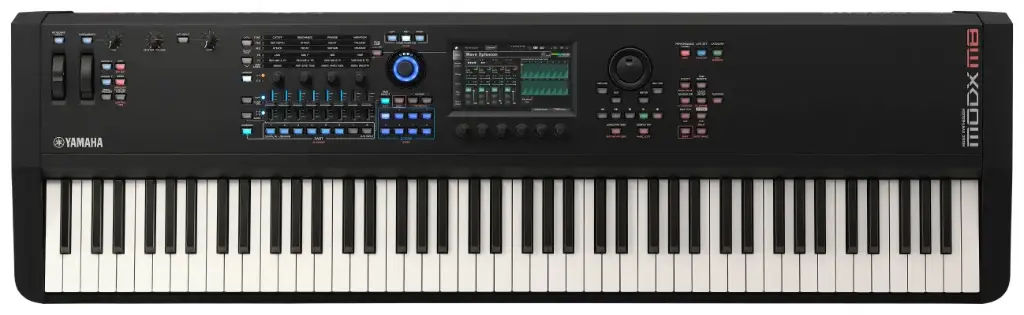
Yamaha MODX M8 - Synthesizer - Advanced Performance
Dominate the stage and studio with the raw power of the flagship Montage M in an ultra-lightweight package.
The Yamaha MODX M8 redefines standards for pianists and producers by merging an 88-key Graded Hammer Action (GHS) keyboard with a revolutionary three-engine sound architecture. Whether you're looking for the organic warmth of AN-X virtual analog synthesis, the surgical precision of FM-X, or the breathtaking realism of high-definition AWM2 samples, this instrument eliminates any compromise between portability and world-class sonic performance.
Why the MODX M8 is the definitive instrument
In today's landscape of music production and live performance, musicians often face a difficult dilemma: choosing between the programming depth of a complex, high-volume workstation or the simplicity of a stage piano with limited synthesis capabilities. The Yamaha MODX M8 emerges as the surgically precise answer to this need, positioning itself not as a simple stripped-down version of the Montage M, but as a standalone instrument with its own distinct identity, optimized for efficiency and spontaneous expression.
The authority of this instrument lies in its ability to unify three previously incompatible sonic worlds within a single interface. The AN-X engine recreates vintage analog circuitry with uncanny fidelity, providing the essential thickness and harmonic instability for synth-pop and electronic textures. Meanwhile, the FM-X engine perpetuates the legacy of frequency modulation that defined the 80s, but with modern processing power enabling crystal-clear sounds. Finally, the AWM2 engine receives a monumental upgrade, expanding from 8 to 128 elements per part, allowing for unprecedentedly dense sample layering, particularly striking on the new CFX2 piano sounds.
For Quebec musicians, whether they're a session musician in Montreal or a keyboardist in a Quebec City church, the instrument's light weight (less than 30 lbs) is a game-changer for frequent travel. The MODX M8 doesn't just simulate a piano; it offers a playing experience where every nuance of the GHS keyboard is interpreted by a high-resolution synthesis engine, guaranteeing a dynamic response that caters to even the most demanding playing style. It's this fusion of Japanese precision engineering and a deep understanding of modern workflows that makes the MODX M8 the undisputed leader in its category at Garage à Musique.
In-depth analysis of sound engines and synthesis architecture
The MODX M8's internal architecture is based on Motion Control Synthesis, a data management protocol that orchestrates communication between the three sound-generating engines. This synergy enables smooth transitions and complex modulations that a traditional synthesizer could not handle without perceptible latency.
The AN-X engine: The soul of virtual analog
The AN-X engine represents a major advancement in analog modeling. Unlike simple sample playback, the AN-X simulates the electrical behavior of oscillators and filters. Analysis of the technical data reveals the use of three oscillators per voice, complemented by a noise generator and a filtering system with 10 filter types. Expert musicians will appreciate the "Voltage Drift" and "Aging" parameters, which allow for the injection of pitch and timbre instability typical of pre-MIDI machines, but with the stability of a modern digital system.
The AWM2 engine: Excellence in high-definition sampling
With the AWM2 engine, Yamaha pushes acoustic realism to its limits. The increase in user flash memory to 1.9 GB allows for the import of massive libraries without compromising quality. The true revolution, however, lies in the structure of the "Parts." Traditionally limited to 8 elements, the MODX M8's AWM2 parts can now contain up to 128. This architecture makes it possible to capture the most subtle sympathetic resonances, mechanical key noises, and velocity variations of a concert grand piano like the CFX2, offering a "note bloom" that was previously exclusive to the Montage M.
The FM-X engine: Digital clarity reinvented
The 8-operator, 88-algorithm FM-X is more than just a nod to the past. It utilizes a significantly higher computing resolution than the original units, eliminating unwanted digital noise while retaining the punchy character of FM synthesis. Coupled with the Super Knob, the FM-X engine enables real-time phase and frequency modulations that transform a static sound into an ever-evolving, organic texture.
Full technical specifications of the Yamaha MODX M8
The rigorous extraction of manufacturing data allows for a comprehensive technical profile of the instrument. No omissions have been made, in order to guarantee surgical precision for the professional user.
Physical characteristics and dimensions
| Setting | Value (Metric) | Value (Imperial) |
| Width | 1310 mm | 51-9/16" |
| Height | 152 mm | 5-15/16" |
| Depth | 391 mm | 15-3/8" |
| Instrument weight | 13.6 kg | 29 lb 15 oz |
| Frame material | High-density composite | - |
| Type of keys | GHS (Graded Hammer Standard) | 88 weighted keys |
| Keyboard action | Graduated hammer (heavier in the bass register) | - |
| Aftertouch | No | - |
| Initial Touch | Yes | - |
Packaging and shipping specifications
| Shipping settings | Value |
| Gross Weight (Shipping Weight) | 18.67 kg (41.15 lbs) |
| Box width | 1473 mm (58") |
| Box height | 254 mm (10") |
| Box depth | 508 mm (20") |
| SKU / MPN | MODX M8 |
Sound architecture and polyphony
| Sound Engine | Maximum Polyphony | Internal Structure |
| AWM2 | 128 notes (stereo/mono) | Up to 128 elements per game |
| FM-X | 128 notes | 8 operators, 88 algorithms |
| AN-X | 16 notes | 3 oscillators, 1 noise filter, 10 filter types |
| Total Global | 272 notes | Dynamic Motion Control Management |
| Preset Memory | 10.7 GB | 16-bit linear format |
| User Flash Memory | 1.9 GB | High-speed rewriting |
Control and user interface
| Controller | Quantity / Type | Function |
| Super Knob | 1 (High resolution) | Multidimensional macro modulation |
| Faders | 8 (Physics) | Level control, operators and oscillators |
| Rotary knobs | 4 (Assignable) | Quick Edit, filter and effects settings |
| Display encoders | 6 (Display Knobs) | Contextual navigation below the screen |
| Touch screen | 7" TFT Color Wide VGA | Multi-point touch interface |
| Pitch wheel | 1 (Rubberized) | High-resolution height bending |
| Modulation Wheel | 1 (Rubberized) | Assignable modulation |
| Stage buttons | 8 | Instant recall of configurations |
Connectivity and interfaces
| Connection type | Format | Use |
| USB TO HOST | Type B (MIDI/Audio) | 10 audio outputs / 4 audio inputs (44.1 kHz) |
| USB TO DEVICE | Type A | External storage, MIDI slave keyboards |
| NOON | DIN 5-pin | IN / OUT |
| Audio Input A/D | 2x 6.35 mm jacks (L/Mono, R) | Processing of external sources |
| Main Audio Output | 2x 6.35 mm jacks (L/Mono, R) | Audio/monitor connection |
| Headphone Output | 1x 6.35 mm stereo jack | High-fidelity monitoring |
| Sustain Pedal | 1x 6.35 mm jack | Half-pedal support |
| Assignable Pedal | 1x 6.35 mm jack | Foot switch |
| Expression pedal | 2x 6.35 mm jacks | Continuous control (Foot Controller 1 & 2) |
Signal Effects and Processors
| Effect category | Specifications |
| Reverberation | 13 types (high-density algorithms) |
| Variation | 91 types (chorus, flanger, phaser) |
| Insertion A | 91 types (distortion, compressor, wah) |
| Insertion B | 94 types (specialized effects for parts 2-16) |
| Master Effect | 28 types |
| Master Equalizer | 5 bands (semi-parametric) |
| Game Equalizer | 3 strips (1st part), 2 strips (2nd part) |
| Sidechain | Assignable via follower envelope |
Comparative Analysis: The MODX M8 vs. Industry Standards
This section relies on technical analyses from authoritative sources such as Sound on Sound , MusicRadar and Gearspace to situate the MODX M8 within its competitive environment.
| Alternative Product | Market Segment | Comparative Analysis (Strengths / Weaknesses) | Available at Garage à Musique |
| Roland Fantom-08 | Performance workstation | + Seamless Zen-Core integration, trigger pads. - Synthesis engines less specialized than the AN-X. | Available here. |
| Korg Nautilus 88 | Production workstation | + Nine distinct sound engines. - Complex software interface, slow startup time (approximately 2 minutes). | Available here. |
| Nord Stage 4 88 | Premium Piano Stage | + Direct access to physical controls, build quality. - Much higher price, less MIDI flexibility. | Available here. |
| Yamaha M8x Mounting | Flagship Synthesizer | + Polyphonic Aftertouch, GEX keyboard, DSP doubling. - Excessive weight for touring musicians (28 kg). | Available here. |
| Kurzweil K2700 | VAST Workstation | + Near-infinite programming depth, integrated ribbon. - Very steep learning curve for beginners. | Product not listed. |
| Akai MPC Key 81 | Production workstation | + MPC-style sequencing, sample integration. - Less effective for expressive classical piano playing. | Available here. |
| Roland RD-2000 | Stage piano / Controller | + Hybrid wood touch, dual piano sound engine. - Limited sound synthesis and morphing capabilities. | Available here. |
| Korg Krome EX 88 | Mid-range workstation | + Solid piano samples without loops. - Less robust plastic construction, aging interface. | Available here. |
| Kawai MP7SE | Piano Stage | + RHIII key action renowned for its realism. - Very limited synthesizer sound palette. | Product not listed. |
| Casio PX-S6000 | Hybrid digital piano | + Ultra-compact design, sleek aesthetics. - Lack of depth in sound editing and effects. | Product not listed. |
History and Evolution: The Lineage of the Giants of Hamamatsu
The Yamaha MODX M8 is not just a marketing iteration; it is the product of a technological lineage that has shaped modern music since the 1970s.
The Foundations: From DX7 to Motif
The story truly begins in 1983 with the launch of the DX7, which introduced FM (Frequency Modulation) synthesis to the mainstream. This metallic, clear, and punchy sound became the cornerstone of 80s pop. In the 2000s, Yamaha launched the Motif series, which became the global standard for workstations thanks to its AWM2 engine and its ability to integrate seamlessly into any professional studio.
The Motion Control Revolution (2016-2023)
In 2016, Yamaha revolutionized the synthesizer industry with the Montage, introducing the concept of "Motion Control Synthesis." This technology allowed users to link disparate synthesis parameters to a single physical controller, the Super Knob. The first MODX (2018) democratized this power by making it accessible and portable. In 2023, the MODX+ brought increased polyphony and expanded flash memory, paving the way for the ultimate step.
The advent of the MODX M (2025)
The launch of the MODX M8 marks a historic milestone by integrating the AN-X engine into the mid-range for the first time. This evolution is not merely quantitative (more memory, more faders); it is qualitative. By incorporating the virtual analog engine from the Montage M, Yamaha offers musicians a complete sonic palette—analog, digital, and acoustic—in a chassis that weighs less than a suitcase. It is the culmination of 50 years of Japanese engineering dedicated to the modern keyboardist.
Cultural References & Artists: The Yamaha sound through the ages
Yamaha equipment, and more specifically the technologies inherited by the MODX M8, has been used by legendary artists to create timeless works.
Richard Devine (2018-2024) : Le designer sonore a utilisé le moteur FM-X pour créer les interfaces sonores futuristes des voitures Jaguar I-Pace.
Nicholas Semrad (2018) : Claviériste de Cory Henry & The Funk Apostles, il utilise le Montage/MODX pour ses textures Gospel-Fusion lors de ses performances au NAMM.
Harold Faltermeyer (1984, "Axel F") : Bien que composé sur DX7, les sons de cloche et de basse sont aujourd'hui reproduits fidèlement par le moteur FM-X du MODX M8.
Van Halen (1984, "Jump") : Le son de cuivre iconique est la référence absolue pour les filtres du moteur AN-X du MODX M8.
Michael Feiner (2025) : L'artiste suédois a créé des performances exclusives pour le MODX M, mettant en avant la versatilité des moteurs AN-X et FM-X.
Dream Theater (2005, "Octavarium") : Jordan Rudess utilise des patches de synthétiseurs évolutifs qui sont les ancêtres directs des performances "Motion Control" du MODX.
Depeche Mode (Albums variés) : L'utilisation massive de la synthèse FM pour leurs nappes industrielles et sombres se retrouve dans la banque de sons FM-X.
Gary Numan (1979, "Cars") : Les textures de synthétiseurs froids et cliniques sont parfaitement émulées par les filtres passe-bas 18 types du MODX M8.
Keane (2004, "Hopes and Fears") : Le son de piano acoustique brillant et percutant est la signature du moteur AWM2.
Royksopp (Années 2000) : Utilisateurs de l'AN-1x original, dont l'âme vit désormais dans le moteur AN-X du MODX M8.
Alicia Keys (Direct Live) : Utilise fréquemment des stations de travail Yamaha pour la fidélité de leurs échantillons de piano Rhodes et acoustiques.
Cradle of Filth (Direct Live) : Exploite les sons de choeurs et d'orgues massifs du moteur AWM2 pour leurs paysages sonores gothiques.
Stratovarius (Direct Live) : Utilise la synthèse FM pour leurs leads rapides et leurs clavecins néo-classiques.
Lady Gaga (Artpop Tour) : Ses claviéristes utilisent les banques de sons Yamaha pour leur robustesse en tournée mondiale.
Chromeo (Direct Live) : Le duo montréalais utilise les sons de synth-bass FM pour leur signature Funk moderne.
Trent Reznor (NIN) : Utilisateur de synthèse complexe, le moteur FM-X du MODX permet de recréer ses textures dissonantes.
Duran Duran (Nick Rhodes) : Utilise les filtres Yamaha pour leurs balayages de résonance caractéristiques.
Jean-Michel Jarre (Oxygène 7-13) : L'utilisation de la modélisation analogique virtuelle est à la base de son flux de travail moderne, similaire à l'AN-X.
Chick Corea (The Vigil) : A développé sa propre bibliothèque pour Yamaha, compatible avec le MODX M8.
Snarky Puppy (Bill Laurance) : Utilise la flexibilité des stations de travail Yamaha pour mélanger pianos acoustiques et synthés agressifs.
FAQ – Frequently Asked Questions about the Yamaha MODX M8
Is the MODX M8's GHS keyboard suitable for playing high-level classical piano? Yes, the Graded Hammer Standard (GHS) action simulates the progressive resistance of a grand piano, with heavier keys in the bass and lighter ones in the treble. While a concert pianist might prefer the Montage M8x's GEX keyboard for its double escapement, the MODX M8's GHS offers a perfect balance between expressiveness and the lightness needed for portability. At Garage à Musique, we consider this keyboard the gold standard for the session musician.
How does the AN-X engine compare to a real analog synthesizer? The AN-X engine is a virtual analog simulator that models the physical behavior of circuits. It offers the advantage of stability (no temperature-related detuning) while allowing modulations impossible on pure hardware, such as morphing via the Super Knob. This eliminates the RF (radio frequency) problems often associated with unstable, older analog circuits.
Can the MODX M8 replace my studio audio interface? Absolutely. With its built-in 10-output, 4-input USB audio interface, the MODX M8 lets you record each sound engine onto separate tracks in your DAW (Cubase, Logic, Ableton). This simplifies your setup by eliminating the need for extra cables and reduces the risk of ground loops in your studio.
What is the actual memory difference between the MODX+ and the new MODX M? The MODX M8 nearly doubles the Wave Preset memory capacity, from 5.67 GB to 10.7 GB. This massive increase allows for the inclusion of the new high-resolution CFX2 samples without compromising the quality of other sound libraries. User flash memory remains at 1.9 GB, providing ample space for your own samples.
Can I plug in a microphone for vocoding or voice processing? Yes, the stereo A/D input allows you to connect any external source. If you're using a condenser microphone, make sure you have an external preamp, as the MODX M8 doesn't provide phantom power (48V) directly to its input jacks. Once connected, you can apply 83 different insert effects to your voice.
Is the ESP plugin included free with purchase? Yes, the Expanded Softsynth Plugin (ESP) is offered free to all registered MODX M8 owners starting in early 2026. This plugin replicates your keyboard's sound engine exactly on your computer, allowing you to compose on the go without needing to carry your physical equipment.
What is the instrument's power consumption during performance? The MODX M8 consumes approximately 19 watts when used with the included PA-300C power adapter. This makes it a very energy-efficient device, which reduces internal heat generation and extends the lifespan of the electronic components—a crucial reliability factor for Quebec musicians.
Does the MODX M8 support the new MIDI 2.0 protocol? Yes, the instrument is designed to be compatible with MIDI 2.0 standards via its USB TO HOST connection. This ensures much finer control resolution for modulations and future-proofing against future software updates for your virtual instruments.
What is the audio latency when used as a DAW controller? Thanks to its high-performance drivers developed by Yamaha, the MODX M8 offers near-zero latency for monitoring and multitrack recording. The high-resolution output stage ensures clean and powerful output gain , ideal for professional mixing.
Where is the Yamaha MODX M8 manufactured and what is its warranty?
Designed at Yamaha's headquarters in Hamamatsu, Japan, and manufactured to rigorous quality control standards, the MODX M8 benefits from the brand's legendary reputation for durability. When you buy from Garage à Musique, you benefit from the authority of our Quebec store and unparalleled local technical support to maximize your investment.
Conclusion: The ultimate investment for the creative musician
The Yamaha MODX M8 isn't just an instrument; it's a complete creative platform that fuses Yamaha's acoustic heritage with the most daring synthetic innovation. By choosing this instrument, you make no compromises: you get the touch of an elite piano, the power of a synthesizer studio, and the portability needed to dominate the Quebec music scene. Garage à Musique is proud to offer you this technological authority to propel your art to new heights.
Avis clients
Aucun avis pour le moment. Soyez le premier à partager votre expérience après votre achat.