
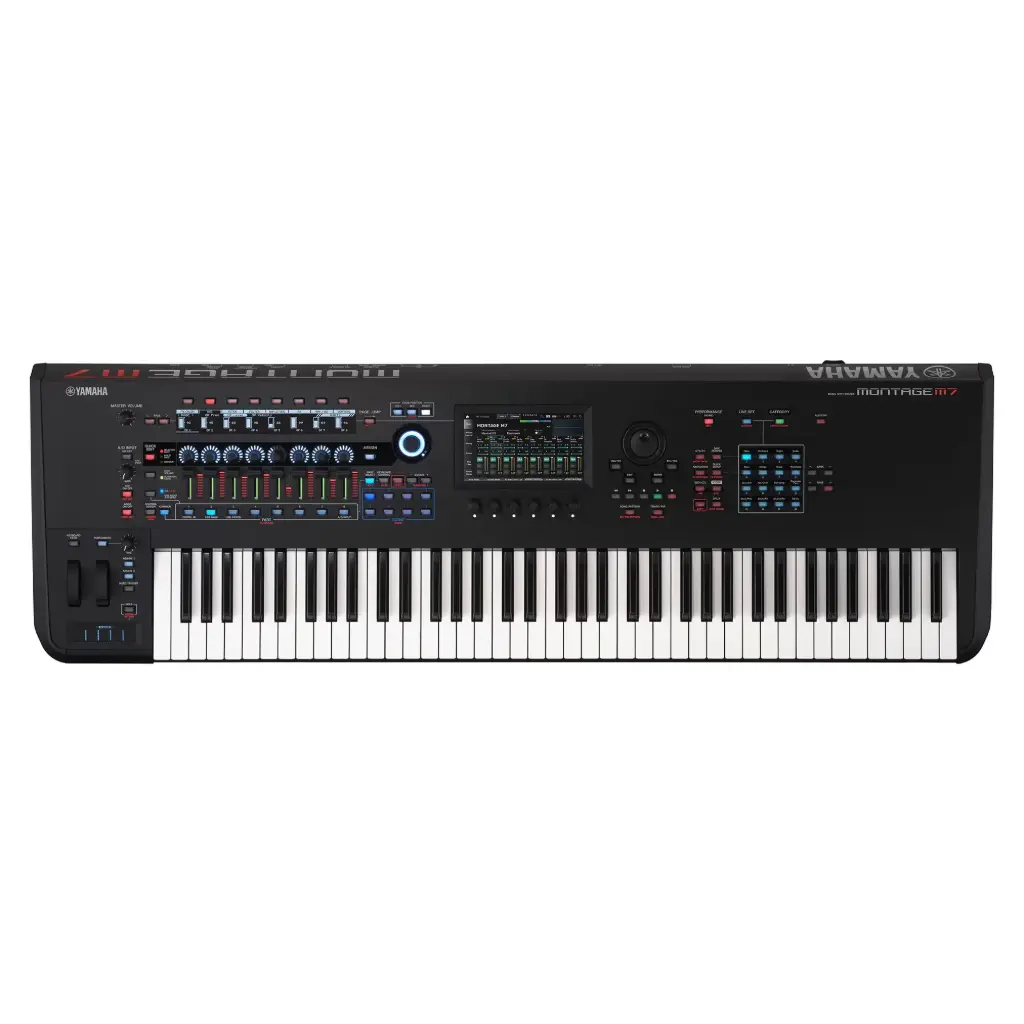
Yamaha Montage M7 - Synthesizer - Performance
Uncompromising creative power: the perfect balance between playing range and portability. The Yamaha Montage M7 is the strategic choice for the professional keyboardist, offering 76 keys with FSX action and aftertouch in a significantly lighter package than its larger sibling. Equipped with the triple AN-X, FM-X, and AWM2 architecture, this next-generation synthesizer delivers a massive 400-note polyphony for unprecedented sonic depth. Whether you're on stage in Quebec or in the studio, benefit from a 32-output USB audio interface for seamless integration, now available at Garage à Musique.
Why the M7 Mount is the linchpin of your setup
For touring musicians in Quebec, the dilemma is often the same: having enough octaves for complex keyboard splits without the burden of an 88-key piano. The Yamaha Montage M7 brilliantly solves this equation. It retains the entire "Motion Control" synthesis engine of the flagship M8X, but in a 17.6 kg chassis—nearly 10 kg lighter—which makes all the difference when traveling between Montreal and the regions.
The integration of the new AN-X engine is a revolution for lovers of authentic analog modeling. It's not a simple emulation; it's a recreation of the physical behavior of the circuits, including voltage drift for that sought-after organic instability. Coupled with the FSX keyboard—renowned since the Motif line for its fast response and durability—the Montage M7 allows for surgical expressiveness on synth leads and evolving pads. At Garage à Musique, we recommend the M7 as the centerpiece for those who demand the depth of a studio workstation with the agility of a stage instrument.
Sound Architecture: The Technological Triptych
The Montage M7 relies on three sound generators working in symbiosis to offer a sound palette that spans decades.
1. AN-X (Analog Physical Modeling) engine
The AN-X engine redefines analog sound at Yamaha. It features three oscillators with five waveforms and a noise generator, passing through two filters with ten filter types. You get the warmth of vintage synthesizers with the precision of modern digital control, ideal for cutting through a dense band mix.
2. AWM2 (Advanced Wave Memory 2) engine
The AWM2 engine has been significantly improved, now offering 128 elements per part. This density allows for extremely smooth transitions for "nameable" sounds such as world-class acoustic pianos and high-definition orchestral string sections. Pre-installed memory has been increased to 10 GB, doubling that of the previous generation.
3. FM-X (Frequency Modulation) Engine
Inheriting the legacy of the legendary DX7, the FM-X utilizes 8 operators and 88 algorithms to create punchy, crystal-clear sounds. Thanks to "Smart Morph," you can use artificial intelligence to navigate between different FM configurations with a single touch, creating sonic morphing impossible to achieve manually.
Full Technical Specifications
Technical data extracted from official Yamaha records for the Montage M7 model.
Dimensions and Physics
| Characteristic | Specification |
| Width | 1244 mm (49") |
| Height | 131 mm (5-3/16") |
| Depth | 396 mm (15-9/16") |
| Weight | 17.6 kg (38 lbs., 13 oz.) |
| Box dimensions | 1430 mm x 259 mm x 482 mm |
| Keyboard Type | FSX (Semi-weighted) |
| Number of Keys | 76 |
| After pressure | Yes (Channel Aftertouch) |
Performance and Polyphony
| Setting | Value |
| Total Polyphony | 400 notes (128 Preset AWM2 + 128 User AWM2 + 128 FM-X + 16 AN-X) |
| Synthesis Engines | AWM2, FM-X, AN-X |
| Multi-timbral capability | 16 internal sections + A/D and USB inputs |
| Wave Preset Memory | 10 GB (16-bit linear format) |
| User Wave Memory | 3.7 GB (Flash) |
| Number of Performances | 3,369 factory presets |
| Filters | 18 types (Low-pass, High-pass, Band-pass, Notch) |
Controls and Interface
| Component | Details |
| Main Screen | 7" TFT Color Wide VGA LCD touch screen |
| Secondary Screen | 512 x 64 Full-dot LCD (Quick Edit) |
| Super Knob | Multiple modulation control |
| Ribbon Controller | 5 segments with Hold function |
| Sliders | 8 with LED indicators (Red/Blue) |
| Potentiometers | 8 with LED rings + 6 Display Knobs |
| Dedicated Buttons | Keyboard Hold, Portamento, Navigation, Page Jump |
Connectivity and Audio
| Port | Specification |
| Main Exits | 2 x 6.3 mm Balanced TRS jacks |
| Assignable Exits | 2 x 6.3 mm Balanced TRS jacks |
| A/D Inputs | 2 x 6.3 mm jacks (Mic/Line with dedicated gain) |
| USB interface | 32 outputs / 6 inputs (44.1 kHz - 192 kHz) |
| NOON | IN, OUT, THRU (5 pin DIN) + USB TO HOST |
| USB TO DEVICE | 2 ports (for storage and external controllers) |
| Pedals | Sustain, Assignable, 2 x Foot Controller |
Comparative Analysis: The M7 Montage vs. the Competition
Based on industry consensus (Sound on Sound, MusicRadar, Gearspace), here's how the M7 compares to other market standards.
| Alternative Product | Market Segment | Comparative Analysis (Technical Facts) | Available at Garage à Musique |
| Roland Fantom-7 EX | Production Workstation | Points Forts : Séquenceur clip-based supérieur, intégration DAW plus poussée. Points Faibles : Synthèse acoustique moins détaillée, pas de ruban. | Available here |
| Korg Nautilus 73 | Mid-range workstation | Strengths: 9 specialized sound engines, more affordable price. Weaknesses: No aftertouch, less fluid user interface, fewer physical controls. | Available here |
| Nord Stage 4 Compact (73) | Stage Piano / Synth | Strengths: Direct access to parameters, exceptional modeling organ. Weaknesses: Very limited FM and AWM2 synthesis capabilities, no sequencer. | Available here |
| Kurzweil PC4-7 | Performance Workstation | Strengths: Very deep VAST engine, 256 voices of polyphony. Weaknesses: No integrated USB audio interface, plastic chassis. | Product not listed |
| Yamaha MODX7+ | Lightweight Workstation | Strengths: Identical AWM2/FM-X engines, extreme portability (7 kg). Weaknesses: No AN-X engine, no aftertouch, inferior keyboard quality. | Available here |
| Roland Fantom-07 | Compact Workstation | Points Forts : Très léger, moteur Zen-Core polyvalent. Points Faibles : Polyphonie limitée sur les couches complexes, pas de V-Piano. | Available here |
| Korg Kronos 2 73 | Workstation (Discontinued) | Points Forts : Séquenceur audio complet, stockage SSD. Points Faibles : Temps de démarrage longs, technologie d'écran vieillissante. | Product not listed |
| Nord Grand 2 | Premium Stage Piano | Points Forts : Mécanique de touche Kawai. Points Faibles : 73/76 touches non disponibles dans ce format, synthèse limitée. | Available here |
| Roland RD-2000 | Stage Piano | Points Forts : Double moteur de piano. Points Faibles : Flux de travail peu adapté à la synthèse moderne ou aux séquences complexes. | Available here |
| Akai MPC Key 61 | Production Workstation | Points Forts : Échantillonnage et flux de travail MPC natif. Points Faibles : 61 touches seulement, moins axé sur le jeu instrumental expressif. | Product not listed |
History & Technological Evolution
The Montage M7 is the culmination of a lineage that has defined the "Yamaha sound" for 40 years:
L'Héritage DX (1983) : Le moteur FM-X du M7 est le descendant direct du DX7, offrant désormais 8 opérateurs avec une résolution bien supérieure.
La Dynastie Motif (2001) : Le clavier FSX du M7 est la version raffinée de l'action qui a fait le succès des Motif XS7 et XF7, privilégiée par les claviéristes pour sa réponse nerveuse.
La Transition Montage (2016) : Le premier Montage a introduit le concept de "Motion Control" et le Super Knob. Le M7 (2023) complète cette vision en ajoutant le moteur AN-X et une interface utilisateur accélérée.
Cultural References & Artists
The Yamaha Montage/Motif sound is ubiquitous in musical culture:
Simon Oslender (Simon Oslender Trio) : Utilise le Montage M7 pour ses performances de jazz fusion, exploitant la réactivité des orgues VCM.
Matt Johnson (Jamiroquai) : Artiste phare utilisant le Montage pour ses textures funk et ses solos de synthé incisifs.
Greg Phillinganes (Michael Jackson, Toto) : Maître des "Lush Layers" sur Montage M, il utilise l'instrument pour reproduire les nappes orchestrales massives en concert.
Erskine Hawkins (Eminem) : A migré du Motif XF au Montage pour la clarté des pianos acoustiques et des Rhodes lors des tournées mondiales.
Nahre Sol : Compositrice et pédagogue utilisant le Montage M pour explorer les limites entre le classique et l'avant-garde.
Harold Faltermeyer - Axel F (1984) : Les cloches et basses FM sont désormais des performances préréglées fidèles dans le moteur FM-X.
Van Halen - Jump (1984) : Le son de cuivre analogique iconique est une démonstration parfaite de la puissance du moteur AN-X.
Gary Numan - Cars (1979) : Les textures froides et mécaniques sont recréées avec une précision chirurgicale par le M7.
Jamiroquai - White Knuckle Ride (2010) : Utilisation des modulations en temps réel via le ruban et le Super Knob.
Beyoncé - Renaissance Tour : L'architecture AWM2 est utilisée pour les sections de cuivres et les nappes synthétiques hybrides.
Justin Timberlake - FutureSex/LoveSounds (2006) : Produit en grande partie avec l'écosystème Motif, dont les sons sont inclus en version haute résolution dans le M7.
Rihanna - Umbrella (2007) : Les sons orchestraux percutants proviennent des banques AWM2 héritées et améliorées.
Alicia Keys (Live) : Utilise les pianos de concert Yamaha pour leur présence constante en façade.
Snarky Puppy (Live) : Le Montage M est devenu un standard pour leurs textures polyphoniques complexes.
Dr. Dre - 2001 (1999) : L'influence des pianos et cordes Yamaha a défini le son G-Funk, conservé dans les banques Heritage du M7.
FAQ - Technical Expertise and Usage Tips
What is the difference in feel between the M7 and the M8X?
The Montage M7 uses the FSX keyboard, which is a high-quality, semi-weighted action with channel afterpressure. Unlike the M8X, which simulates a piano's hammer action, the M7 offers a much faster response, ideal for synthesizer runs, organ solos, or drum parts. It's the instrument of choice if your playing prioritizes agility over pure piano realism.
Does the Montage M7 require an external transformer for Quebec?
No, the Montage M7 has a universal internal power supply. Simply plug the included AC cord directly into a standard 120V outlet. At Garage à Musique, we still recommend using a line conditioner to protect sensitive circuits from power surges and line noise.
Can the A/D input of the M7 handle an electric guitar signal?
Absolutely. You can plug a guitar or bass directly into the A/D inputs. Simply set the gain control to "Line" or "Mic" depending on your output level. The signal can then be routed through two dedicated insert effects processors, allowing you to use amp simulations or delays synced to the synthesizer's tempo.
How to avoid background noise or interference in performance?
The Montage M7 is equipped with the PAC2 (Pure Analog Circuit 2) circuit, which drastically reduces background noise. To avoid a ground loop , always use balanced TRS cables for your main outputs. If you are using a computer via USB, ensure that all your equipment is on the same grounding circuit.
Can a condenser microphone be used without an external preamp?
The Montage M7 does not offer phantom power on its A/D inputs. For a condenser microphone, you will need to use an external preamp or power supply. A standard dynamic microphone (such as an SM58) will work perfectly when used directly to feed the internal vocoder.
What is the actual use of the 32-output USB interface?
This is a major advantage for the studio. Instead of mixing all your sounds into the synthesizer, you can send each part (up to 16 stereo parts) to a separate track in your DAW via a single USB cable. This eliminates the latency associated with multiple conversions and allows for professional mixing with your usual plugins while preserving the original hardware sound.
Does the AN-X engine consume a lot of polyphony?
The AN-X engine has its own dedicated 16-note polyphony reserve. This means that even if you create a massive analog pad, it won't interfere with your 128 AWM2 piano notes or your 128 FM-X synth notes. It's this intelligent management that allows the M7 to handle dense performances without any dropouts.
What exactly does Smart Morph offer?
Smart Morph uses a machine learning algorithm to analyze the characteristics of multiple FM-X sounds. It creates a morphing map on the touchscreen, allowing you to swipe your finger to discover new hybrid timbres between your presets. It's an instant sound design tool that eliminates the usual complexity of FM programming.
Is the ribbon controller configurable?
Yes, the 5-segment ribbon can be assigned to almost any parameter (filter, resonance, Leslie speed, etc.). The dedicated "Hold" function allows you to maintain the value where you removed your finger, which is crucial for sustaining modulation while playing with both hands.
How can I ensure I have the latest sounds available?
Yamaha regularly updates the Montage M firmware. These updates often add new types of effects (like the Rotary VCM) and free sound banks. At Garage à Musique, we can help you check if your unit is up to date with the latest version to ensure maximum stability.
Garage Music Commitment
Investing in a Yamaha Montage M7 means choosing technological excellence. At Garage à Musique, we're not just salespeople, we're passionate users. Whether you're in Gaspé or Gatineau, our team of experts is here to ensure your Montage M7 becomes a natural extension of your creativity.
Avis clients
Aucun avis pour le moment. Soyez le premier à partager votre expérience après votre achat.