
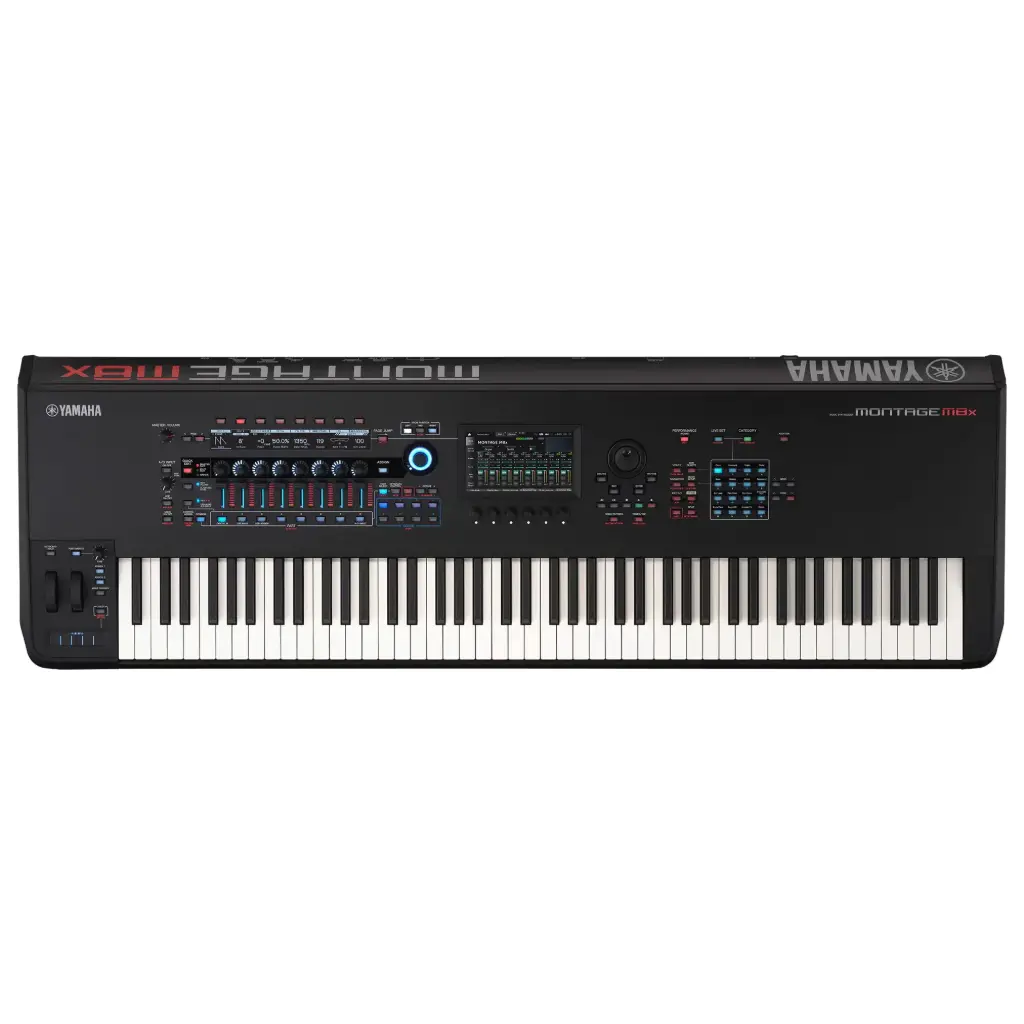
Yamaha Montage M8X - Synthesizer - Performance
The new benchmark in sonic expression: absolute synthesis power at your fingertips. The Yamaha Montage M8X merges three revolutionary synthesis engines—AN-X, FM-X, and AWM2—with the all-new GEX keyboard featuring weighted keys and polyphonic aftertouch. Designed for demanding professionals, this instrument offers 400-note polyphony and a 32-output USB audio interface for seamless studio integration. Experience the authenticity of a grand piano and the versatility of a cutting-edge synthesizer in a single machine, now available at Garage à Musique.
Why the Montage M8X is redefining standards in Quebec
The Quebec music scene, from Montreal stages to Quebec City studios, demands instruments capable of bridging the gap between perfect acoustic reproduction and radical sonic innovation. The Yamaha Montage M8X is not simply an update; it represents a paradigm shift for the modern keyboardist. As the successor to the original Montage, it solves the fundamental problem of the professional musician: the need for massive hybrid textures without ever sacrificing the physical feel of the instrument.
The introduction of the AN-X engine marks Yamaha's triumphant return to authentic analog modeling, delivering the organic warmth that plugins often struggle to replicate live. For the pianist, the switch to the GEX keyboard with polyphonic aftertouch transforms each note into a living source of modulation, allowing control of timbre, filter, or vibrato simply by pressing each key individually. It's a technology reminiscent of legendary instruments like the CS-80, but with the stability and processing power of the 21st century. Garage à Musique positions this instrument as the ultimate tool for those who refuse to choose between a concert grand piano and a wall of modular synthesizers.
Sound Architecture: The Power of Three Engines
The heart of the Montage M8X lies in the "Motion Control Synthesis Engine", an architecture that coordinates three separate sound generators to achieve a polyphony of 400 notes, a technical feat that eliminates any fear of note stealing during the densest performances.
1. AN-X (Analog Physical Modeling) engine
The AN-X engine is a meticulous recreation of the behavior of classic analog circuits. Unlike simple sampling, it models the interactions between three oscillators, a noise generator, and sophisticated filters. This approach allows for deep bass sounds, piercing leads, and evolving pads that respond unpredictably and organically to your commands. The user benefits from 16 voices dedicated exclusively to this engine, ensuring that the analog textures retain their full integrity even within a multi-part performance.
2. AWM2 (Advanced Wave Memory 2) engine
The AWM2 engine is the cornerstone of Yamaha's acoustic reproduction. On the Montage M8X, it reaches unparalleled heights with 128 elements per part, enabling surgically precise articulation for orchestral instruments, pianos, and percussion. Waveform memory has been doubled compared to the previous generation, increasing to 9.97 GB of presets, complemented by 3.8 GB of user flash memory for your own samples.
3. FM-X (Frequency Modulation) Engine
A direct successor to the DX7 but propelled into a new era, the FM-X offers 8 operators and 88 algorithms. This engine excels at creating the crystal-clear digital sounds, intricate bells, and aggressive textures that have defined modern pop and electronic music. With 128 voices of dedicated polyphony, the FM-X integrates seamlessly with other engines thanks to Smart Morph, a technology that uses artificial intelligence to create smooth transitions between different FM settings.
Full Technical Specifications
The following tables present all technical data extracted from Yamaha's engineering resources, organized for quick and comprehensive reference.
Dimensions and Weight
| Characteristic | Specification |
| Width | 1446 mm (56-15/16") |
| Height | 170 mm (6-11/16") |
| Depth | 460 mm (18-1/8") |
| Weight | 28.1 kg (61 lbs., 15 oz.) |
| Box dimensions | 1647 mm x 261 mm x 572 mm |
| Weight including packaging | Check in store for shipping costs |
Control Interface (Hardware)
| Component | Technical Details |
| Number of keys | 88 weighted keys |
| Keyboard type | GEX keyboard with grand piano-style repeat |
| Sensitivity | Initial Touch (Velocity) and Polyphonic Aftertouch |
| Ribbon controller | 5-segment ribbon with dedicated Hold function |
| Wheels | Pitch Bend and Modulation |
| Super Knob | Control of multiple modulations in one gesture |
| Sliders | 8 Control Sliders with LED Indicators |
| Rotary knobs | 8 Knobs with LED rings + 6 Display Knobs |
| Main screen | 7" TFT Color Wide VGA LCD touch screen |
| Secondary screen | 512 x 64 Full-dot LCD for fast editing |
Sound Generator and Polyphony
| Setting | Value |
| Synthesis engines | AWM2, FM-X, AN-X |
| Total Polyphony | 400 simultaneous notes |
| AWM2 Polyphony | 128 (Preset) + 128 (User) notes |
| FM-X Polyphony | 128 notes |
| AN-X Polyphony | 16 notes |
| Wave Preset Memory | 10 GB (16-bit linear format) |
| User Wave Memory | 3.7 GB (Expandable Flash) |
| Multi-timbrality | 16 internal sections + audio inputs (A/D, USB) |
| Performance | 3,369 factory presets |
| Filters | 18 types (Low-pass, High-pass, Band-pass, Notch) |
Effects and Processing System
| Type of Effect | Capacity / Variety |
| Reverberation | 12 types (high-resolution algorithms) |
| Variation | 88 types |
| Insertion A | 88 types (available for all 16 parts) |
| Insertion B | 89 types |
| Master Effect | 26 types |
| EQ Master | 5 parametric bands |
| EQ of Part | 3 strips (part 1), 2 strips (part 2) |
| A/D Input Effects | 83 types (including Vocoder and Sidechain) |
| Analog Circuit | Pure Analog Circuit 2 (PAC2) for crystal-clear audio output |
Connectivity and Audio Interface
| Port / Connector | Specification |
| Main Exits | 2 x 6.3mm Balanced TRS jacks (L/MONO, R) |
| Assignable Exits | 2 x 6.3mm Balanced TRS jacks (L, R) |
| Headphone jack | 1 x 6.3mm standard stereo phone jack |
| A/D Inputs | 2 x 6.3 mm jacks (L/MONO, R) with Gain knob |
| NOON | IN, OUT, THRU (5-pin DIN) |
| USB TO DEVICE | 2 ports for external storage and controllers |
| USB TO HOST | MIDI and Audio (32 outputs / 6 inputs) |
| Pedals | 2 x Foot Controller, 1 x Sustain, 1 x Assignable |
Comparative Analysis: The Montage M8X vs. its peers
Choosing a flagship workstation is a major decision. We've compiled data from expert consensus (Sound on Sound, MusicRadar, Gearspace) to position the Montage M8X within its ecosystem.
| Alternative Product | Market Segment | Comparative Analysis (Industry Expertise) | Available at Garage à Musique |
| Roland Fantom 8 EX | Production workstation | Points Forts : Séquenceur de type clip excellent pour la composition rapide. Points Faibles : Pas d'après-pression polyphonique ; synthèse moins profonde que le FM-X. | Available here |
| Nord Stage 4 88 | Piano/Synth Stage | Points Forts : Accès direct aux contrôles physiques, légèreté. Points Faibles : Capacités de multitimbralité et de séquençage très limitées face au Montage. | Available here |
| Korg Nautilus 88 | Synthetic Workstation | Points Forts : 9 moteurs sonores hérités du Kronos. Points Faibles : Moins de contrôles physiques (pas de curseurs dédiés), écran moins réactif. | Available here |
| Kurzweil K2700 | Hybrid Workstation | Points Forts : Puissance de la synthèse VAST inégalée pour le design sonore pur. Points Faibles : Interface utilisateur datée et courbe d'apprentissage très abrupte. | Product not listed |
| Roland RD-2000 | Stage Piano | Points Forts : Double moteur de piano V-Piano pour un réalisme ultime. Points Faibles : Fonctions de synthétiseur et de production très limitées. | Available here |
| Yamaha MODX8+ | Lightweight Workstation | Points Forts : Moteur sonore AWM2/FM-X identique au Montage original. Points Faibles : Pas de moteur AN-X, pas d'après-pression polyphonique, construction plastique. | Available here |
| Nord Grand 2 | Premium Stage Piano | Points Forts : Mécanique de touche Kawai exceptionnelle. Points Faibles : Quasi aucune capacité de synthèse profonde ou d'édition multicanal. | Available here |
| Korg Kronos 2 | Workstation (Discontinued) | Points Forts : Séquenceur audio 16 pistes intégré. Points Faibles : Matériel vieillissant, temps de chargement longs via SSD. | Product not listed |
| Akai MPC Key 88 | Production Workstation | Points Forts : Flux de travail MPC natif, échantillonnage intégré. Points Faibles : Moins axé sur la synthèse haute résolution et le jeu de piano expressif. | Product not listed |
| Nord Piano 5 | Digital Piano | Points Forts : Bibliothèques de pianos Nord renommées. Points Faibles : Pas une workstation ; fonctionnalités MIDI et de contrôle réduites. | Available here |
History and Technological Evolution
The Montage M8X's history is part of a prestigious lineage that has shaped the sound of modern music for over forty years.
L'Héritage DX et FM (1983) : Avec le lancement du DX7, Yamaha a introduit la synthèse FM dans le monde entier. Le Montage M8X honore cette lignée avec le moteur FM-X, qui multiplie par mille la puissance de calcul des opérateurs originaux.
La Révolution Motif (2001) : La série Motif est devenue le standard des studios et des tournées mondiales grâce à son moteur d'échantillonnage AWM2. Le passage au Montage en 2016 a introduit le Motion Control, mais c'est avec le Montage M en 2023 que Yamaha fusionne enfin cet héritage avec la modélisation analogique AN-X.
L'Innovation GEX et Poly-AT : Le Montage M8X réintroduit l'après-pression polyphonique, une fonction qui avait pratiquement disparu des claviers de grande production depuis le milieu des années 80, offrant aux musiciens une dimension expressive perdue.
Cultural References & Artists
The Yamaha sound is present on countless classic and contemporary albums. Here is a selection of authentic examples illustrating the use of these technologies:
Michael Jackson - Thriller (1982) : L'usage massif du DX7 pour les sons de cloches et de basses FM a défini l'esthétique de l'album.
Jamiroquai - Seven Days in Sunny June (2005) : Matt Johnson utilise les pianos électriques et les synthétiseurs Yamaha pour leur présence organique dans le mix.
Eminem - Tournées Mondiales (2013-2018) : Erskine Hawkins utilise le Motif XF8 puis le Montage pour ses sons de piano de concert et de Rhodes.
Toto - Live in Paris (2007) : Greg Phillinganes utilise les stations de travail Yamaha pour reproduire les nappes orchestrales complexes de "Africa" et "Rosanna".
Beverly Hills Cop - Axel F (1984) : Harold Faltermeyer a utilisé le DX7 pour les sons de marimba et de percussions FM qui portent le thème.
Beyoncé - Renaissance (2022) : Les textures de basses synthétiques et de nappes sont souvent conçues par des producteurs comme Tricky Stewart utilisant l'écosystème Yamaha.
Van Halen - Jump (1984) : Bien que l'original soit un OB-Xa, les moteurs AN-X du Montage M8X recréent ce son de cuivre analogique avec une fidélité absolue.
Justin Timberlake - FutureSex/LoveSounds (2006) : Timbaland a largement utilisé le Motif ES7 pour les sons de claviers percutants de cet album.
Stevie Wonder - Performances Live : Utilisateur historique de la synthèse FM et des pianos Yamaha pour leur réponse dynamique.
Jamiroquai - White Knuckle Ride (2010) : Matt Johnson exploite les filtres et la modulation en temps réel caractéristiques du flux de travail Montage.
50 Cent - Get Rich or Die Tryin' (2003) : Scott Storch a produit de nombreux hits avec le Motif ES8, notamment pour les lignes de piano chromatiques.
Rihanna - Umbrella (2007) : Produit par Tricky Stewart, utilisant les banques de sons orchestrales et synthétiques de la série Motif.
Michael Jackson - Invincible (2001) : Rodney "Darkchild" Jerkins a utilisé le Motif pour les textures R&B modernes de l'album.
Gary Numan - Cars (1979) : Les sons de synthétiseurs froids et analogiques sont désormais parfaitement reproduits par le moteur AN-X du Montage M.
Daft Punk - Tron: Legacy (2010) : L'usage de stations de travail pour orchestrer les éléments synthétiques et acoustiques.
Alicia Keys - Performances Live : Utilise fréquemment les pianos de concert Yamaha intégrés pour leur clarté en façade.
Snarky Puppy - Performances Live : L'usage du Montage pour les textures polyphoniques complexes et les solos de synthétiseur.
Jacob Collier - Djesse Vol. 3 (2020) : Exploitation de la multitimbralité étendue pour des arrangements denses.
Dr. Dre - 2001 (1999) : L'influence des sons de piano et de cordes Yamaha dans la production Hip-Hop West Coast.
Simon Oslender - Trio Performances : Utilise le Montage M8X pour fusionner orgue VCM et synthèse moderne.
FAQ - Technical Expertise and Usage Tips
What does the GEX keyboard offer compared to the Montage 8's older Balanced Hammer? The GEX keyboard is a major evolution, offering a faster repeat mechanism that simulates the double escapement of a grand piano. Unlike standard weighted keyboards, which can feel "heavy" for synthesizer parts, the GEX offers superior agility, crucial when using polyphonic after-stress to modulate individual notes within a chord. This significantly improves dynamic control and reduces fatigue during extended playing sessions.
Is the Montage M8X prone to ground loop issues in the studio? Thanks to the Pure Analog Circuit 2 (PAC2), the Montage M8X features very high-quality balanced outputs that minimize interference. However, like any high-performance equipment, a ground loop can occur if your audio system is not properly grounded. The use of balanced TRS cables is essential. The PAC2 ensures an extended dynamic range and an optimized signal-to-noise ratio, guaranteeing that your preamp gain remains clean even at high volumes.
Can a studio microphone be fed directly through the A/D input? The Montage M8X's A/D input is designed for line-level or mic-level signals, but it does not provide phantom power. To use a condenser microphone, you will need to use an external preamp. The advantage is that the incoming signal can be processed by the two dedicated insert effects processors, allowing you to use the internal vocoder or envelope follower to modulate your synth sounds with your own voice.
What is the latency when using the Montage M8X as a USB audio interface? Yamaha uses state-of-the-art Steinberg USB drivers that enable ultra-low latency , often imperceptible to the musician. With 32 digital outputs, you can route each part of your performance directly to separate tracks in your DAW (such as Cubase or Ableton), which is ideal for professional mixing without multiple analog-to-digital conversions, thus preserving signal integrity from RF interference.
Is the Montage M8X compatible with my old Motif sounds or those from the original Montage? Yes, backward compatibility is a cornerstone of Yamaha's strategy. You can directly import libraries from both the original Montage and the MODX. For Motif XF users, conversion tools are available to recover your samples and user performances. At Garage à Musique, we consider this longevity a major selling point for professionals who have invested years in their sound programming.
How does the AN-X engine compare to a real analog synthesizer? The AN-X engine uses physical modeling that recreates the instabilities and nonlinear behavior of analog components, including parameters like "Voltage Drift" to simulate the natural detuning of vintage oscillators. This delivers a warmth and thickness of sound that purely digital synthesis cannot achieve, without the maintenance drawbacks or thermal fragility of older analog circuits.
Can the Super Knob be used to control external software? Absolutely. The Super Knob, along with all sliders and rotary knobs, transmits MIDI (Control Change) messages. This allows you to assign the Super Knob to control parameters in your VST plugins or mixing software, making the Montage M8X the command center of your studio. Its high-resolution control ensures smooth transitions without the "zipper noise" often associated with standard MIDI controllers.
Is polyphonic afterburning difficult to master? It does require a learning curve to calibrate your finger strength, but it opens up a world of possibilities. Unlike monophonic afterburning (where pressing a key affects the entire keyboard), here you can maintain a stable string chord while only vibrating the highest note. The benefit for the user is an almost "vocal" or "violin-like" expressiveness on a keyboard instrument.
How does the instrument handle live sound transitions? Thanks to the Seamless Sound Switching (SSS) function, you can move seamlessly from one performance to another without the previous one abruptly cutting off. This includes preserving reverb and delay tails. It's an essential feature for keyboardists performing live in Quebec who need to seamlessly transition between song sections without any technical silence.
How durable is the touchscreen under touring conditions? The 7-inch touchscreen is industrial-grade, designed to respond accurately even after thousands of hours of use. In case of any lag, a calibration function is accessible via the Utility settings. Its visibility is optimized for dark scenes, and the addition of six rotary buttons below the screen allows for parameter adjustments without obscuring the display—a major ergonomic advantage over its competitors.
Garage Music Commitment
At Garage à Musique, our mission is to guide you in mastering these complex technologies. Whether you're in Vancouver, Montreal, or elsewhere in the country, we provide local technical expertise to ensure your transition to the Yamaha Montage M8X is a complete success. This instrument represents the pinnacle of Japanese engineering, designed for musicians who demand excellence in every note.
Avis clients
Aucun avis pour le moment. Soyez le premier à partager votre expérience après votre achat.