
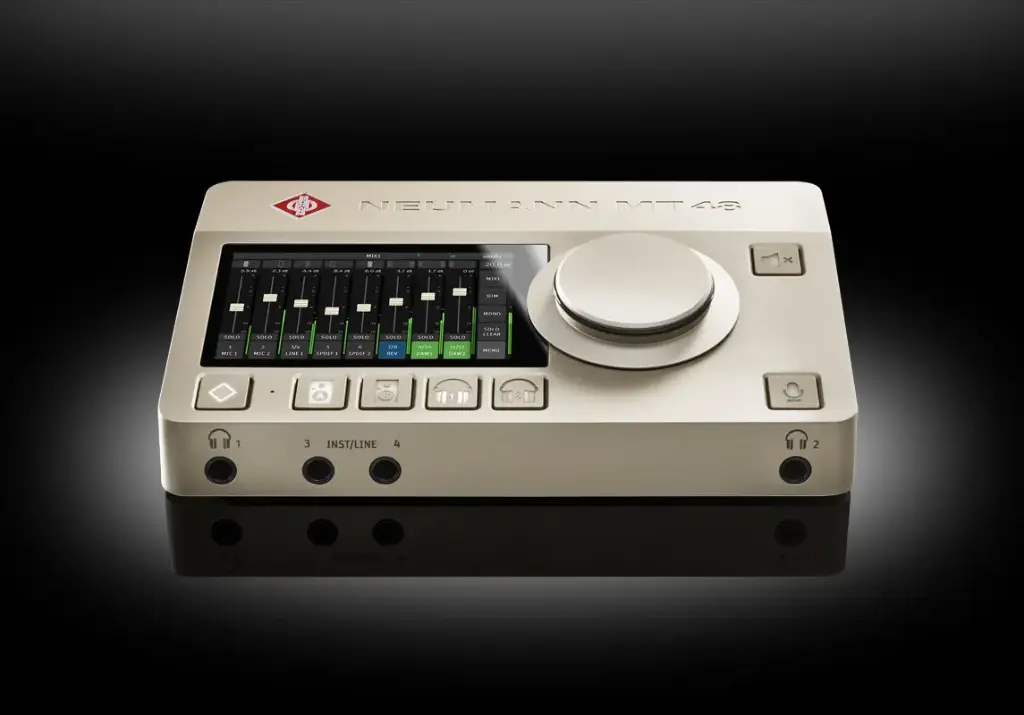
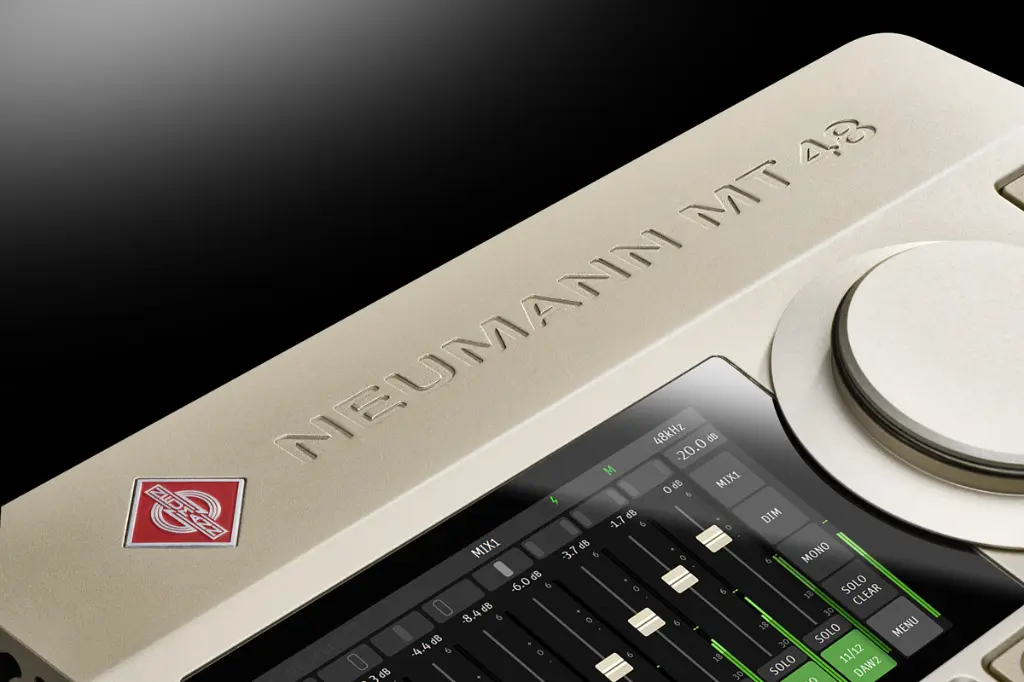

Neumann MT 48 US - Audio Interface - Studio Quality
The Neumann MT 48 US redefines sonic perfection by eliminating the last bottleneck in your signal chain thanks to a phenomenal dynamic range of 136 dB.
Born from a historic collaboration with Merging Technologies, this USB-C and AES67 interface combines world-class preamps offering 78 dB of gain with an ultra-powerful internal DSP engine for zero-latency monitoring. Whether you're capturing the delicate nuances of an acoustic instrument or managing an immersive Dolby Atmos mix, the MT 48 guarantees absolute transparency from the microphone diaphragm to your ears, positioning your studio at the forefront of modern audio engineering.
Why the MT 48 is the Pivot of Your Studio
The audio industry has long faced a technical paradox: owning microphones worth thousands of dollars, like the legendary Neumann U 87 Ai, while connecting them to interfaces whose dynamic range tops out at 120 dB. This discrepancy creates unwanted natural compression and background noise that obscures the most subtle details of the performance. The Neumann MT 48 US definitively solves this problem. Offering a dynamic range of 136 dB, it delivers four times the resolution of conventional high-end interfaces, capturing the entire sonic spectrum without compromise.
Developed in close collaboration with the Swiss engineers at Merging Technologies—the undisputed masters of high-fidelity conversion—the MT 48 is not simply a recording tool, but a true precision digital mixing console. Its intuitive touchscreen interface allows you to manage four independent monitor mixes, each with its own 4-band parametric EQ, a full dynamics processor (gate, compressor, limiter), and studio-quality reverb. This internal processing power frees up your computer's resources and enables instant interaction between the artist and their monitor mix, a critical factor in achieving a truly engaging performance.
One of the most tangible advantages for Quebec musicians lies in the "Dual Output" technology. This revolutionary feature allows you to simultaneously record the clean (Dry) signal and the DSP-processed (Wet) signal onto separate tracks in your digital audio workstation (DAW). This provides the security of an unprocessed backup while preserving compression or EQ settings applied during recording if they prove ideal. By eliminating the need for expensive and bulky external devices, the MT 48 becomes the nerve center of an elite studio, whether fixed or mobile.
Full Technical Specifications
Analysis of the MT 48's technical performance reveals figures that redefine market standards. Each component has been selected for its ability to maintain signal integrity under the most demanding conditions.
Audio Performance and A/D to D/A Conversion
| Characteristic | Detailed Specification |
| Dynamic Range (Microphone Inputs) | 136 dB-A |
| Dynamic Range (Line Inputs) | 138.5 dB-A |
| Dynamic Range (Instrument Inputs) | 135 dB-A |
| Dynamic Range (Line Outputs) | 123 dB-A |
| Dynamic Range (Headphone Outputs) | 122 dB-A (High) / 117 dB-A (Low) |
| Equivalent Input Noise (EIN @ 150 Ω) | -128 dBu-A |
| Maximum sampling rate | 192 kHz |
| Binary resolution | 24-Bit |
| THD + N (Preamp + ADC @ 1 kHz, 0 dBFS) | < -110 dB (0.0003%) |
| Crosstalk (@ 1 kHz) | < -110 dB |
Analog Inputs (Precision Capture)
| Section | Technical Details |
| Mic/Line Inputs 1-2 | 2x Combo XLR-1/4" TRS (Arrière) |
| Gain Range (Microphone) | +12 dB à +78 dB (par paliers de 0.5 dB ou 0.1 dB fin) |
| Gain Range (Line) | 0 dB à +66 dB |
| Input impedance (Mic/Line) | 10 kΩ |
| Maximum Input Level (Microphone) | 0 dBu (sans Pad), +12/+24 dBu (avec Pad) |
| Attenuator (Pad) | -12 dB / -24 dB |
| Instrument/Line Inputs 3-4 | 2x 1/4" TRS (Avant) |
| Input impedance (Inst/Line) | 2 MΩ (Symétrique) / 1 MΩ (Asymétrique) |
| Gain Range (Inst/Line) | 0 dB à +66 dB |
| Maximum Input Level (Inst) | +18 dBu |
Analog Outputs and Monitoring
| Section | Technical Details |
| Main Outs (1-2) | 2x XLR (Arrière) |
| Line Outs (Line Outs 3-4) | 2x 1/4" TRS (Arrière) |
| Output impedance (Line) | < 70 Ω |
| Maximum Output Level (Line) | +24 dBu |
| Headphone Outputs (Independent) | 2x 1/4" TRS (Avant) |
| Output impedance (Headphones) | 0.035 Ω (Ultra-basse impédance) |
| Maximum output level (Headphones) | +16 dBu (High) / +8 dBu (Low) |
| Crossfeed Headset | Ajustable pour simulation d'enceintes |
Digital Connectivity and Network
| Interface | Specifications |
| Computer Connection | USB-C 2.0 High Speed (480 MB/s) ou supérieur |
| Audio Network (AoIP) | Port RJ-45 Gigabit Ethernet (AES67 / RAVENNA) |
| Dante compatibility | Dante Ready (via firmware alternatif et licence Audinate) |
| Optical Input/Output | 1x Toslink (ADAT or S/PDIF) |
| ADAT Channels | 8ch (48kHz), 4ch (96kHz), 2ch (192kHz) |
| MIDI I/O | 2x 1/4" TRS (Entrée/Sortie) avec support GPIO |
| Synchronization | Internal, RAVENNA, ADAT, S/PDIF |
Physical Characteristics and Nutrition
| Setting | Measurement / Type |
| Frame material | Métal monobloc fraisé (dissipateur thermique) |
| Dimensions | 200 x 128 x 40 mm (7.87" x 5.03" x 1.57") |
| Weight | 0.95 kg (2.09 lbs) |
| Control screen | Écran tactile couleur capacitif |
| Assembly | Pas de vis pour pied de micro intégré sous l'unité |
| Food | Bloc secteur USB-C (9V-15V DC) ou PoE+ (Power over Ethernet) |
| Electricity consumption | < 25 W |
Comparative Analysis: The Desktop Conversion Summit
To understand the MT 48's positioning, it's essential to compare it to current standards documented by the experts at Sound on Sound and Gearspace . The MT 48 distinguishes itself not through an accumulation of gimmicky features, but through the raw superiority of its conversion components.
| Alternative Product | Market Segment | Comparative Analysis (Strengths / Weaknesses) | Available at Garage à Musique |
| Universal Audio Apollo Twin X | Desktop DSP | + Plugins UAD exclusifs, interface Thunderbolt. - Plage dynamique de 127 dB vs 136 dB sur MT 48. Pas de port réseau AES67 natif. | Available here |
| RME Babyface Pro FS | Portable Pro | + Drivers extrêmement stables, latence ultra-faible. - Pas d'écran tactile, gain des préamplis limité à 65 dB (vs 78 dB pour Neumann). | Available here |
| Apogee Symphony Desktop | Mastering Desktop | + Émulations de préamplis vintage, écran tactile. - Pas de connectivité réseau pour les grands studios, écosystème logiciel plus fermé. | Product not listed |
| Merging Anubis (Pro/Premium) | Broadcast/Network | + Supporte le DSD/DXD, deux ports RJ45. - Pas d'ADAT, pas de connexion USB directe simple pour les musiciens. | Product not listed |
| Audient iD44 MKII | Premium Home Studio | + Rapport qualité/prix imbattable, inserts hardware. - Conversion limitée à 96 kHz, plage dynamique de 126 dB seulement. | Available here |
| Prism Sound Lyra 2 | Audiophile Reference | + Transparence légendaire, circuit "Overkiller". - Interface logicielle datée, pas de DSP interne pour le monitoring temps réel. | Product not listed |
| RME Fireface UCX II | Versatile Interface | + Enregistrement USB direct (DURec), TotalMix FX. - Format demi-rack moins ergonomique, écran minuscule sans tactile. | Available here |
| Antelope Zen Tour SC | Desktop DSP/FPGA | + Grand nombre d'entrées/sorties, effets FPGA. - Stabilité logicielle parfois critiquée par les utilisateurs pro sur les forums. | Product not listed |
| Universal Audio Apollo x4 | Studio Project | + 4 entrées micro Unison, puissance DSP. - Conversion moins précise que le moteur Merging, nécessite Thunderbolt. | Available here |
| Focusrite Clarett+ 8Pre | Rack Studio | + 8 préamplis intégrés, excellent pour les batteries. - Pas de contrôle tactile, moins transportable, plage dynamique de 118 dB. | Available here |
History & Evolution: The Heritage of Swiss Precision
The launch of the MT 48 in 2023 marks a major turning point in Neumann's century-long history. For the first time, the Berlin-based company is venturing into the field of audio interfaces, thus completing its "diaphragm-to-ear" signal chain.
Technologically, the MT 48 is the direct successor to the Merging Anubis , developed by the Swiss manufacturer Merging Technologies. This collaboration led to Merging's integration into the Sennheiser Group alongside Neumann. While the Anubis was a purely network-based tool intended for broadcast and classical music, the MT 48 was redesigned for the modern producer. The crucial addition of USB-C connectivity and ADAT optical ports transformed a niche technology into a universal studio standard.
The software evolution has also been significant. Initially limited to stereo mixing, the MT-48 quickly integrated the "Monitor Mission" via a firmware update. This evolution now allows the interface to be transformed into a complete immersive monitoring controller, capable of managing Dolby Atmos 7.1.4 configurations with advanced bass management and room calibration. This flexibility ensures that the MT-48 remains a key component in studios, even in the face of evolving broadcast standards.
Cultural References & Artists: A Global Adoption
Merging/Neumann conversion technology is the cornerstone of the most prestigious productions of the last decade.
Michel Gallone (Ingénieur, Suisse) : Utilise cette technologie pour ses travaux avec Céline Dion et Shania Twain.
Paul Novotny (Tiny Studio, Toronto) : Utilise l'écosystème Merging pour produire du jazz en Dolby Atmos au Canada.
Soundmirror (Boston, USA) : Le studio de référence pour les enregistrements orchestraux mondiaux (Grammy Awards) jure par la technologie Pyramix/Merging.
Marta Salogni (Productrice, UK) : Travaille avec Björk et Animal Collective en utilisant cette précision de conversion.
Masato Ushijima (CEO Sonologic-Design, Japon) : Utilise la MT 48 pour la production sonore de films et de jeux vidéo de haut niveau.
Radiohead (Groupe, UK) : Leurs sessions chez Medley Studios (Copenhague) bénéficient de la transparence de l'écosystème Merging/Neumann.
Prince (Artiste, USA) : Également client historique des studios équipés de cette technologie de conversion suisse.
Maurizio Zulli (Ingénieur, Suisse) : A utilisé l'interface en conditions extrêmes sur le glacier de Gries pour National Geographic.
CBC (Radio-Canada, Toronto) : Utilise le réseau AES67/ST 2110 basé sur cette technologie pour ses infrastructures de diffusion.
James Reynolds (Producteur, UK) : Mixage pour BTS et Snoop Dogg avec les outils de monitoring Merging/Anubis.
Lewis Chapman (The Ranch, UK) : Réalise des mixages Atmos pour Ed Sheeran et Caroline Polachek avec cette chaîne Neumann.
Rusanda Panfili (Violoniste) : Soliste pour Hans Zimmer, utilise la MT 48 pour ses enregistrements personnels.
Jeremy Tusz (Milwaukee Symphony Orchestra) : Enregistre des orchestres complets grâce à la portabilité et la qualité de cette interface.
Andreas Klein (Pianiste) : Utilise ces convertisseurs pour capturer la dynamique naturelle du piano de concert.
Joshua Faulkner (Battery Studios, UK) : Utilise l'interface pour la production de l'artiste Skepta.
Michael Perez-Cisneros (New York) : Lauréat d'un Grammy pour le meilleur album de Jazz Latin grâce à cette fidélité de capture.
Henrik Oppermann (Schallgeber, Berlin) : Pionnier du son 3D utilisant l'interface pour ses installations immersives.
Roberto Toledo (New World Symphony, Miami) : Forme la prochaine génération de musiciens avec l'arsenal technologique Merging/Neumann.
Adam Ayan (Ayan Mastering, USA) : Le maître du mastering (Grammy winner) utilise ces outils pour leur transparence absolue.
Morten Lindberg (2L, Norvège) : La référence mondiale du son immersif en DXD utilise exclusivement ces convertisseurs.
FAQ - Technical Expertise and Decision Support
Why is a 136dB dynamic range so important for my recordings? A high dynamic range means that the interface's electronic background noise is virtually nonexistent. For the musician, this allows you to capture very quiet sources (like a whisper or a delicately played acoustic guitar) without any hiss, while still maintaining massive headroom for unexpected loudness spikes. You no longer need to compress at the input to eliminate noise, thus preserving the full purity of the original gain .
Can I really do without an external preamp with the MT 48's 78 dB of gain? Absolutely. Most standard interfaces stop at 60 or 65 dB of gain, which necessitates the use of cloud lifters for ribbon mics or demanding dynamic microphones like the Shure SM7B. The MT 48 offers ultra-clean gain up to 78 dB, which is more than enough for any microphone on the market, guaranteeing a rich, detailed signal without adding distortion or background noise.
Does the MT 48 work without a computer for live performance? Yes, that's one of its key strengths. In standalone mode, it becomes a high-end digital mixing console. You can control the faders, EQ, compressors, and reverb directly via the touchscreen. It's the ideal solution for small ensembles or soloists who want studio-quality sound on stage without the complexity of a computer, while also eliminating the risk of processing latency .
How does Dual Output technology help me secure my sessions? It allows you to create two recording streams for each input. You can record the audio with your DSP settings (EQ, compression) for immediate results, while simultaneously recording a "dry" track (without effects). If you ever regret a setting after the session, you still have the perfect original take. This eliminates the fear of "committing" processing during recording.
Is the interface compatible with Dolby Atmos? Absolutely. With the "Monitor Mission" update, the MT 48 handles configurations up to 7.1.4. It offers built-in calibration tools to align your speakers in time and phase, as well as sophisticated bass management. It's a superior replacement for very expensive monitor controllers while offering superior conversion quality.
What's the difference between AES67 and USB for my studio? USB is perfect for a direct and simple connection to your DAW. AES67 (AoIP) allows you to connect the MT 48 to an audio network over long distances using a single Ethernet cable. This makes it possible, for example, to have the interface in the recording booth and the computer in the control room without any loss of quality, while also facilitating the expansion of the number of channels via other network devices.
Is the MT-48 compatible with mobile devices like the iPad? Yes, it's "Class Compliant," meaning it's natively recognized by iPadOS and macOS without the need for complex driver installations. For creators on the go, it's the ultimate tool: simply plug the interface into your iPad, power it via the dedicated USB Power port or an external battery, and you have a 192 kHz mastering studio wherever you are.
How do you manage interference or ground loop issues with this device? The solid metal chassis acts as effective shielding against radio frequencies ( RF ). Furthermore, the high-quality external power supply and the option to use PoE+ (Power over Ethernet) electrically isolate the interface, drastically reducing the risk of ground loops often encountered in setups with many analog devices.
Is it possible to control the interface remotely? Absolutely. The MT 48 can be controlled via a web interface from any browser on your network. Whether you're a lone engineer in the cab or need an assistant to adjust levels from a tablet, the software's user-friendliness is designed for complete flexibility. This connectivity ensures long-term compatibility with all operating systems.
Why buy my Neumann MT 48 from Garage à Musique rather than an international platform? Choosing Garage à Musique means ensuring you have access to expert local support based in Quebec. We're not just salespeople; we understand the technical challenges of AES67 network integration and immersive monitoring. By buying from us, you benefit from a personalized service guarantee and the assurance of dealing with passionate individuals who validate every technical specification to guarantee your creative success, from coast to coast.
Avis clients
Aucun avis pour le moment. Soyez le premier à partager votre expérience après votre achat.