
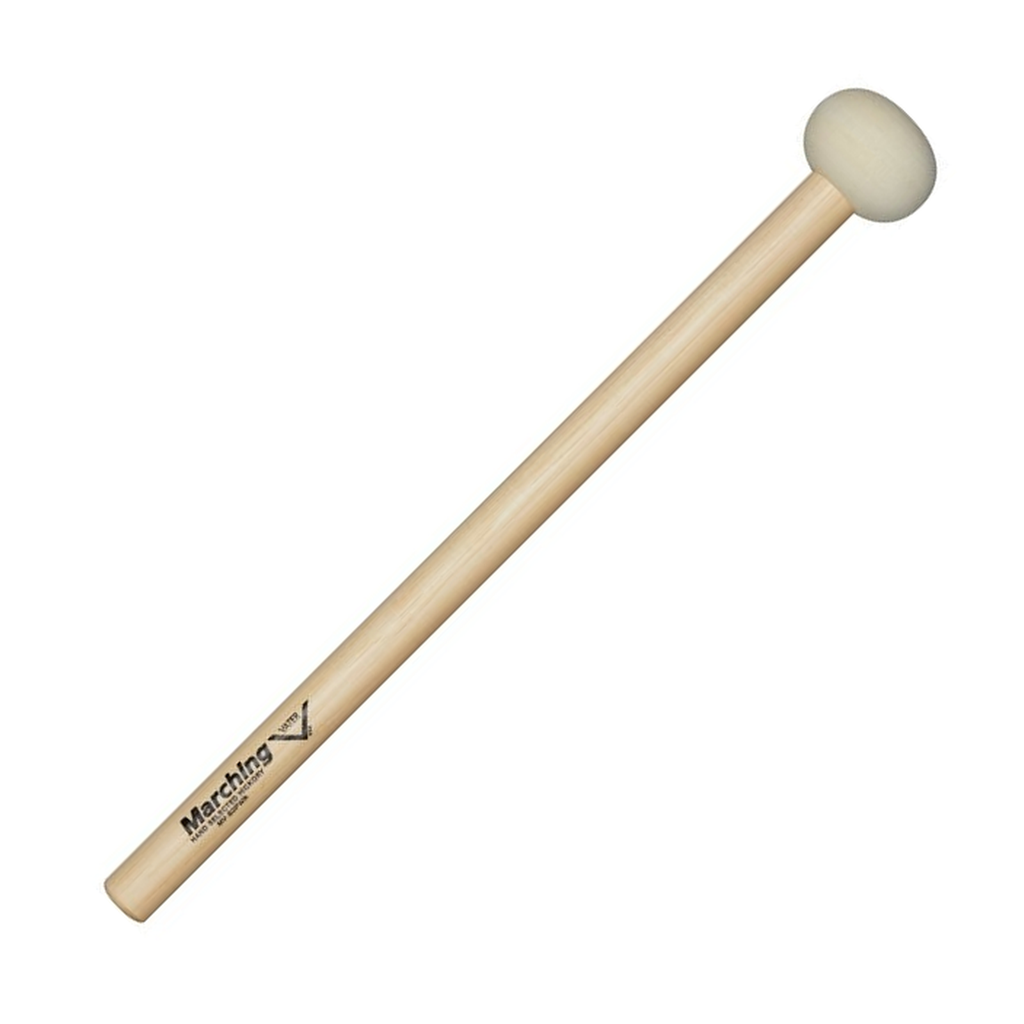
Vater Power MV-B3PWR Marching Bass Drum Mallets — for 24 to 26 in Drums
The MV-B3PWR is a marching bass drum mallet for the 24 or 26 in drum, the one that holds the centre of the line. At this diameter, the head takes real time to get moving, and the mallet stops being an accessory: it becomes the way the player takes back control of that delay.
What sets it apart
- Size made for 24 and 26 in drums
- 0.870 in shaft, swelling to 0.890 in under the head
- Enough mass to get a large head moving without forcing
- Strength designed for writing on the rim
- Fits into a full line with no change in grip
- Solid wood, no insert or glued joint at the point of impact
The delay of a large head, and how to make up for it
The wider the drum, the longer its head takes to start. On a 26 in drum, the gap between the stroke and the sound heard at the far end of the stadium is large enough to throw off a whole line if the players do not anticipate it.
A properly sized mallet reduces the part of the problem that depends on the tool: enough mass for the head to speak on the first stroke, not so much that the rebound lags. That is exactly the balance point this size aims for.
Why a solid shaft, and not a lightened one
A shaft could be lightened by hollowing it out or building it from two materials. The Power series stays with one solid piece whose cross-section grows toward the head. The choice costs weight and pays back in lifespan: there is no joint where the rim strikes.
Over a full season of parades and competitions, that is the difference between replacing one pair of mallets and replacing four.
The centre drum sets the groove of the line
Listeners place the pulse of a bass drum line on its middle voices, not on its extremes. The 24 or 26 in drum is therefore the one you hear when you ask whether the section is together.
Equipping that position properly often fixes a problem that was wrongly blamed on the biggest drum.
Specifications
| Drums | 24 in and 26 in |
|---|---|
| Shaft, grip | 0.870 in (22.1 mm) |
| Shaft, impact | 0.890 in (22.6 mm) |
| Construction | Solid shaft, thickness increasing toward the head |
| Intended use | Centre voice of a marching line |
What it is for
- Centre drum of a five-drum bass line
- Drum and bugle corps in competition
- College-level band marching outdoors
- Repertoire that demands clean attacks on a large head
- Renewing a mallet inventory at the end of the season
Compare with other manufacturers
At this drum size, from other manufacturers:
| Manufacturer | Comparable model | What differs |
|---|---|---|
| Vic Firth | Corpsmaster MB3 | Different head density, narrower shaft grip |
| Innovative Percussion | FBX-3 | Composite shaft, less flex |
| Zildjian | Marching range with felt heads | Narrower choice of drum sizes |
| Yamaha | Field-Master, Large size | Diameter matching defined differently |
Frequently asked questions
- Why does the mallet need to get bigger with the drum?
- Because a large head needs more energy to get moving. A mallet that is too small forces the player to hit harder, which hurts consistency before it adds any volume.
- Will one pair last a whole season?
- With repertoire that has no rim clicks, often yes. Once rims enter the writing, wear concentrates on a narrow area of the shaft and replacement comes sooner.
- Can I mix this series with standard mallets in the same line?
- Technically yes, but the grips differ from one drum to the next and the section loses its consistency of touch.
- Is the wood finished?
- The shaft is finished to keep a secure grip even with marching gloves. A shaft left damp after a performance in the rain should air-dry, never near a heat source.
Avis clients
Does your line sound off on the centre drums?
Aucun avis pour le moment. Soyez le premier à partager votre expérience après votre achat.