
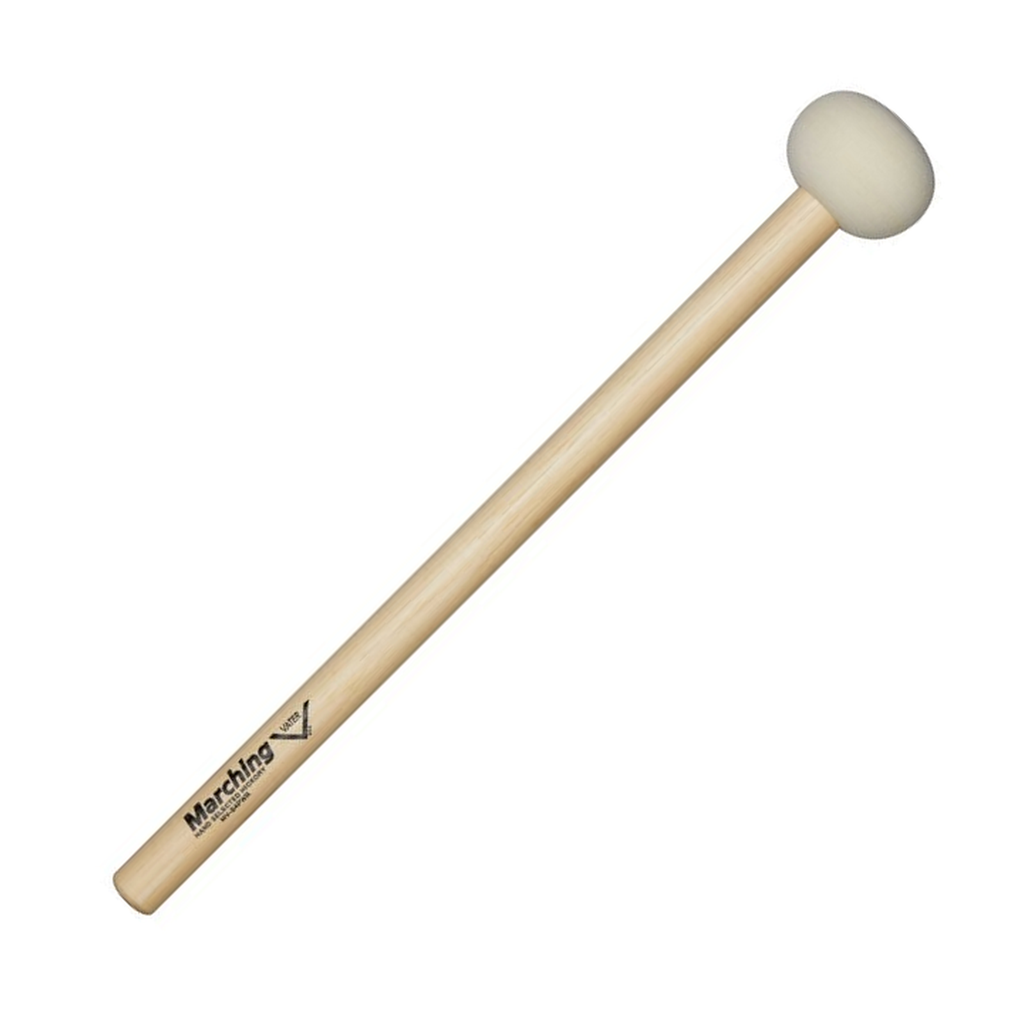
Vater Power MV-B4PWR Marching Bass Drum Mallets — for 28 to 30 in Drums
The MV-B4PWR is a marching bass drum mallet for 28 and 30 in drums. At this size, the drum no longer serves the rhythmic figure: it serves the harmonic foundation of the whole ensemble, and the challenge is no longer hitting hard but getting a defined pitch.
What sets it apart
- Made for 28 and 30 in drums
- 0.870 in shaft in the hand, 0.890 in where it meets the head
- Size meant for the heads that need the most energy to start
- Maximum wood cross-section where the rim click lands
- Grip consistent with the rest of the Power series
- Designed for a head that needs energy to get going
A big drum does not produce a hit, it produces a note
On a 28 or 30 in drum, what you hear at a distance is not the attack but the note that settles in afterward. A mallet that is too hard puts a slap up front and lets the low end arrive behind it, in disorder.
A head sized for the drum covers more surface and moves the drumhead all at once. The result is an identifiable pitch, which lets you tune the line the way you tune toms rather than simply stacking it by volume.
The motion changes when the mass goes up
With a heavier tool, the player stops pushing and starts letting it fall. The wrist throws, gravity does the rest, and the rebound comes back on its own if the head is properly tensioned.
It is the most common technical correction on the low drums of a school line: the right mallet makes the correct motion easier than the forced one.
What the shaft takes on here
The bigger the drum, the farther its rim sits from the player's body and the more the shaft works as a lever. The full 0.890 in section under the head makes the most sense on these drums, where the same written figure wears the wood more than it does on a small drum.
Specifications
| Drum range | 28 in to 30 in |
|---|---|
| Shaft at the grip | 0.870 in (22.1 mm) |
| Shaft at the head | 0.890 in (22.6 mm) |
| Profile | Increasing, with no thinned area |
| Position | Low voice of a marching line |
What it is for
- Low drum of a marching bass drum line
- Drum corps using 28 and 30 in drums
- Repertoire looking for distinct pitches between drums
- Teaching a dropping motion rather than a pushing one
- Outdoor performances where low-end projection matters
Compare with other manufacturers
Big-drum marching mallets from other manufacturers:
| Manufacturer | Comparable model | What differs |
|---|---|---|
| Vic Firth | Corpsmaster MB4 | Different head profile, thinner shaft at the grip |
| Innovative Percussion | FBX-4 | Fibre shaft, different behaviour on rim clicks |
| Yamaha | Field-Master, Extra Large size | Five sizes spread across a different diameter chart |
| Pearl | Marching mallets from its Championship range | Sold mostly to complement the brand's own drums |
Frequently asked questions
- Does a heavier mallet give more volume?
- Mostly it gives a fuller note. Volume depends first on the speed of the stroke; the mass is there to get a large head moving without forcing.
- How do you tune a marching bass drum line?
- By stepping the pitches from highest to lowest and checking that each drum keeps an identifiable note. A properly sized mallet head is a condition for hearing it.
- Do these mallets work for an indoor performance?
- They work, but they are designed for outdoors. Indoors, a softer fibre head limits the attack and avoids overloading the room.
- Is the thick shaft awkward with gloves?
- No, the finish stays secure under a glove. It is rather without gloves, with damp hands, that a grip this size needs attention.
Avis clients
Do your big drums sound like a thud instead of a note?
Aucun avis pour le moment. Soyez le premier à partager votre expérience après votre achat.