
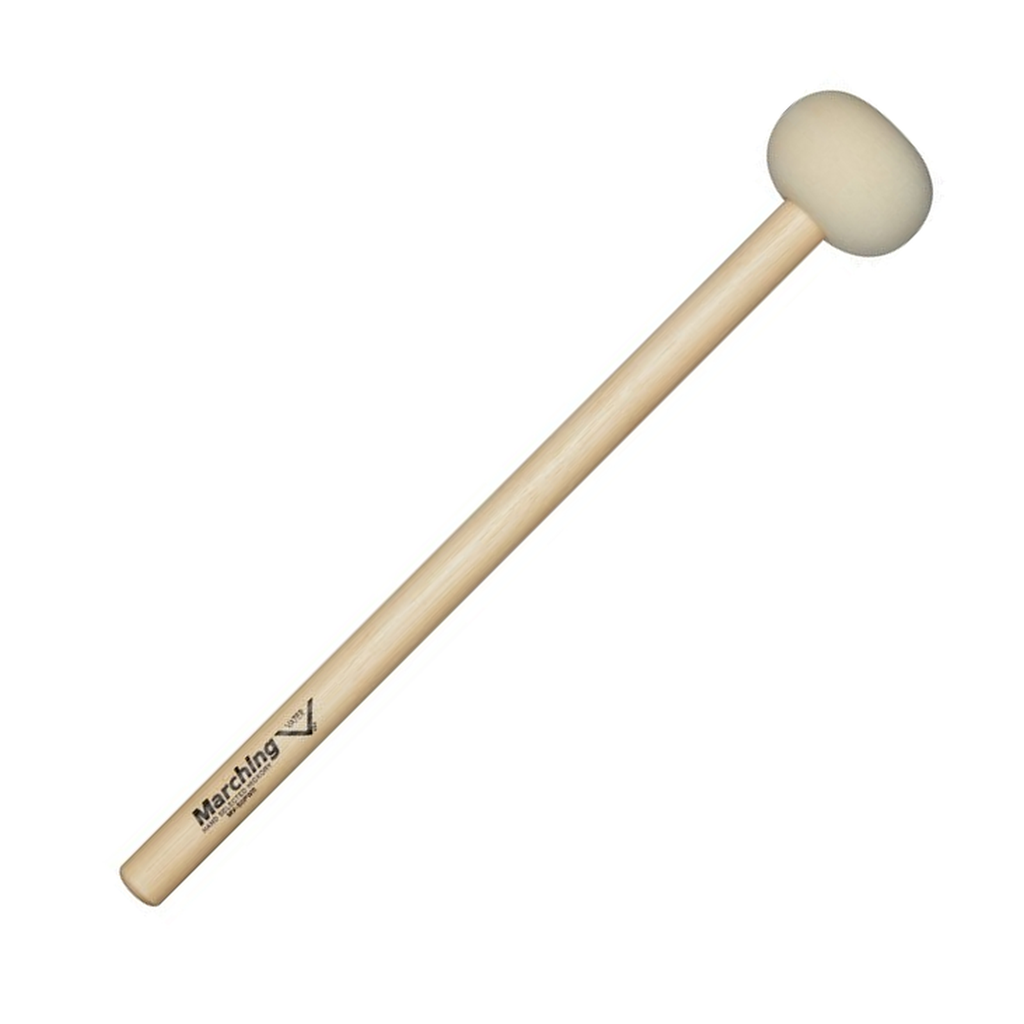
Vater Power MV-B5PWR Marching Bass Drum Mallets — for 30 in and Larger Drums
The MV-B5PWR is the largest marching bass drum mallet in the Power series, reserved for drums of 30 in and larger. These drums are rare and their challenge is specific: they are so big that the slightest imprecision in the stroke is heard as lateness, not as a wrong note.
What sets it apart
- The largest size in the series, for 30 in and up
- 0.870 in shaft at the grip, 0.890 in at the impact point
- Head sized for the largest drumhead in a line
- One-piece shaft, no joint at the point of impact
- Same grip as the four smaller sizes
- Meant for lines that reach below the pitch of the usual drums
The drum that always arrives last
A drum over 30 in responds slowly. Between contact and the moment the note is full, enough time passes for the listener to hear a delay if the player plays exactly on the beat. Experienced lines correct by playing slightly ahead.
The mallet is part of that equation. An undersized head forces a harder stroke, which stiffens the wrist, which costs even more precision. The right size makes anticipation possible because it makes the stroke consistent.
A big drum does not mean a heavy stroke
Faced with a drum this size, the temptation is to give it everything. That is what produces muddy low voices: the head is pushed beyond its useful travel, and the note turns into a rush of air.
With a mallet sized to the drum, maximum volume is reached well before the limit of the stroke. That leaves headroom for dynamics, which is exactly what a judge is listening for.
When a line really needs this size
Drums over 30 in are not common. Many lines stop at 28 or 30 in, and the next size down is enough for them; moving up a size without moving up a drum gains nothing, apart from an oversized head that slows the rebound.
The criterion is therefore the instrument, never the player's level. Measure the drum, read the range stated by the manufacturer, and stick to it: it is the only way to keep a line where every voice responds to the same motion.
Specifications
| Minimum drum diameter | 30 in |
|---|---|
| Grip | 0.870 in (22.1 mm) |
| Just under the head | 0.890 in (22.6 mm) |
| Shaft family | Power Bass, increasing cross-section |
| Use | Lowest drum in the line |
What it is for
- Lowest drum of a six-drum marching line
- Drum corps with oversized drums
- Ensembles extending the line toward the low register
- Large-scale outdoor performances
- Like-for-like replacement for a player already using this size
Compare with other manufacturers
Beyond 30 in, from other manufacturers:
| Manufacturer | Comparable model | What differs |
|---|---|---|
| Vic Firth | Corpsmaster MB5 | Largest size in its own chart, different head profile |
| Innovative Percussion | FBX-5 | Synthetic shaft, weight distributed differently |
| Yamaha | Field-Master, Jumbo size | Rated for 30 in and up, with a different head geometry |
| Promark | Largest size in its marching range | Attached-head construction rather than one piece |
Frequently asked questions
- Does a bass line really need a fifth mallet size?
- Only if the line has a drum over 30 in. On a four-drum line whose largest drum is 28 in, the next size down is enough.
- Why does the lowest drum seem to be behind the beat?
- Because acoustically it is: the head takes longer to respond. Seasoned lines play slightly ahead, and a properly sized tool makes that anticipation consistent.
- Can these mallets be used on a 36 in concert bass drum?
- Mechanically nothing prevents it, but the head is designed to project outdoors. In an orchestra, a concert mallet gives a rounder low end and a much softer attack.
- How should I store mallets this size?
- Lying flat, head free, with no weight resting on it. A head compressed for weeks keeps a flat spot that you hear when the season starts again.
Avis clients
Is your biggest drum dragging behind the rest of the line?
Aucun avis pour le moment. Soyez le premier à partager votre expérience après votre achat.