Vater MVB2 Marching Bass Drum Mallets — Extra-Hard Felt, 20 to 22 in Drums
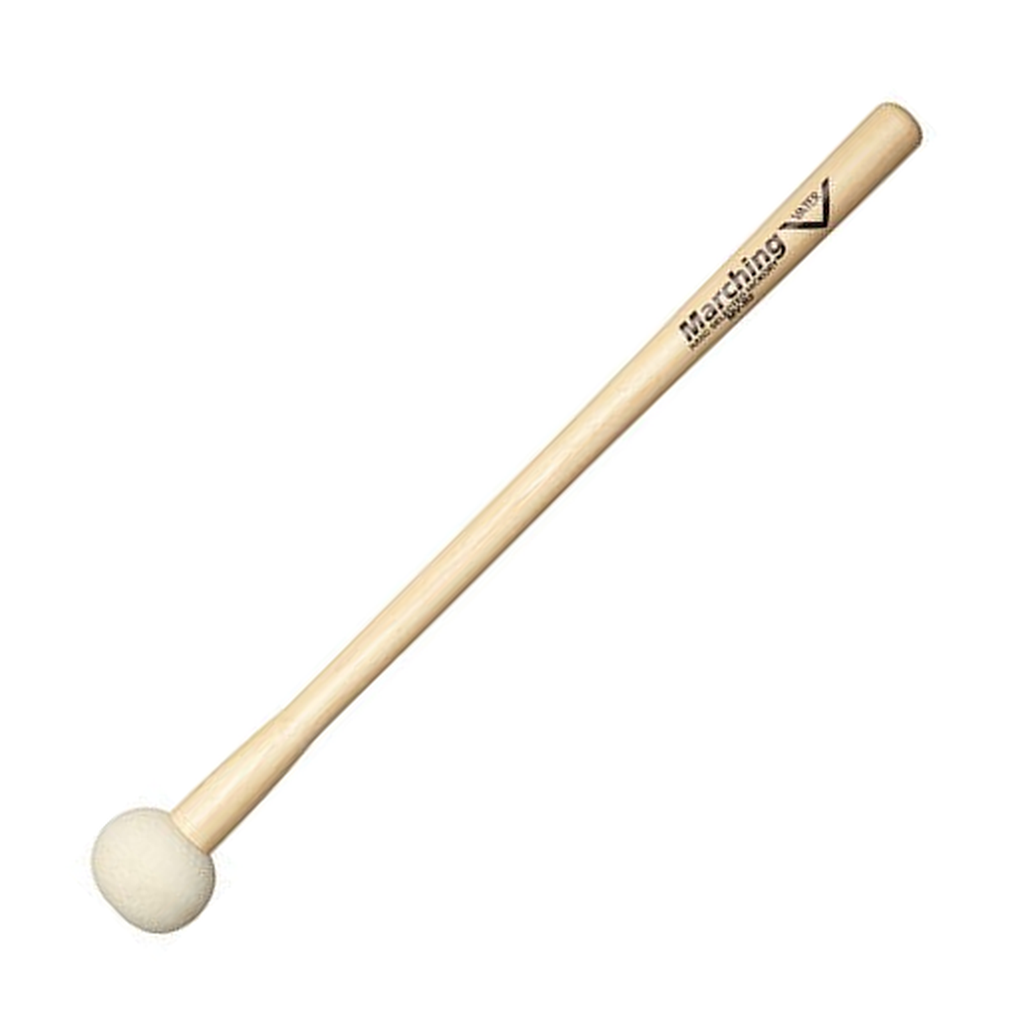
The MVB2 is the benchmark marching bass drum mallet for 20 and 22 in drums: double-tapered hickory shaft, extra-hard felt head. It is the combination that projects outdoors, and the one most sections set their baseline sound on.
What sets it apart
- 20 and 22 in drums
- Extra-hard felt head, clean attack
- Hourglass-shaped hickory shaft: 0.780, 0.600, then 0.790 in
- The front swell adds mass to the stroke
- Projection designed for the open air
- The same shaft profile across all five sizes in the series
Extra-hard felt, and what it really does
Dense felt barely compresses. Contact with the drumhead is therefore brief, and the energy passes all at once instead of spreading out. You hear it as a clean attack followed by a low end that develops behind it.
Outdoors, that attack is what makes a bass drum line audible in the middle of a band. Without it, the low end alone dissipates into the air and the wind before it reaches the stands.
Why 0.600 in in the middle of the shaft
The thinnest part of the shaft is not there by chance. It lightens the centre of gravity and gives the wood controlled flex: the shaft bends very slightly on contact, which returns a little energy to the rebound.
Too thin and it would break; too thick and the mallet would become a rigid bat that sends all the shock back into the wrist. The three shaft dimensions — 0.780, 0.600 and 0.790 in — work as one design, not three independent measurements.
The best-selling size, and why
20 and 22 in drums are the most common in school bands, because they stay portable for a teenager while still giving a real low end. This mallet size is therefore the one replaced most often.
In practice, it is the pair to keep in reserve in the band room: it is the one you will run out of first.
Specifications
| Drum diameters | 20 in and 22 in |
|---|---|
| Head | Extra-hard felt |
| Grip | 0.780 in (19.8 mm) |
| Thin section | 0.600 in (15.2 mm) |
| Behind the head | 0.790 in (20.1 mm) |
| Shaft wood | Hickory |
What it is for
- 20 or 22 in drum in a marching line
- School band in an outdoor parade
- Drum corps in outdoor competition
- Repertoire that needs an attack heard at a distance
- Spare pair for a school's inventory
Compare with other manufacturers
Hard felt marching mallets from other makers:
| Manufacturer | Comparable model | What differs |
|---|---|---|
| Vic Firth | Dense-felt Corpsmaster | Single-taper shaft, balance further back |
| Innovative Percussion | Hard-head marching mallets | Fibre shafts offered alongside wood |
| Yamaha | Field-Master, mid size | Different size matching chart |
| Pearl | Mallets from its marching line | Developed to match its own drums |
Frequently asked questions
- How is it different from the Puff Fleece version of the same size?
- The head. Extra-hard felt slaps more and carries further; fleece softens the attack and suits indoor venues better.
- Does hard felt damage the batter head?
- It marks it faster than a softer mallet, because the energy passes over a very short time. In a marching program, the bass drum head is a consumable just like the mallets.
- How long does a felt head last?
- As long as it stays round and firm. As soon as a flat spot appears on the side that always strikes, the sound becomes uneven depending on how the mallet is turned.
- Should you rotate the head?
- Yes, it is a good habit. Turning the mallet a quarter turn from time to time spreads the wear and nearly doubles its useful life.
Avis clients
Does your bass drum disappear behind the brass in a parade?
Aucun avis pour le moment. Soyez le premier à partager votre expérience après votre achat.