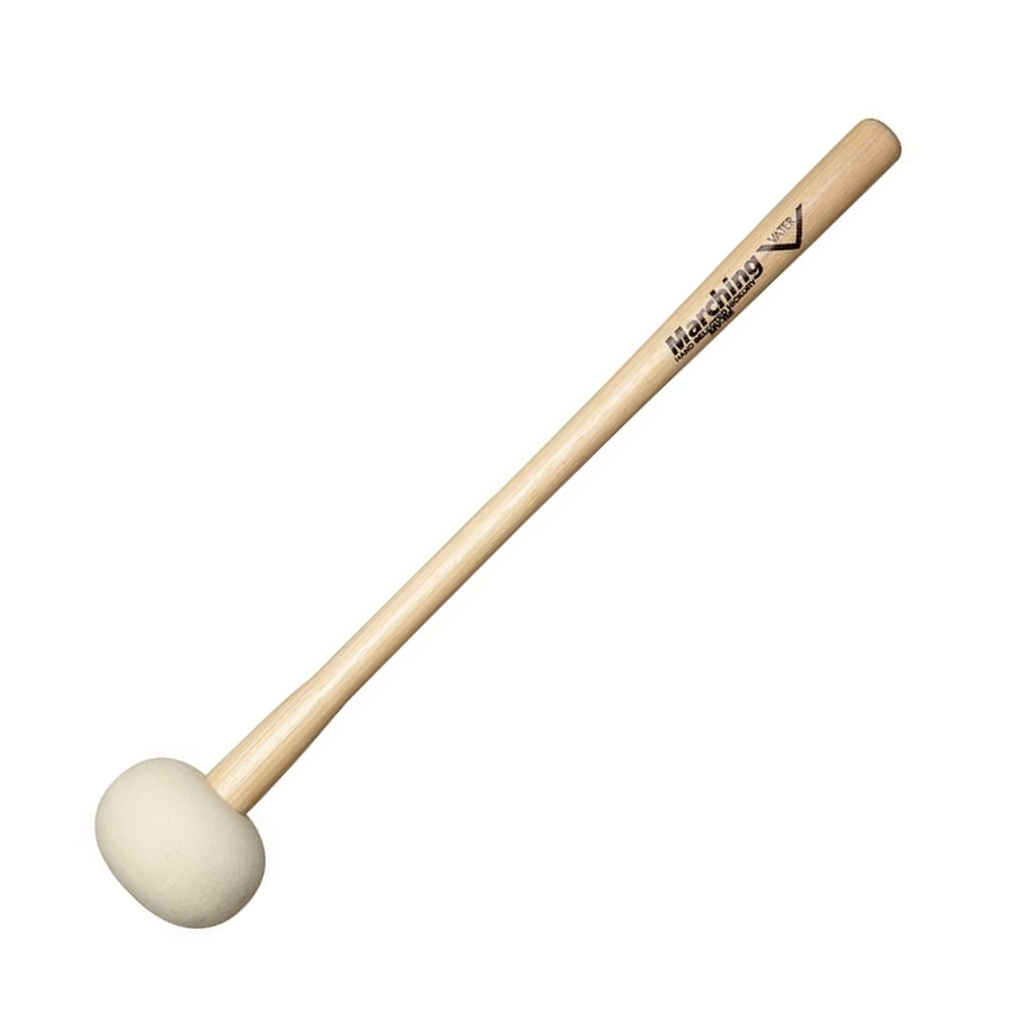
Vater MVB5 Marching Bass Drum Mallets — Extra-Hard Felt, 30 in and Larger Drums
The MVB5 is the largest size on the standard marching shaft, for 30 in drums and larger. On a drum that size, extra-hard felt is nothing aggressive: it is what lets a huge head produce an identifiable note rather than a rumble.
What sets it apart
- Reserved for 30 in and larger drums
- Extra-hard felt head, large format
- Hickory shaft: 0.780 in, then 0.600 in, then 0.790 in
- The front swell acts as mass in the stroke
- Gives a very large head a clear pitch
- The largest size in the standard family
On a large head, hardness creates pitch
The instinct would be to use a soft mallet on a very large drum, to avoid harshness. The effect is the opposite of what you expect: with no attack, the ear finds no reference point and the low note comes across as an indistinct rumble.
A firm head gives the drumhead the starting point the ear needs. The low end that follows becomes a note, with a recognizable pitch, and the line can be tuned from the highest drum to the lowest.
A large size is not played like a small one
With a mallet this heavy, the stroke gets shorter. The player swings from the forearm and lets the mallet do the work; anything added in amplitude is paid for by lagging behind the pulse.
That is the main correction for a beginner bass drum section, and the right mallet size makes it much easier to get: the tool itself discourages an oversized stroke.
What wears out a head this size, and how to prevent it
A felt head this large takes every stroke in the same spot as long as the player never rotates the mallet in the hand. The covering then packs down on one side and eventually develops a flat spot.
Three habits push that day back: rotate the mallet a quarter turn now and then, store it flat with nothing on top, and let it air-dry after a wet performance. Felt compressed on one side never recovers its shape, and the lowest drum in the line is where that flaw is heard most.
Specifications
| Minimum drum diameter | 30 in |
|---|---|
| Covering | Extra-hard felt |
| Dimension at the hand | 0.780 in (19.8 mm) |
| Mid-shaft dimension | 0.600 in (15.2 mm) |
| Dimension before the head | 0.790 in (20.1 mm) |
| Shaft material | Hickory |
What it is for
- Lowest drum in a marching line
- Drum corps with oversized drums
- Repertoire calling for distinct pitches
- Large-scale outdoor performances
- Replacement for a section already using the standard shaft
Compare with other manufacturers
The largest marching sizes from other makers:
| Manufacturer | Comparable model | What differs |
|---|---|---|
| Vic Firth | Corpsmaster, largest size | Different head profile and shaft balance |
| Innovative Percussion | Large format from its marching line | Stiffer composite shaft |
| Yamaha | Field-Master, largest size | Diameter range stated differently |
| Zildjian | Large-format marching mallet | Narrower choice of coverings |
Frequently asked questions
- Why a hard head on the biggest drum?
- Because the attack is what gives a large head a recognizable pitch. Without it, the low end sounds like a rumble and the line can no longer be tuned.
- How is it different from the Puff Fleece version of the same size?
- The covering. Fleece softens the attack, which suits indoor venues; extra-hard felt keeps the definition the open air requires.
- How should mallets this size be stored?
- Flat, heads free, with no weight on top. A crushed head keeps a permanent flat spot.
- Will this size work on a 28 in drum?
- The next size down is a better fit. An oversized head slows the rebound without adding anything to the low end.
Avis clients
Does your lowest drum sound like a rumble?
Aucun avis pour le moment. Soyez le premier à partager votre expérience après votre achat.