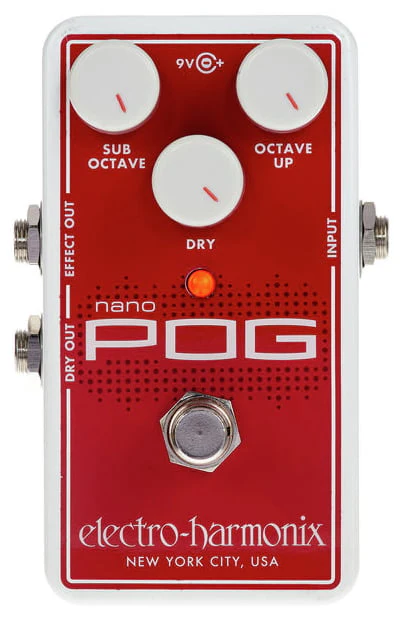
Electro-Harmonix Nano POG - Octave Generator Pedal
Discover the Electro-Harmonix Nano POG, a polyphonic octave generator that condenses the legendary, flawless tracking of the POG family into an ultra-compact format to enrich your sound with deep bass and crystal-clear treble.
This content will be shared across all product pages.
Huge sound, minimal size
At Garage à Musique , we know that space on your pedalboard is precious. The Electro-Harmonix Nano POG packs the legendary power of EHX octave generators into an ultra-compact package. It's not just an effect: it's the tool that will transform your 6-string guitar into a majestic 12-string, or give your bass a depth worthy of a massive synthesizer.
Thanks to its absolutely perfect polyphonic tracking algorithm, the Nano POG never falters. Whether you're playing complex chords, rapid arpeggios, or extreme bends , the pedal tracks every note with surgical precision. Add a sparkling upper octave, a rumbling lower octave, or blend all three to create the famous "organ sound" that made the POG series so renowned.
Features tailored for professionals
Tracking Polyphonique Sans Faille : Oubliez les octavers analogiques qui "glitchent" sur les accords. Le Nano POG analyse et pitch chaque note de votre accord simultanément et parfaitement.
Interface Intuitive : Trois boutons (Sub Octave, Octave Up, Dry). C'est tout ce dont vous avez besoin pour sculpter votre son en quelques secondes sur scène.
Double Sortie Intelligente : Utilisez la sortie Dry pour envoyer votre signal pur vers un ampli, et la sortie Effect vers un autre ampli ou une pédale de basse pour un mur de son stéréo gigantesque.
Format Nano : Toute la puissance du Micro POG original, mais dans un châssis die-cast robuste qui se glisse dans les moindres recoins de votre configuration.
🛠️ Technical Specifications
| Characteristic | Detail |
| Type of effect | Polyphonic Octave Generator (Pitch Shifter) |
| Available Voices | Dry (Original), Sub Octave (-1), Octave Up (+1) |
| Rotary controls | Sub Octave, Octave Up, Dry |
| Audio Connections | 1x 1/4" Inlet, 2x 1/4" Outlets (Effect Out / Dry Out) |
| Switching | True Bypass (Silent switch) |
| Food | 9V DC Center Negative (Consumption: approximately 25mA) |
| Power supply | EHX 9.6DC-200 adapter included |
| Dimensions | 114mm (W) x 70mm (D) x 53mm (H) |
Comparative Table: The War of the Mini-Octavers
| Characteristic | EHX Nano POG | EHX Micro POG | TC Electronic Sub 'N' Up Mini |
| Tracking Quality | Perfect (Polyphonic) | Perfect (Polyphonic) | Very good (Polyphonic) |
| Clutter | Ultra-compact (Nano) | AVERAGE | Ultra-compact (Mini) |
| Separate Exits | Yes (Dry / Effect) | Yes (Dry / Effect) | No (1 mixed output) |
| Customization | Immediate (Buttons) | Immediate (Buttons) | Via the TonePrint app |
| Power supply included | Yes | Yes | No |
Frequently Asked Questions (FAQ)
1. What is the difference between the Nano POG and the older Micro POG?
In terms of sound: none! The Nano POG uses the exact same cutting-edge polyphonic algorithm and internal components as the Micro POG. The only difference is the enclosure, which is much smaller and optimized for modern pedalboards .
2. Where should I place the Nano POG in my effects chain?
For the processor to analyze your notes with maximum accuracy, it needs to receive the purest possible signal. Always place the Nano POG at the beginning of your signal chain, right after your tuner, and before your distortion, fuzz, or modulation pedals.
**Astuce : une fuzz placée après le POG sonne de manière incroyablement massive !**
3. Does the Nano POG work well with a bass guitar?
Absolutely. It's very popular with bass players, especially Mike Kerr of Royal Blood. The tracking is extremely fast, even on the lower strings. The addition of the Octave Up (+1) with a slight distortion allows a bassist to fill the soundstage as if there were a rhythm guitarist with them.
4. Is it an analog or digital pedal?
The Nano POG is digital. This is a technological necessity: it's physically impossible for a 100% analog circuit to process complete chords without creating chaotic distortion. EHX's DSP processor is what makes this clarity possible.
5. What is the purpose of the "Dry Out" port?
It allows you to split your signal. The "Effect Out" output sends the mixed sound to your main amp. The "Dry Out" output sends only the pure, unaltered sound of your guitar. You can send this to a second amplifier to create a huge stereo effect, or to the direct input of a recording console.
Huge sound, minimal size
At Garage à Musique , we know that space on your pedalboard is precious. The Electro-Harmonix Nano POG packs the legendary power of EHX octave generators into an ultra-compact package. It's not just an effect: it's the tool that will transform your 6-string guitar into a majestic 12-string, or give your bass a depth worthy of a massive synthesizer.
Thanks to its absolutely perfect polyphonic tracking algorithm, the Nano POG never falters. Whether you're playing complex chords, rapid arpeggios, or extreme bends , the pedal tracks every note with surgical precision. Add a sparkling upper octave, a rumbling lower octave, or blend all three to create the famous "organ sound" that made the POG series so renowned.
Features tailored for professionals
Tracking Polyphonique Sans Faille : Oubliez les octavers analogiques qui "glitchent" sur les accords. Le Nano POG analyse et pitch chaque note de votre accord simultanément et parfaitement.
Interface Intuitive : Trois boutons (Sub Octave, Octave Up, Dry). C'est tout ce dont vous avez besoin pour sculpter votre son en quelques secondes sur scène.
Double Sortie Intelligente : Utilisez la sortie Dry pour envoyer votre signal pur vers un ampli, et la sortie Effect vers un autre ampli ou une pédale de basse pour un mur de son stéréo gigantesque.
Format Nano : Toute la puissance du Micro POG original, mais dans un châssis die-cast robuste qui se glisse dans les moindres recoins de votre configuration.
🛠️ Technical Specifications
| Characteristic | Detail |
| Type of effect | Polyphonic Octave Generator (Pitch Shifter) |
| Available Voices | Dry (Original), Sub Octave (-1), Octave Up (+1) |
| Rotary controls | Sub Octave, Octave Up, Dry |
| Audio Connections | 1x 1/4" Inlet, 2x 1/4" Outlets (Effect Out / Dry Out) |
| Switching | True Bypass (Silent switch) |
| Food | 9V DC Center Negative (Consumption: approximately 25mA) |
| Power supply | EHX 9.6DC-200 adapter included |
| Dimensions | 114mm (W) x 70mm (D) x 53mm (H) |
Comparative Table: The War of the Mini-Octavers
| Characteristic | EHX Nano POG | EHX Micro POG | TC Electronic Sub 'N' Up Mini |
| Tracking Quality | Perfect (Polyphonic) | Perfect (Polyphonic) | Very good (Polyphonic) |
| Clutter | Ultra-compact (Nano) | AVERAGE | Ultra-compact (Mini) |
| Separate Exits | Yes (Dry / Effect) | Yes (Dry / Effect) | No (1 mixed output) |
| Customization | Immediate (Buttons) | Immediate (Buttons) | Via the TonePrint app |
| Power supply included | Yes | Yes | No |
Frequently Asked Questions (FAQ)
1. What is the difference between the Nano POG and the older Micro POG?
In terms of sound: none! The Nano POG uses the exact same cutting-edge polyphonic algorithm and internal components as the Micro POG. The only difference is the enclosure, which is much smaller and optimized for modern pedalboards .
2. Where should I place the Nano POG in my effects chain?
For the processor to analyze your notes with maximum accuracy, it needs to receive the purest possible signal. Always place the Nano POG at the beginning of your signal chain, right after your tuner, and before your distortion, fuzz, or modulation pedals.
**Astuce : une fuzz placée après le POG sonne de manière incroyablement massive !**
3. Does the Nano POG work well with a bass guitar?
Absolutely. It's very popular with bass players, especially Mike Kerr of Royal Blood. The tracking is extremely fast, even on the lower strings. The addition of the Octave Up (+1) with a slight distortion allows a bassist to fill the soundstage as if there were a rhythm guitarist with them.
4. Is it an analog or digital pedal?
The Nano POG is digital. This is a technological necessity: it's physically impossible for a 100% analog circuit to process complete chords without creating chaotic distortion. EHX's DSP processor is what makes this clarity possible.
5. What is the purpose of the "Dry Out" port?
It allows you to split your signal. The "Effect Out" output sends the mixed sound to your main amp. The "Dry Out" output sends only the pure, unaltered sound of your guitar. You can send this to a second amplifier to create a huge stereo effect, or to the direct input of a recording console.
Avis clients
Aucun avis pour le moment. Soyez le premier à partager votre expérience après votre achat.