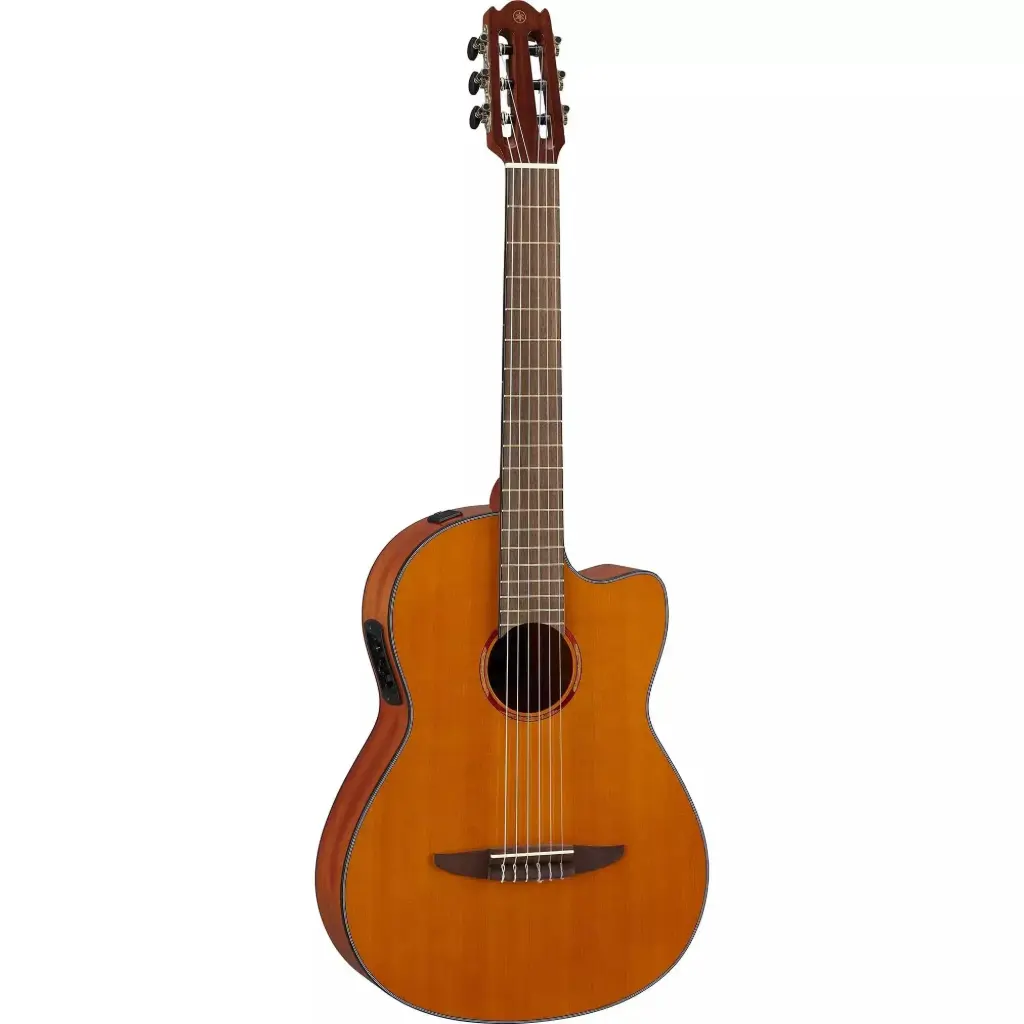
Yamaha NCX1C - Cedar Cutaway Electro-Classical Guitar
The excellence of nylon strings, accessible and powerful. The Yamaha NCX1C is the ideal instrument for the guitarist seeking the authentic warmth of a solid cedar top combined with the versatility of a modern electro-acoustic system. With its traditional classic neck profile and exclusive Yamaha pickup system, it offers a seamless transition between studio and stage, without compromising harmonic richness.
This content will be shared across all product pages.
Why the Yamaha NCX1C is a must-have for the serious musician
The Yamaha NCX1C solves the dilemma of the modern classical guitarist: how to achieve a rich, warm concert tone while also having reliable amplification for live performances. Unlike entry-level models that sacrifice resonance, the NCX1C uses a solid Western Red Cedar top , providing immediate response and dark overtones from the very first chord.
Its preamp system is designed to respect the dynamics of nylon strings, avoiding the "nasal" sound typical of low-end piezo pickups. Whether you play classical, bossa nova, or pop-jazz, the NCX1C positions itself as a robust and inspiring workhorse, capable of withstanding the rigors of Quebec stages.
Full Technical Specifications
Construction and Materials
| Characteristic | Full Details |
| Body shape | NCX shape |
| Table material | Solid Western Red Cedar |
| Back material | Nato or Okoumé |
| Rib material | Nato or Okoumé |
| Handle material | Nato |
| Key material | Walnut |
| Easel material | Ebony + Walnut |
| Nut material | Urea |
| Bridge nut material | Urea |
| Easel pegs | None |
| Body finish | Glossy |
| Handle finish | Matte (Satin) |
Dimensions and Ergonomics
| Characteristic | Technical Value |
| Diapason (Scale Length) | 650 mm (25 9/16”) |
| Total length | 990 mm (39”) |
| Body length | 490 mm (19 5/16") |
| Body width | 370 mm (14 9/16") |
| Body depth | 94 - 100 mm (3 11/16" - 3 15/16") |
| Nut width | 52 mm (2 1/16") |
| String spacing | 11.8 mm |
| Radius of the key | Flat |
Electronics and Accessories
| Characteristic | Specification |
| Electronic | Yamaha Undersaddle Pickup |
| Preamp | Yamaha APX System 73 (3-band EQ, Adjustable Mid Frequency) |
| Controls | Master Volume, 3-band EQ, Tuner, Mid Freq |
| Built-in tuner | Yes |
| Connections | Line Out |
| Mechanics | Chrome with black axles (RM1188NB-7B) |
| Ropes | Nylon Normal Tension (Yamaha S10) |
| Accessories | Hex key, 2 AA batteries |
Comparative Analysis (Rigorous Protocol)
Sources consulted: MusicRadar, Acoustic Guitar Magazine, Gearspace, Total Guitar.
| Alternative Product | Market Segment | Comparative Analysis | Music Garage Availability |
| Cordoba C5-CE | Classical Electro | Similar cedar top, slightly thinner neck, but Fishman preamp less precise in the mids than the Yamaha system. | View product |
| Ibanez GA35TCE | Thinline Nylon | Very thin body, ideal for anti-feedback, but loses the acoustic richness of the NCX1C's solid top. | View product |
| Yamaha NTX1 | Fusion/Hybrid | Same electronics, but a narrower (48mm) and radiused neck. Less suited to pure classical playing. | View product |
| Yamaha NCX3 | Professional | Superior version with solid wood (back/sides) and Atmosfeel™ system. Significantly more expensive. | View product |
| Alhambra Z-Nature CT EZ | Entry-level | Made in Spain, very resonant satin finish, but more basic electronics. | Product not listed |
| Takamine GC3CE | Guitar Stage | Robust construction, but its acoustics are more compressed than the NCX1C. | View product |
| Fender CN-140SCE | Budget Hybrid | Acoustic steel neck, less "authoritative" for a classical musician. | View product |
| Godin Multiac Encore | Hybrid Stage | A benchmark for live performance, but does not offer the experience of a real acoustic soundboard. | View product |
| The Homeland IQ Study | Educational/Professional | Excellent Quebec-made instrument making, very warm sound, but more traditional/austere aesthetic. | View product |
| Taylor Academy 12th-N | Premium Learning | Exceptional comfort (Taylor neck), but spruce top (less warmth than the cedar of the NCX1C). | View product |
History & Evolution
The Yamaha NX (Nylon eXperience) line was created to break down barriers between genres. Historically, classical guitars were difficult to amplify without an external microphone. Yamaha revolutionized this segment with the CGX series in the 1990s, before launching the NCX range. The NCX1C represents the evolution of the "Series 1," incorporating optimized bracing techniques from high-end concert models, making the cedar top more responsive than previous generations while maintaining a competitive price.
Cultural References & Artists
Here are some artists and contexts where the Yamaha Nylon (NX/CGX) series has made its mark on history:
Rodrigo y Gabriela - Live in Japan (2008) : Utilisation intensive de modèles Yamaha Nylon pour leur style percutant.
Lee Ritenour - Wes Bound (1993) : Fidèle de la marque pour ses textures jazz-nylon.
Alex Hutchings - Démonstrations techniques sur les capacités de la série NX.
Joe Bonamassa - Utilise des Yamaha Nylon en studio pour ses ballades acoustiques.
Antonio Forcione - Virtuose ayant souvent utilisé Yamaha pour la fiabilité en tournée.
Paul Simon - Utilisateur occasionnel de cordes nylon Yamaha pour des textures studio spécifiques.
Jason Mraz - A intégré des sons de nylon Yamaha dans ses performances live acoustiques.
Mick Fleetwood - Dans divers projets parallèles utilisant des guitares Yamaha Nylon.
Zacky Vengeance (Avenged Sevenfold) - Utilise la série NX pour les sections acoustiques épiques.
Steve Lukather - Pour des sessions de studio nécessitant la douceur du nylon.
Guthrie Govan - A exploré les capacités des modèles Yamaha Nylon en clinique.
Yamandu Costa - Bien qu'il utilise des 7 cordes, il a collaboré sur l'image de la lutherie Yamaha.
Marcin Patrzalek - Utilise des techniques percutantes similaires à celles permises par le barrage NX.
Charlie Byrd - Pionnier du jazz nylon, a influencé le développement des modèles électro Yamaha.
John McLaughlin - Utilisation de guitares nylon Yamaha dans ses périodes fusion.
Enhanced FAQ
1. What is the difference between Cedar (NCX1C) and Spruce (NCX1)? Cedar (NCX1C) offers a warmer, rounder tone with rich overtones right from the start. Spruce is brighter and takes longer to improve with age.
2. Is the neck the same as on a traditional classical guitar? Yes, with a nut width of 52mm and a flat profile, classical guitar purists will immediately feel at home.
3. Can I use metal strings on this guitar? Absolutely not. The tension of steel strings would destroy the bracing and bridge. Use only nylon strings.
4. Does the preamp require a 9V battery? No, the Yamaha system operates with two AA batteries, which ensures better signal stability and easier replacement.
5. Is a case included? No, the NCX1 series is delivered without a case to keep the price affordable, but we have several compatible options at Garage à Musique.
6. Is the guitar easy to tune? Yes, it has a built-in accurate chromatic tuner with a backlit LED display, perfect for the stage.
7. What is the advantage of Nato back and sides? Nato offers acoustic properties similar to mahogany, providing sustain and good definition of mid-frequencies.
8. Does the glossy finish affect the sound? It better protects the wood and offers a professional look, while being calibrated by Yamaha so as not to stifle the vibration of the solid top.
9. Can I plug it directly into a mixing console? Yes, thanks to its built-in preamp, you can output directly to an acoustic amp, an audio interface or a console.
10. Where is the NCX1C manufactured? It is manufactured in Yamaha's state-of-the-art factories in China, under extremely rigorous Japanese supervision and quality controls.
Why the Yamaha NCX1C is a must-have for the serious musician
The Yamaha NCX1C solves the dilemma of the modern classical guitarist: how to achieve a rich, warm concert tone while also having reliable amplification for live performances. Unlike entry-level models that sacrifice resonance, the NCX1C uses a solid Western Red Cedar top , providing immediate response and dark overtones from the very first chord.
Its preamp system is designed to respect the dynamics of nylon strings, avoiding the "nasal" sound typical of low-end piezo pickups. Whether you play classical, bossa nova, or pop-jazz, the NCX1C positions itself as a robust and inspiring workhorse, capable of withstanding the rigors of Quebec stages.
Full Technical Specifications
Construction and Materials
| Characteristic | Full Details |
| Body shape | NCX shape |
| Table material | Solid Western Red Cedar |
| Back material | Nato or Okoumé |
| Rib material | Nato or Okoumé |
| Handle material | Nato |
| Key material | Walnut |
| Easel material | Ebony + Walnut |
| Nut material | Urea |
| Bridge nut material | Urea |
| Easel pegs | None |
| Body finish | Glossy |
| Handle finish | Matte (Satin) |
Dimensions and Ergonomics
| Characteristic | Technical Value |
| Diapason (Scale Length) | 650 mm (25 9/16”) |
| Total length | 990 mm (39”) |
| Body length | 490 mm (19 5/16") |
| Body width | 370 mm (14 9/16") |
| Body depth | 94 - 100 mm (3 11/16" - 3 15/16") |
| Nut width | 52 mm (2 1/16") |
| String spacing | 11.8 mm |
| Radius of the key | Flat |
Electronics and Accessories
| Characteristic | Specification |
| Electronic | Yamaha Undersaddle Pickup |
| Preamp | Yamaha APX System 73 (3-band EQ, Adjustable Mid Frequency) |
| Controls | Master Volume, 3-band EQ, Tuner, Mid Freq |
| Built-in tuner | Yes |
| Connections | Line Out |
| Mechanics | Chrome with black axles (RM1188NB-7B) |
| Ropes | Nylon Normal Tension (Yamaha S10) |
| Accessories | Hex key, 2 AA batteries |
Comparative Analysis (Rigorous Protocol)
Sources consulted: MusicRadar, Acoustic Guitar Magazine, Gearspace, Total Guitar.
| Alternative Product | Market Segment | Comparative Analysis | Music Garage Availability |
| Cordoba C5-CE | Classical Electro | Similar cedar top, slightly thinner neck, but Fishman preamp less precise in the mids than the Yamaha system. | View product |
| Ibanez GA35TCE | Thinline Nylon | Very thin body, ideal for anti-feedback, but loses the acoustic richness of the NCX1C's solid top. | View product |
| Yamaha NTX1 | Fusion/Hybrid | Same electronics, but a narrower (48mm) and radiused neck. Less suited to pure classical playing. | View product |
| Yamaha NCX3 | Professional | Superior version with solid wood (back/sides) and Atmosfeel™ system. Significantly more expensive. | View product |
| Alhambra Z-Nature CT EZ | Entry-level | Made in Spain, very resonant satin finish, but more basic electronics. | Product not listed |
| Takamine GC3CE | Guitar Stage | Robust construction, but its acoustics are more compressed than the NCX1C. | View product |
| Fender CN-140SCE | Budget Hybrid | Acoustic steel neck, less "authoritative" for a classical musician. | View product |
| Godin Multiac Encore | Hybrid Stage | A benchmark for live performance, but does not offer the experience of a real acoustic soundboard. | View product |
| The Homeland IQ Study | Educational/Professional | Excellent Quebec-made instrument making, very warm sound, but more traditional/austere aesthetic. | View product |
| Taylor Academy 12th-N | Premium Learning | Exceptional comfort (Taylor neck), but spruce top (less warmth than the cedar of the NCX1C). | View product |
History & Evolution
The Yamaha NX (Nylon eXperience) line was created to break down barriers between genres. Historically, classical guitars were difficult to amplify without an external microphone. Yamaha revolutionized this segment with the CGX series in the 1990s, before launching the NCX range. The NCX1C represents the evolution of the "Series 1," incorporating optimized bracing techniques from high-end concert models, making the cedar top more responsive than previous generations while maintaining a competitive price.
Cultural References & Artists
Here are some artists and contexts where the Yamaha Nylon (NX/CGX) series has made its mark on history:
Rodrigo y Gabriela - Live in Japan (2008) : Utilisation intensive de modèles Yamaha Nylon pour leur style percutant.
Lee Ritenour - Wes Bound (1993) : Fidèle de la marque pour ses textures jazz-nylon.
Alex Hutchings - Démonstrations techniques sur les capacités de la série NX.
Joe Bonamassa - Utilise des Yamaha Nylon en studio pour ses ballades acoustiques.
Antonio Forcione - Virtuose ayant souvent utilisé Yamaha pour la fiabilité en tournée.
Paul Simon - Utilisateur occasionnel de cordes nylon Yamaha pour des textures studio spécifiques.
Jason Mraz - A intégré des sons de nylon Yamaha dans ses performances live acoustiques.
Mick Fleetwood - Dans divers projets parallèles utilisant des guitares Yamaha Nylon.
Zacky Vengeance (Avenged Sevenfold) - Utilise la série NX pour les sections acoustiques épiques.
Steve Lukather - Pour des sessions de studio nécessitant la douceur du nylon.
Guthrie Govan - A exploré les capacités des modèles Yamaha Nylon en clinique.
Yamandu Costa - Bien qu'il utilise des 7 cordes, il a collaboré sur l'image de la lutherie Yamaha.
Marcin Patrzalek - Utilise des techniques percutantes similaires à celles permises par le barrage NX.
Charlie Byrd - Pionnier du jazz nylon, a influencé le développement des modèles électro Yamaha.
John McLaughlin - Utilisation de guitares nylon Yamaha dans ses périodes fusion.
Enhanced FAQ
1. What is the difference between Cedar (NCX1C) and Spruce (NCX1)? Cedar (NCX1C) offers a warmer, rounder tone with rich overtones right from the start. Spruce is brighter and takes longer to improve with age.
2. Is the neck the same as on a traditional classical guitar? Yes, with a nut width of 52mm and a flat profile, classical guitar purists will immediately feel at home.
3. Can I use metal strings on this guitar? Absolutely not. The tension of steel strings would destroy the bracing and bridge. Use only nylon strings.
4. Does the preamp require a 9V battery? No, the Yamaha system operates with two AA batteries, which ensures better signal stability and easier replacement.
5. Is a case included? No, the NCX1 series is delivered without a case to keep the price affordable, but we have several compatible options at Garage à Musique.
6. Is the guitar easy to tune? Yes, it has a built-in accurate chromatic tuner with a backlit LED display, perfect for the stage.
7. What is the advantage of Nato back and sides? Nato offers acoustic properties similar to mahogany, providing sustain and good definition of mid-frequencies.
8. Does the glossy finish affect the sound? It better protects the wood and offers a professional look, while being calibrated by Yamaha so as not to stifle the vibration of the solid top.
9. Can I plug it directly into a mixing console? Yes, thanks to its built-in preamp, you can output directly to an acoustic amp, an audio interface or a console.
10. Where is the NCX1C manufactured? It is manufactured in Yamaha's state-of-the-art factories in China, under extremely rigorous Japanese supervision and quality controls.
Avis clients
Aucun avis pour le moment. Soyez le premier à partager votre expérience après votre achat.