
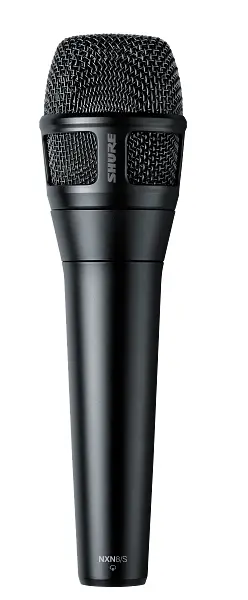
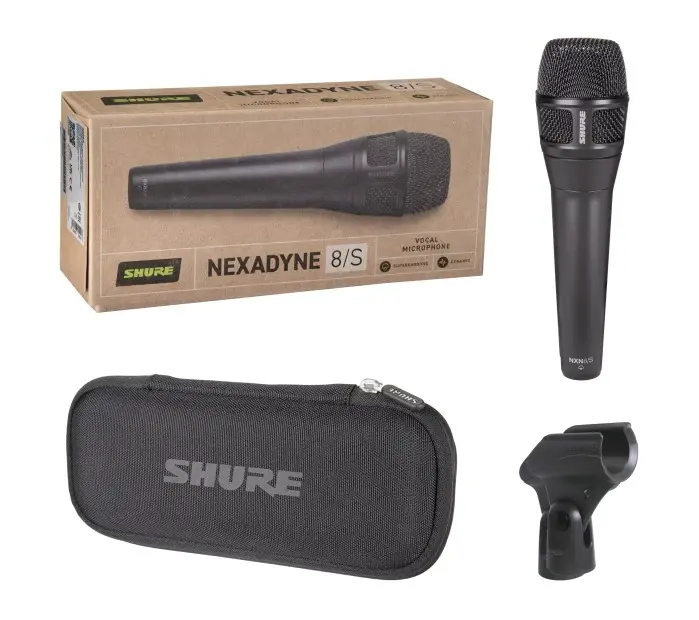
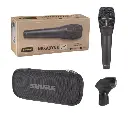
Shure Nexadyne 8/S Supercardioid Dynamic Vocal Microphone
The Shure Nexadyne 8/S (NXN8/S) is a supercardioid dynamic vocal microphone for the stage. Its tight pattern gives maximum rejection of cymbals, monitor wash and crowd noise: it is made for singers who share a crowded stage with a full band.
What sets it apart
- Supercardioid pattern, for maximum off-axis rejection
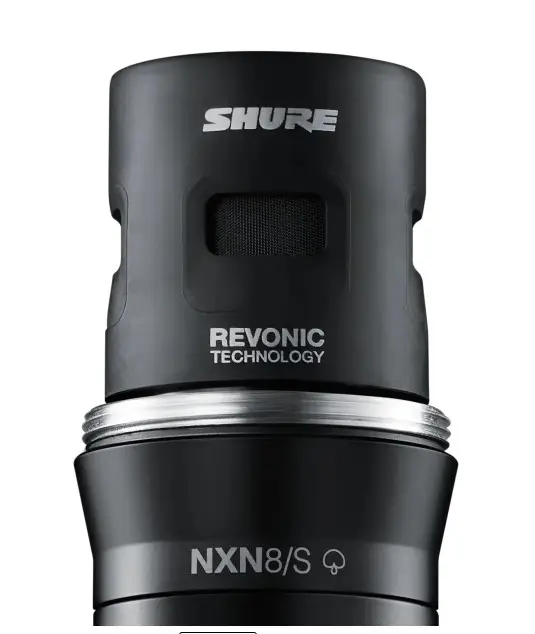
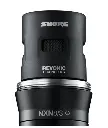
- Patented Revonic dual transducer that shapes the signal inside the capsule
- Sensitivity of -51 dBV/Pa, higher than the 8/C (-54 dBV/Pa)
- Hardened grille that resists dents, in a discreet black finish
- Clip and zippered case included
8/S or 8/C: picking the pattern
The Nexadyne 8 comes in two versions on the same platform. The 8/C, cardioid, offers an open sound and a wide pickup area, for singers who alternate quiet passages and full voice. The 8/S, supercardioid, tightens pickup to isolate the voice on a busy stage. Shure's guides give the 8/S a sensitivity of -51 dBV/Pa versus -54 for the 8/C, an impedance of 450 ohms versus 300, and a weight of 294 g versus 258.
What the front-of-house engineer gains
In every Nexadyne capsule, a second transducer wired opposite the first removes mechanical vibration before the signal even reaches the XLR output. Shure claims three effects, with no published measurement: a cleaner, more detailed input, less corrective EQ at the board and shorter soundchecks. The brand also states that its hotter output leaves more gain before feedback; the verifiable figure is the guide's sensitivity, -51 dBV/Pa versus -54 for the 8/C.
Placement and connection
Shure recommends placing unwanted sources, monitors and loudspeakers, behind the mic, and checking the placement before each show to limit feedback. The preamp should offer an input impedance of at least 1000 ohms, like most modern preamps. The mic comes with an A25E clip, an ANXNC zippered case and a brass thread adapter.
Specifications
| Type | Dynamic (moving coil), Revonic dual-transducer technology |
|---|---|
| Polar pattern | Supercardioid |
| Frequency response | 50 Hz to 20 kHz |
| Sensitivity | -51 dBV/Pa at 1 kHz |
| Output impedance | 450 ohms |
| Recommended load impedance | 1000 ohms minimum |
| Connector | 3-pin male XLR |
| Housing | Die-cast aluminum, black paint |
| Weight | 294 g |
| Included accessories | A25E clip, ANXNC zippered case, brass adapter |
What it's for
- Lead vocals on a loud stage, full band behind
- Singer standing close to the drums and cymbals
- Shows with several floor monitors
- Touring, from a small bar to a large venue
Compared with other manufacturers
Other tight-pattern dynamic vocal microphones, from other manufacturers. Data as published by each manufacturer.
| Model | Polar pattern | Frequency response | Notable feature |
|---|---|---|---|
| Shure Nexadyne 8/S | Supercardioid | 50 Hz to 20 kHz | Revonic dual transducer |
| Sennheiser e 945 | Supercardioid | 40 Hz to 18 kHz | 350-ohm impedance, about 365 g |
| Electro-Voice ND96 | Supercardioid | 30 Hz to 15 kHz close-talk | Selectable vocal tuning, four-point shock mount |
| Audix OM7 | Hypercardioid | Not shown on the manufacturer's page | Deliberately low output, 8 to 10 dB below a typical dynamic |
Frequently asked questions
- What is the difference between the Nexadyne 8/S and the Nexadyne 8/C?
- The polar pattern. The 8/C is cardioid, more open and more forgiving of movement; the 8/S is supercardioid, tighter, to reject cymbals, monitors and the crowd. The rest of the platform is shared.
- Is there a wireless version of the Nexadyne 8/S?
- Yes, as a capsule for Shure wireless handheld transmitters: the RPW204 in black and the RPW206 in nickel. The model on this page is the wired version, with an XLR output.
- What is the frequency response of the Nexadyne 8/S?
- 50 Hz to 20 kHz, the same as the 8/C, according to Shure's user guide.
Avis clients
Which stage did this Nexadyne 8/S prove itself on? Comments are open.
Aucun avis pour le moment. Soyez le premier à partager votre expérience après votre achat.